What Is Corporate Housing? A Complete Guide

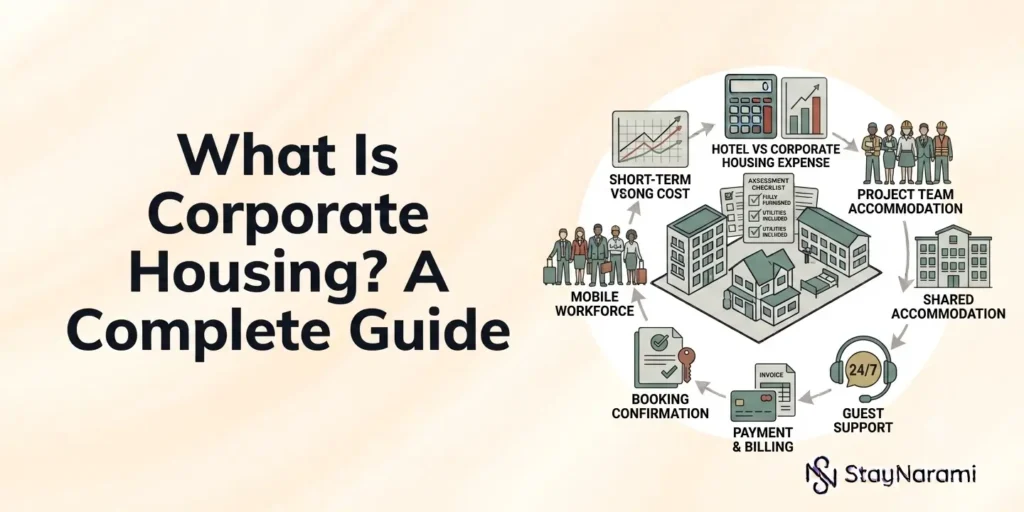
Give Your Team More Than a Hotel Room
StayNarami helps companies find furnished homes for employees, crews, and project teams staying 30 days or longer.
Your company just won a project three states over. The crew has to be on-site in two weeks, and they’ll be there straight through the summer. Now comes the part nobody enjoys: figuring out where fifteen people are going to sleep for four months. Hotels are the reflex answer, and they fall apart the second you run the math. A block of rooms for that long is brutal on a budget, and nobody does their sharpest work after ten weeks of living out of a duffel bag. Cheap short-term rentals aren’t much better. You’re rolling the dice on quality, and stitching together a dozen separate listings turns into a part-time job of its own.
That’s what corporate housing is all about. The demand continues to increase. At the end of 2024, the total costs of global business travel were approximately $1.48 trillion and are projected to reach approximately $2 trillion by 2028. It’s all the same; longer assignments and larger project teams are all a reflection of people needing a place to live truly, not just crash for a night.
So if you’ve been asking what corporate housing is and whether it fits your people, this guide keeps it plain. We’ll walk through the corporate housing definition, how it compares to a normal rental, the kinds you can pick from, who leans on it, what shows up inside, and what you can expect to pay. By the end, you’ll know enough to make a smart call for your next project, move, or emergency placement.
TL;DR (Too Long; Didn’t Read)
- Corporate housing refers to fully furnished temporary housing with a booking period of 30 or more days. Provides more space, privacy, and everyday living than a hotel and is more affordable than a regular apartment.
- It’s typically employed in employee relocation, construction workers, project teams, government contractors, healthcare staff, and evacuees.
- One price for most corporate housing will cover furniture, utilities, Wi-Fi, kitchenware, and laundry, as well as flexible leasing terms. The final choice will depend on the place in question, how long the individual(s) will be there, how many people will be staying together, the desired amenities, and cost.
- This guide describes the details of corporate housing, what it consists of, who utilizes it, and how it can cost you, along with when it becomes a better means of investing in a hotel or simple rental.
What Is Corporate Housing?
The simplest corporate housing definition is a fully furnished home rented for a temporary period, usually 30 days or longer.
The Corporate Housing Providers Association (CHPA) describes it as
“Fully furnished, temporary residential-style accommodations.”
The properties can be apartments, condominiums, townhomes, or single-family homes. Typically, they have the furniture, kitchen equipment, utilities, internet, and essentials that a guest needs to move in without having to set up at a new house. Even though that’s right in the name, corporate housing is not only for executives or big companies. It can be arranged by an employer, government agency, insurance company, project manager, relocation company, or even an individual.
Corporate housing is also known by several other names, including:
- Furnished corporate apartments
- Executive housing
- Serviced apartments
- Temporary furnished housing
- Corporate rentals
- Extended-stay housing
The exact name matters less than the setup. A true corporate housing property should be ready for everyday living, not just sleeping.
How Corporate Housing Differs from a Regular Rental
From the outside, a corporate apartment could appear to be a standard apartment. The distinction is in the details of the lease and what is included.
The typical apartment rental is for one year. The tenant may have to set up the furniture, electrical, water, internet, kitchen equipment, linens, etc. There may be security deposits, application fees, and early termination penalties as well.
Temporary corporate housing eliminates a lot of that setup. The home is already set up, utilities may be on, and the lease is tailored for a shorter time period.
1. Furnishings and Amenities Included
A regular rental hands you an empty box. You haul in the bed, the couch, and the plates yourself, and then you spend an afternoon on hold with the power company and the internet provider. That’s a fair trade when you’re planting roots. For a three-month gig, it’s a headache with no real payoff.
That turns it on its head with furnished corporate apartments. The bed is turned, the kitchen is outfitted down to the coffee mugs, and the Wi-Fi is functioning before you’ve unpacked. That’s not an incidental, either. About 82% of business travelers indicate that fast Wi-Fi connectivity is the most critical feature of a temporary workspace, and a good corporate unit is designed to provide this service from the get-go.
2. Lease Length and Flexibility
Then there’s the lease itself. A standard rental usually chains you to 12 months, with a penalty waiting if you leave early. Corporate housing bends to your schedule instead. Most stays land somewhere between 30 days and a few months, and plenty of providers will stretch shorter or longer without much fuss.
That flexibility is really the whole appeal. Your timeline sets the terms, not the landlord’s. This side-by-side sums up where the three options split apart:
Types of Corporate Housing
The nice part is you’re not stuck with one shape of corporate housing. It spans a handful of property types, so you can fit the space to the people in it and the reason they’re there.
1. Furnished Apartments
This is the backbone of the industry. The furnished apartments vary from studios to spacious multi-bedroom options and are typically located within a residential complex that offers a gym, parking, and laundry facilities. They’re ideal for a single traveling worker, a consultant on an extended stay, or an individual moving to a new town who wants a neighborhood setting rather than a hotel hallway.
2. Extended-Stay Units
These are in between a hotel and an apartment. This means you’ll be away from a full kitchen, and light housekeeping services are included in the price for a little less square footage. They’re great for shorter business trips or for anyone who doesn’t want to consider chores at all.
3. Single-Family Homes and Condos
A house is more likely to prevail when you’re living with a full crew or a whole family. Four bedrooms provide room for a full project team, and the cost is much less per person than four hotel rooms. Then a family that is burned out or flooded out is typically just looking for a real house to return to, a place that is like life rather than living in limbo waiting for the pieces to fall into place.
Feature |
Corporate Housing |
Regular Apartment |
Extended-Stay Hotel |
| Furniture | Usually included | Usually not included | Included |
| Kitchen | Normally a full kitchen | Full kitchen, but not equipped | Often a kitchenette |
| Utilities | Often included in the rate | Paid and arranged separately | Included |
| Housewares | Usually included | Not included | Limited |
| Lease period | Commonly 30 days or longer | Often 12 months | Nightly, weekly, or monthly |
| Living space | Separate living and sleeping areas are common | Full residential space | Often one room or studio |
| Housekeeping | Optional or scheduled | Not included | Often included |
| Best fit | Temporary stays lasting weeks or months | Longer residential use | Shorter stays and travelers wanting hotel service |
Explore a Smarter Way to Handle Longer Stays
StayNarami provides corporate housing with furniture, kitchens, utilities, Wi-Fi, and flexible terms for temporary business assignments.
Who Uses Corporate Housing
The crowd is wider than most people guess. Temporary corporate housing got its start shuttling executives around, but the guest list has grown well past that. Relocation still accounts for about 35% of demand across North America, and yet it’s nowhere close to the only reason people book.
Construction crews use it for out-of-state builds that drag on for months. Government workers and contractors need vetted, compliant places while they’re posted somewhere on a temporary basis. Corporate teams and consultants get parked near a client site or a new branch for a long stretch. Travel nurses take it for short hospital contracts far from home. Families displaced by disasters land in it through insurance claims when their own place is unlivable. And plenty of ordinary folks use it while they’re caught between homes, whether they’re mid-move, mid-renovation, or working through a long medical treatment in another city.
The through-line is the same for every one of them. They need something comfortable and dependable for longer than a few nights but shorter than a full year. Hotels are too tight and too pricey for that window. A standard lease is too stiff. Corporate housing fills the gap neither one can cover.
What’s Typically Included in Corporate Housing
“Furnished” honestly undersells it. A well-run unit is meant to be lived in from night one, which means it shows up with a lot more than a couch and a mattress.
1. Utilities, Furniture, and Housewares
The whole idea is that you buy and set up nothing. In most units you can count on:
- Furniture in every room, including beds, seating, and a real dining setup
- A working kitchen with a stove, fridge, and microwave, plus the pots, pans, dishes, and utensils to use them
- Linens, towels, and the small housewares you never think about until they’re missing
- Electricity, water, and gas folded into the rent
- Fast internet, often with cable or streaming layered on top
Because it’s all rolled into one monthly number, budgeting gets a lot easier. There are no deposits scattered across five companies and no stack of utility bills landing on the expense report each month.
2. Additional Services (Cleaning, Concierge)
A lot of providers go well past the four walls. Depending on the property and what you’re paying, that can include regular housekeeping, laundry, a 24/7 contact for when something breaks, help sorting out local logistics, and even concierge support. This is the “service” half of the equation. Someone is actively running the experience so your team can put their heads down and get to work.
How Much Does Corporate Housing Cost?
So, let’s face the facts: the normal thing people ask is simply monetary. Depending on the city, place, and length of stay, the price may also vary, but having some reasonable averages may help.
On average, the cost of renting a furnished one-bedroom for 2026 is approx $3300 per month (or ~$110 per night) for furniture and utilities. A majority of providers are distributed across the markets and unit sizes and quote somewhere in the range of $3,000 – $5,000 monthly.
Then compare that to a hotel. In 2025, the average U.S. hotel room will cost nearly $4,900 for a 30-day month, not counting tax, and no one’s eaten a single meal. If there’s no kitchen to cook at, the expenses to eat out add another $50-$100 per day per person. Sum up all of those costs, and corporate housing will typically cost 30%-50% less than an equivalent upscale hotel for the same length of time. Let’s take a look at a one-month example:
Option |
Rough Monthly Cost |
Meals and Extras |
What You Get |
| Furnished corporate apartment | $3,000 – $5,000 | Lower, thanks to a full kitchen | Whole home, utilities, Wi-Fi, space |
| Extended-stay hotel | ~$4,900+ | Higher, eating out most days | One room, limited kitchen |
There’s one more thing that quietly saves money. In a lot of places, once a stay crosses the 30-day mark, it’s exempt from the hotel and occupancy taxes that get bolted onto short nightly bookings. On a long assignment, that alone can add up to real savings.
How to Book Corporate Housing
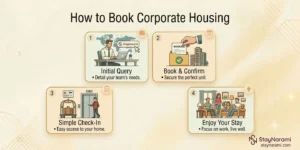
Booking is simpler than most people brace for, especially when the provider does the heavy lifting. It generally runs three steps.
You give them the information, such as location, date, number of people, number of bedrooms, and non-negotiables such as pet-friendly units or “within five miles of the site. The provider then searches and secures units that fit and typically presents you with a couple of options to compare. Lastly, on day one, your crew steps into a completely ready location and sets up.
A few habits smooth the whole ride. Book early when you can, because the good units in busy cities get claimed fast. Be upfront about your budget and your dates. And ask flat-out what’s included, so nothing catches you off guard at check-in. When a single provider wrangles multiple units for a group, you also get one point of contact and one invoice instead of a tangle of separate bookings. Anyone who has ever coordinated housing for a team knows how much that’s worth.
Need housing for a crew or project team?
Skip the hotel math and the hit-or-miss listings. StayNarami sources, furnishes, and sets up move-in-ready homes anywhere in the U.S. for stays of 30 days or longer.
Is Corporate Housing Right for Your Stay?
Corporate housing is usually worth considering when:
- The stay will last 30 days or longer.
- The guest needs a kitchen and laundry.
- A hotel would feel too small.
- Several employees need housing in one area.
- The traveler needs a residential setting.
- The end date may change.
- A family or pet is traveling.
- The company wants one housing bill instead of several setup costs.
For short trips, however, a hotel might still be the better choice if the guest requires restaurant access, front desk service, and daily housekeeping at the accommodation.
A regular apartment might be cheaper for longer periods of time (more than a year) if the person already has furniture and could set up utilities.
Corporate housing, simply put, is a compromise between those two. It is larger than most hotels and provides a greater daily living component than a traditional apartment, but not as much upkeep.
Frequently Asked Questions
1. What is the difference between corporate housing and an apartment?
Corporate housing comes fully furnished and offers flexible short-term leases, all utilities and services included. In a regular apartment, you are going to be locked into a long lease (usually 12 months) and must move into an empty apartment and set it all up yourself.
2. Is corporate housing the same as an extended-stay hotel?
Not quite. Corporate housing typically offers a more residential atmosphere than a hotel room as well as more space and a full kitchen. It’s also often cheaper per night, because the pricing is monthly as opposed to per night for longer stays.
3. How long can you stay in corporate housing?
Stays will generally last from 30 days to several months. The average is around 83 days, and most providers will be able to do shorter and longer periods, as well, in order to accommodate your time frame.
4. Does corporate housing include utilities and furniture?
Yes. Most corporate housing includes furniture, kitchenware, utilities, and Wi-Fi as standard, all bundled into one monthly rate so there are no separate bills to chase.
5. Who typically pays for corporate housing?
Usually the employer covers it, either by billing the provider directly or reimbursing the employee. That said, individuals can absolutely book on their own when they need temporary housing for a personal reason.
Need housing for your team?
Tell us what you need and we'll take care of the rest — anywhere in the U.S., 30+ days.
Request Housing →Related Articles