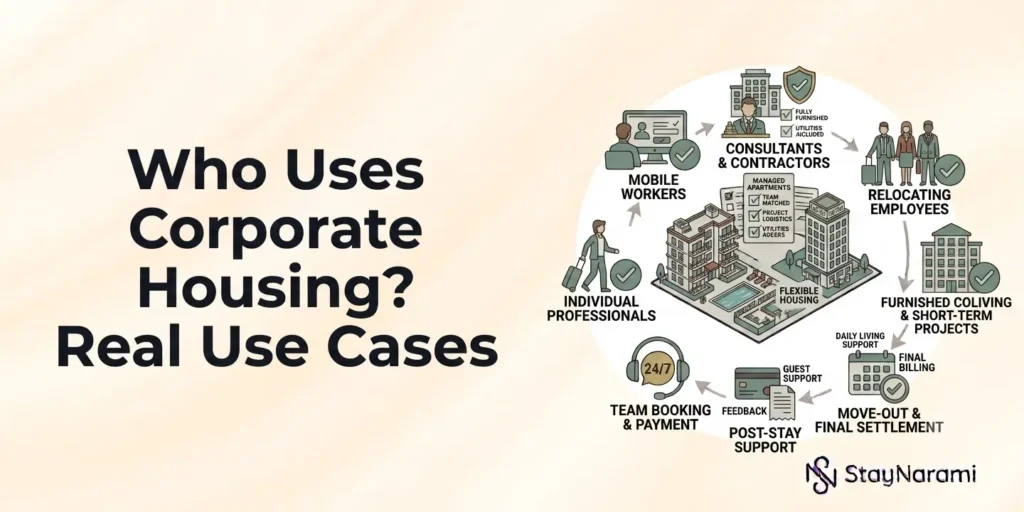
Who Uses Corporate Housing? Real Use Cases

Need Housing for More Than a Short Business Trip?
StayNarami finds furnished homes for relocating employees, project teams, crews, and families who need a comfortable place for 30 days or longer.
A worker arrives for a three-month job, a nurse signs on for a three-month hospital contract, and a family needs a place to stay while their fire-damaged home gets repaired. None of them want to live out of a hotel for months, and none of them need a year-long lease either. So who uses corporate housing? It’s exactly these kinds of people — anyone caught in that in-between stretch, needing more space, a real kitchen, laundry, parking, and a home-like feel that a cramped, expensive hotel room simply can’t offer over a long stay.
While relocation is still one of the top reasons to use corporate housing‚ other categories like project work‚ training‚ insurance placements‚ military travel‚ and internships are also rising in popularity․
The figures reveal the extent of the interest. According to data from the Corporate Housing Providers Association, here’s the breakdown of trips by purpose: relocation – about 33% of stays; project/training work – about 21% of stays; insurance/emergency claims – about 10% of stays; government/military – about 9% of stays; interns – close to 8% (CHPA industry statistics). From a company perspective, the 59th Annual Atlas Corporate Relocation Survey identified 38% providing more temporary housing benefits, with 59% having at least one employee decline (Atlas Van Lines, 2026).
TL;DR (Too Long; Didn’t Read)
- Corporate housing is used by relocating employees‚ project teams‚ nurses on travel assignments‚ construction crews‚ government contractors‚ production teams‚ interns‚ and individuals displaced from their homes․
- It is particularly useful for longer stays of 30 days or more‚ or for guests requiring additional space‚ a full kitchen‚ laundry‚ parking‚ strong Wi-Fi, or flexibility without signing a year-long lease․
- Housing depends on reasons for housing‚ number of people‚ desired location‚ price range‚ commuting distance‚ and estimated length of stay․
- With this guide‚ you will know who is able to stay in corporate housing (with real examples)‚ so you can assess whether your scenario fits in that category before you spend a single dollar․
Corporate Housing Use Cases at a Glance
Here are the main corporate housing use cases, sorted by how much demand each one creates.
Who books it |
Typical stay |
What they need most |
| Relocating employees | 30–90 nights | Space for family, school access, flexible end date |
| Consultants and project teams | 60–180 nights | Separate bedrooms, desk space, fast Wi-Fi |
| Traveling nurses | 13 weeks | Close to hospital, rate under the stipend |
| Construction and industrial crews | 3–12 months | Parking for trucks, laundry, early check-ins |
| Insurance policyholders | 2–12 months | Kitchen, pet-friendly, same school district |
| Production crews | 4 weeks–6 months | Volume bookings, odd hours, blackout curtains |
| Government and military | 30 nights–1 year | Rates at or under per diem, clean paperwork |
| People between homes | 1–6 months | Month-to-month terms, storage nearby |
“CHPA advocates for stays of 30 days or more.” — Corporate Housing Providers Association
That 30-night floor is the dividing line. Under a month, a hotel usually wins. Over it, furnished housing almost always wins on both cost and comfort.
Relocating Employees
A regional bank promotes a branch manager in Kansas City and needs to run a Denver location in three weeks. Her house has not sold. Her kids finish the school year in June. She cannot sign a Denver lease until she knows which neighborhood the family wants.
This is a common use case for corporate housing for relocation. The company leases a two-bedroom furnished home close to her new office for 90 days so she can get used to the area, start her first day of work, and wait until her family is ready to sign a longer lease.
1. Why the First 90 Days Are the Hardest
Relocation stalls for boring reasons. Closings slip. Inspections turn up problems. A rental application gets rejected because the new state has no credit history for the applicant yet.
Temporary housing absorbs all of that. And it protects the hire itself — remember that 28% of employees who declined a move in 2025 pointed to housing and mortgage concerns at the destination. A funded landing spot removes the biggest reason someone says no.
Traveling Consultants and Project Teams
A software company assigns four engineers to Columbus to roll out a system for 16 weeks. Then, four hotel rooms at $150 a night add up to approximately $67,000 in lodging costs, which no one can cook, so throw in restaurant food every single day.
Two two-bedroom apartments in the same building cost a fraction of that, and the team can eat breakfast at a table instead of a lobby buffet. This is where corporate housing for business travel stops being a comfort upgrade and starts being a budget decision.
1. Why Corporate Housing for Business Travel Beats a Hotel
The math flips somewhere between two and four weeks, depending on the market. Beyond that point, furnished rentals win on nightly rate, and they add things a hotel room simply does not have: a full kitchen, in-unit laundry, a real desk, and separate bedrooms so a 6 a.m. call does not wake a colleague.
A hotel is built for someone passing through. A furnished apartment is built for someone who has to actually live and work in a city for a while.
Traveling Nurses and Healthcare Workers
The typical length of the travel nursing job is around 13 weeks; however, it can be shorter or longer. Many Agencies don’t arrange for housing; rather, they will pay the nurse what they think is a reasonable housing stipend and allow him to find a place for himself in an unknown city.
They tend to search with specific criteria: close to the hospital, furnished, and within the housing allowance for the full length of the contract. In addition to blackout curtains and minimal light, the nurses who work at night will require quietness and a reduction of daytime noise. Nurse housing stipends may be tax-free if the nurse is in compliance with the IRS “qualifying tax home” rules.
Demand here is not shrinking. The Bureau of Labor Statistics projects roughly 193,000 registered nurse openings each year through the early 2030s, and hospitals keep filling gaps with contract staff. Therapists, techs, and traveling physicians book the same way.
Construction and Industrial Crews
During a turnaround, 40 welders and boilermakers descend on a small town for 9 weeks. There are 60 rooms at the hotel, and one-half of the rooms are occupied. Crews work 12-hour shifts, and when they come back dirty, they need laundry – not turndown service.
Furnished houses and apartment blocks are better than any county hotel! These companies reserve multiple cubes, assign three or four crew members to each cube, and manage parking and work go-karts. Early check-in and 24-hour access are important as shift changes don’t adhere to front desk hours.
Demand is stable, as construction has been one of the few U.S. sectors to continue growing new jobs through 2025. A thin lodging supply in turn creates a demand for employees—such as in data center construction, plant expansions, road construction, and utility construction.
Insurance and Disaster Relief Housing
A pipe bursts in February and floods the first floor of a family’s home. The repair estimate says four months. Their homeowners policy includes additional living expenses coverage, usually capped near 20% of the dwelling amount, and in California a declared emergency requires insurers to offer at least 24 months of those benefits.
What adjusters find out real quick is that families and that hotel burn through the coverage at three times the rate. An average three-bedroom apartment in the same school district, a yard for the dog, and a kitchen help keep the press off the claim and the finances intact.
This is a pattern of fires, storms, floods, and smoke damage. Time estimates will continue to move, so a monthly extension is more important than the lowest possible rate!
See How Corporate Housing Fits Different Stays
StayNarami provides flexible corporate housing for business travel, workforce projects, relocation, medical assignments, and temporary family stays.
Film and Entertainment Production Crews
A streaming series shoots for 11 weeks in a mid-size city. The production needs 30 beds for cast, camera, grip, and wardrobe, all arriving within the same 48 hours, with a few longer bookings for department heads who show up early for prep.
The production home has its own hang-ups. Call times begin as early as 4 a.m., and crews are sleeping at all hours of the day. There is a need for proper parking for gear. Since the weather has caused a shoot day to be canceled, bookings move! Anyone who could take dramas with volume bookings and last-minute cancellations of the plans or programs loses the business.
Government Contractors and Military Personnel
Federal travel runs on per diem caps, and for fiscal year 2026 the standard lodging ceiling across most of the continental U.S. stayed at $110 per night (GSA Per Diem Bulletin FTR 26-01). Hotels in busy metros blow past that number regularly. Furnished apartments often land at or below it, which is the whole reason contractors book them.
Service members on temporary duty or waiting for base housing after a permanent change of station use the same option. Families in that gap need bedrooms and a kitchen, not two adjoining hotel rooms. Documentation matters more in this segment than any other, since reimbursement depends on clean invoices that separate lodging from extras.
Individuals Between Homes
Not all stays are related to an employer. In May, a couple sells their house, followed by closing on the new one in August. A homeowner tears out six weeks’ worth of dust in the kitchen. From someone undergoing a divorce who needs a real place to live while the proceedings are worked out, to a grad student beginning a program in a city, but whose lease does not align with the semester schedule, the need for a short-term rental is universal.
These bookings are month-to-month, extended once often, and are personal bookings. All these renters want is this – a place where they can move in with a suitcase, no year-long contract agreement, and no furniture to purchase and resell.
Which Industries Use Corporate Housing Most
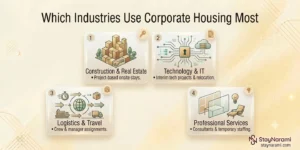
If you want the short list of industries that use corporate housing heavily, it looks like this:
Industry |
Why they book |
Common length |
| Healthcare | Contract nurses, locum physicians, travel techs | 13 weeks |
| Construction and energy | Shutdowns, plant builds, infrastructure work | 3–12 months |
| Consulting and technology | Client sites, rollouts, training cohorts | 2–6 months |
| Insurance | Displaced policyholders under loss-of-use claims | 2–12 months |
| Entertainment | Location shoots and touring crews | 1–6 months |
| Government and defense | Contract work, temporary duty, base transitions | 1–12 months |
| Manufacturing | New plant staffing, equipment installs, interns | 2–6 months |
Technology has been one of the largest single sources of demand in recent industry reporting, but healthcare and construction now push volume just as hard.
What Every One of These Users Has in Common
Strip away the job titles, and the answer to who uses corporate housing gets simple. Every person in this article needs somewhere to live for longer than a business trip and shorter than a lease, in a city where they have no furniture, no utility accounts, and no time to build either.
Too long for a hotel, too short for a lease. That gap is the entire market.
The stay length backs it up. Industry data puts the average furnished stay between 83 and 96 nights, which is roughly three months, about the length of a project, a nursing contract, a home repair, or a house hunt in an unfamiliar city.
Turn Your Dates and Headcount Into Real Housing Options
Share your destination, length of stay, guest count, bed requirements, and budget with StayNarami to find move-in-ready properties that fit your needs.
The Better Choice Depends on the Stay
There is no single winner in the corporate housing vs extended stay hotels comparison.
Hotels are often easier for short trips and uncertain schedules. Corporate housing usually becomes more useful when the guest stays for a month or longer and needs more space, a full kitchen, laundry, and a residential setting.
The best choice is the one that fits the full stay, not just the first few nights.
Contact StayNarami with the destination, dates, number of guests, bed needs, and budget to explore furnished temporary housing for employees, crews, relocating families, or project teams.
Frequently Asked Questions
1. Is corporate housing only for large companies?
No. Families in transition book it, individual professionals book it, and small businesses book it. 30 nights is the normal reservation, not an exception.
2. Can individuals book corporate housing, not just businesses?
Yes. The majority of suppliers are able to accept individual bookings in addition to corporate contracts. Some require proof of work, and this will require ID, reason for the stay, and payment information.
3. What industries rely most on corporate housing?
The biggest users are in healthcare, construction and energy, consulting and technology, insurance, entertainment, and government contracting. This encompasses almost all of those – corporate housing for relocation applies to most industries, as almost every industry transfers employees between cities.
4. Is corporate housing used for insurance claims and displacement?
Often. With limited loss of use coverage, insurers and adjusters often have fire, water, or post-storm policyholders stay in furnished rentals rather than hotels.
5. How long do most people stay?
On average, about three months, though most buildings require a minimum of 30 nights. Contract nurses will contract for 13 weeks, project teams for 2 to 6 months, and insurance contracts will be ongoing for as long as the repairs are required.
6. Can a company book several units at once?
Yes. Crew and team bookings are common, and, if available, people can be accommodated in the same building or a few local buildings.
Need housing for your team?
Tell us what you need and we'll take care of the rest — anywhere in the U.S., 30+ days.
Request Housing →Related Articles