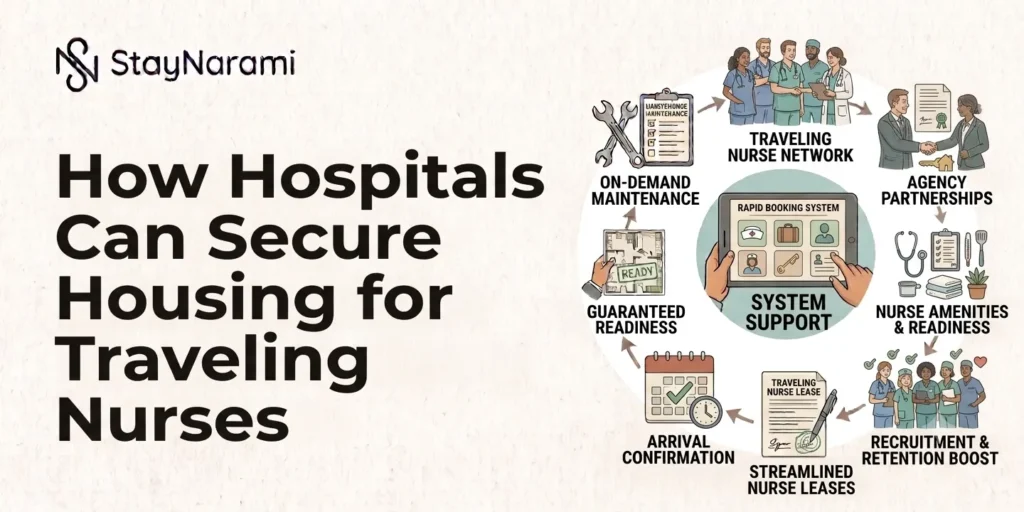
How Hospitals Can Secure Housing for Traveling Nurses

Get the Housing Ready Before the First Shift
StayNarami helps hospitals source furnished housing around the facility, assignment dates, nurse headcount, commute, parking, and budget so housing does not become the final obstacle before arrival.
Hospitals can recruit a qualified traveling nurse, agree on the assignment, and set a start date, only to run into a very practical problem before the first shift: where will the nurse live?
The issue becomes harder when several nurses arrive together, the hospital is in an expensive rental market, or a placement needs to begin within days.
The U.S. Bureau of Labor Statistics projects about 189,100 registered nurse openings each year from 2024 through 2034, showing how much hiring and replacement activity healthcare employers will continue to manage. (U.S. Bureau of Labor Statistics)
Traveling nurses are one way hospitals deal with short-term staffing shortages․ According to the American Hospital Association‚ traveling‚ temporary‚ and agency nurses are among the customary options hospitals have for acute or long-term staffing shortages․
But bringing someone in from another city or state creates another job for HR, staffing, or operations teams: arranging housing for traveling nurses that works with the assignment dates, shift schedule, budget, and commute.
TL;DR (Too Long; Didn’t Read)
- Created for hospitals‚ health systems‚ staffing companies, and HR or operations leaders who book lodging for traveling nurses․
- The ideal housing plan begins before the nurse ever starts, when the hospital verifies assignment dates‚ budget‚ commute time and parking‚ bedroom situation‚ length of lease‚ etc․‚ and identifies if the nurse will receive a housing stipend or if housing will be arranged․
- This centralization for nurses means they don’t have to deal with the inconsistencies of various bookings‚ leases‚ driving long distances‚ and having HR‚ staffing‚ finance‚ and the travelers coordinate․
- This resource will help hospitals develop strategies to provide nurse housing‚ partner with a nurse housing provider‚ plan for multiple placements‚ account for last-minute arrivals‚ and define a repeatable process․
What Is Housing for Traveling Nurses and Why Does It Matter?
Housing for traveling nurses is housing provided to the nurse when they agree to work a temporary job contract far from their permanent home․ A traveling nurse may receive a housing stipend and find their own place to stay or may receive housing through a staffing agency‚ hospital‚ or other housing partner․
Most present-day travel nurse housing programs offer furnished apartments‚ studios‚ extended-stay housing‚ and other rentals as housing․ AMN Healthcare states that agency-supplied furnished housing is an alternative to a lodging allowance, and that location, safety, price‚ and proximity to the hospital or facility being worked at are all considered.
For hospitals arranging accommodation, the home itself is only part of the decision. A useful housing plan also considers:
- distance and normal drive time to the hospital;
- whether the property is furnished and ready for move-in;
- utilities and internet;
- parking;
- laundry access;
- privacy and bedroom arrangements;
- assignment start and end dates;
- extension and early-departure terms;
- pets or accessibility needs when applicable.
Although the rental may appear to be a cost benefit‚ the nurse ending a 12-hour night shift may drive a long way to get home‚ in any direction․
Agreeing with this‚ the American Nurses Association recommends sleep for the prevention of burnout for nurses‚ and recognizes a period of downtime between shifts as important․
Florence Nightingale’s well-known principle remains fitting here:
“The very first requirement in a hospital is that it should do the sick no harm.” — Florence Nightingale
Housing isn’t part of clinical care‚ but if hospitals are hiring temporary workers‚ they should be thinking about the conditions of people delivering that care․
What Options Do Hospitals Have to Secure Housing for Traveling Nurses?

No one housing type is adequate for every assignment‚ and hospitals should choose housing based on the number of nurses assigned‚ length of stay‚ location‚ privacy, and inventory․
Housing option |
Best suited for |
Main consideration |
| Furnished apartment | One or two nurses on a multi-month assignment | Check utilities, furniture, parking, and lease flexibility |
| Furnished house | Several nurses or staff needing more space | Decide whether bedrooms will be shared |
| Extended-stay accommodation | Very short notice or bridge housing | Compare the full monthly cost before using it long term |
| Individual short-term rental | Nurses who prefer their own space | Managing several separate bookings can become difficult |
| Housing-provider placement | Hospitals managing repeated or multiple placements | Give the provider exact dates, headcount, location, and requirements |
Many travel nurses have been given stipends and have found housing themselves․ While this gives the nurse more freedom‚ it does not help the hospital solve the problem of staffing a shift under time pressure․
If the hospital wants greater certainty before arrival, centrally arranged housing for traveling nurses may be more practical.
1. Example: A Four-Nurse ICU Placement
Suppose four ICU nurses are scheduled to start an assignment in three weeks.
Instead of asking each nurse to search independently, the hospital could define a housing radius, budget, parking requirement, bedroom preference, and assignment dates before contacting a provider. The provider can then search against one clear set of requirements rather than dealing with four separate last-minute searches.
That simple change turns housing from an individual problem into a planned part of onboarding.
How Do Hospitals Partner With a Housing Provider for Traveling Nurses?
A housing provider works best when the hospital sends a complete request rather than simply asking, “Do you have anything near our facility?”
A useful request should include:
- Hospital or worksite address
- Number of traveling nurses
- Exact move-in date
- Expected move-out date
- Preferred maximum commute
- Bedroom and privacy requirements
- Number of vehicles and parking needs
- Required amenities
- Pets or accessibility needs
- Target housing budget
- Likelihood of an extension
The housing provider can then search for properties that fit the actual assignment rather than presenting listings that will later be rejected because they are too far away or do not meet the hospital’s needs.
For 30-day-or-longer placements, StayNarami’s current model is built around sourcing fully furnished housing across the United States and coordinating the stay after placement.
Make Travel Nurse Housing Easier to Coordinate
StayNarami provides furnished housing for traveling medical professionals, helping hospitals manage 30+ day assignments with practical locations, move-in-ready homes, and terms built around temporary healthcare placements.
What Steps Should Hospitals Follow to Arrange Nurse Housing Quickly?
This also allows housing to be completed more quickly‚ since it only requires that an assignment is confirmed rather than waiting days for the nurse․ A practical sequence looks like this:
1. Confirm the assignment dates
Do not search using estimated dates if confirmed dates are available. Even a small change in move-in timing can affect availability and cost.
2. Decide who is responsible for housing
Confirm whether accommodation will be arranged and paid for by the nurse‚ staffing agency‚ hospital‚ or the housing provider․
3. Set a realistic housing radius
Measure commute time rather than looking only at mileage. Ten miles in one market can be very different from ten miles in another.
4. Set the requirements before searching
Separate needs from preferences. A private bedroom, parking, or accessibility feature may be essential. A pool may simply be nice to have.
5. Compare total cost
Look beyond monthly rent. Include utilities, furniture, internet, parking, deposits, cleaning charges, and other required fees.
6. Review the lease against the assignment
Pay particular attention to extension terms, cancellation rules, deposits, and what happens if the clinical assignment ends early.
7. Send move-in information before arrival
Before traveling‚ the nurse should have the address‚ directions to the property‚ parking information‚ contact information‚ and property policy․ A current high-ranking travel-nurse housing guideline recommends looking for housing accommodations upon signing a contract and‚ if feasible‚ 4 to 6 weeks prior to the start of the assignment date․
How Do Hospitals Budget for Housing Across Multiple Traveling Nurses?
Hospitals should budget housing for traveling nurses using the full cost of the stay rather than the advertised rent alone.
A simple planning formula is:
Total housing cost = monthly housing cost × length of stay + one-time charges + expected extension buffer
For several nurses, also calculate the cost per nurse.
For example, if two suitable furnished units cost less than four separate rentals while still giving each nurse the agreed level of privacy, the shared arrangement may reduce the overall housing bill. That does not mean hospitals should automatically put more people into each property. Occupancy, privacy, bedrooms, bathrooms, parking, local rules, and the nurses’ housing agreements still matter.
Track these items for each placement:
Budget item |
What to confirm |
| Base rent | Monthly or full-stay price |
| Utilities | Included or billed separately |
| Furniture | What is actually provided |
| Internet | Included, optional, or self-arranged |
| Parking | Number of spaces and any fees |
| Deposit | Amount and refund terms |
| Cleaning | One-time or recurring charge |
| Extension | Rate if the assignment continues |
| Early departure | Financial responsibility if the assignment ends early |
Group pricing is available in instances where multiple units or beds are being booked‚ but an automatic group discount is not guaranteed․ Final sale price may also depend on availability‚ current market demand‚ dates‚ location‚ and property type․
What Should Hospitals Include in a Housing Policy for Traveling Nurses?
If traveling staff are used regularly, a written policy can prevent the same housing questions from being decided from scratch each time.
The policy should state:
- who can receive hospital-arranged housing;
- whether private or shared accommodation is permitted;
- maximum housing budgets or approval rules;
- acceptable commute limits;
- parking standards;
- pet and accessibility procedures;
- who signs the housing agreement;
- how deposits and damages are handled;
- extension procedures;
- early-cancellation procedures;
- who employees contact when housing problems occur.
Additionally, whenever there are exceptions, such as a nurse who works the night shift‚ the change in needs must be articulated, as opposed to an employee who works normal office hours.
How Do Hospitals Handle Housing for Last-Minute Nurse Placements?
Last-minute housing requires fewer optional preferences and faster decisions.
Start with four facts: where‚ when‚ how many people‚ for how long․ Then you have the non-negotiable requirements․ That’s often half your conversation․
Do not spend the first day of the search comparing minor amenities while the available inventory disappears. Prioritize safe, practical accommodation that meets the assignment requirements and allows the nurse to reach the facility reliably.
1. Example: A Nurse Starting Monday
Imagine a hospital confirms a nurse on Thursday for a Monday start.
Your goal is probably not to find a furnished apartment that will be your perfect home‚ but rather any furnished apartment that will work for your arrival date․ Temporary bridge accommodation can often be arranged to cover the first part of your assignment while a 30+ day furnished apartment is located․
The important point is to decide before booking whether moving the nurse twice is worth the disruption and extra cost.
How Do Hospitals Scale Housing When Onboarding Multiple Nurses at Once?
Housing becomes harder when ten nurses are arriving instead of one because every overlooked detail gets multiplied.
Create one housing roster containing each nurse’s:
- arrival and departure dates;
- shift or facility location;
- assigned property;
- bedroom;
- vehicle;
- special requirements;
- move-in status;
- extension status.
Then appoint one hospital contact to work with the housing provider. This prevents HR‚ staffing managers‚ nurses, and finance teams from all sending different instructions for a placement․
To the extent practical‚ place the nurses who are at the same facility or campus in a small number of proximate properties without influencing privacy‚ occupancy‚ and scheduling issues․
How Can We Help Hospitals Secure Housing for Traveling Nurses?
This is particularly true when the 30-day-or-longer temporary housing requirement at the hospital is fulfilled by searching for housing associated with the specific assignment rather than compiling a list of rentals․
StayNarami provides nationwide sourcing for fully furnished, move-in-ready temporary housing and coordinates the stay through the lease period. Hospitals can provide the work location, dates, number of people, vehicle needs, and other requirements so available housing can be matched against those details.
The goal is simple: make housing one less unresolved issue between confirming a traveling nurse and getting that nurse ready to start work.
Bring in the Nurses Without Adding Another Housing Headache
Share your facility location, arrival dates, headcount, budget, and housing requirements with StayNarami to coordinate suitable furnished options through one clear housing request.
Conclusion
Finding housing for traveling nurses should be considered as part of workforce planning rather than as a last-minute issue once recruitment has taken place․
Successful hospitals begin with assignment dates‚ assignment responsibility‚ an agreement on budget‚ reasonable commuting distances‚ and the knowledge of what the person needs․ Such a checklist might include things like what to do when the assignment changes unexpectedly‚ is shortened‚ or is confirmed late․
While one nurse may find it easy‚ a standard protocol and partner eased by the hospital for many nurses‚ multiple placements‚ or groups seeking housing may ease the burden of coordinating housing from the hospital․
Frequently Asked Questions
1. Do hospitals arrange housing for travel nurses or is it the nurse’s responsibility?
Either model can be used. Some traveling nurses receive a housing stipend and arrange accommodation themselves, while agencies or employers may arrange housing directly. The responsibility should be clear before the assignment begins.
2. What is the best way for hospitals to find housing for traveling staff?
Start with the facility address, assignment dates, number of nurses, budget, preferred commute, bedrooms, parking, and essential amenities. Hospitals with regular or multi-person placements may find it easier to work with a temporary housing provider rather than source every property separately.
3. Can hospitals get a group rate for multiple traveling nurses?
Sometimes. A provider or property owner may offer more favorable pricing when several units or a longer stay are booked, but it depends on the local market, inventory, dates, and type of housing. Ask for the total cost rather than assuming a standard group discount.
4. How far in advance should hospitals book housing for new nurse hires?
Begin once the assignment is confirmed. Four to six weeks gives more room to compare options when circumstances allow, but hospitals should start immediately when the hiring timeline is shorter.
5. What happens if a hospital can’t find housing for a nurse in time?
Consider bridge accommodation for the first days or weeks while continuing the search for assignment-length housing. Before choosing this approach, calculate the added cost and determine whether requiring the nurse to move again is practical.
6. Do housing providers work directly with hospital HR or staffing agencies?
They can, depending on the provider and arrangement. Hospitals should appoint one primary contact who can confirm dates, budgets, employee requirements, approvals, and changes so the housing process does not become fragmented.
Need housing for your team?
Tell us what you need and we'll take care of the rest — anywhere in the U.S., 30+ days.
Request Housing →Related Articles