How to Secure Temporary Housing After a Fire or Disaster

Need a Safe Place to Stay After a Disaster?
Find furnished temporary housing based on your household size, preferred location, pets, insurance budget, and expected recovery period.
A fire can force a family to leave home in just a few minutes. But looking for a place to live can take several days, sometimes even a couple of weeks. In 2023, U.S. fire departments responded to an estimated 344,600 residential building fires. These fires caused approximately $11.27 billion in property loss.
Once everyone’s safety is assured, the family needs a place to stay and help with daily necessities. At the same time, they may need to contact the insurance company, take photos of the damage, find temporary housing, and learn which costs insurance will cover.
In this article, we have explained how to secure temporary housing after a fire or disaster. You’ll get to know how to receive financial approval before signing a lease, alongside information on selecting housing for long-term recovery.
TL;DR (Too Long; Didn’t Read)
- Built for homeowners, renters, families, and disaster survivors who need to secure safe temporary housing after a fire or another emergency makes their home unlivable.
- Answers the most urgent questions: Where can you stay immediately after a disaster? Who may pay for temporary housing? How do you get insurance approval before signing a lease? And which housing option is best for a recovery lasting days, weeks, or months?
- The solution is to secure immediate shelter first, contact the insurance company or relevant assistance program, confirm the available housing budget in writing, and choose flexible accommodations based on the household’s actual needs and expected repair timeline.
- In 2023, U.S. fire departments responded to approximately 344,600 residential building fires, resulting in an estimated $11.27 billion in property loss. Because repair timelines can change, families should avoid rigid housing agreements that cannot be extended or ended early.
- In this guide, you will learn how to arrange emergency and long-term housing, understand loss-of-use coverage, compare the complete cost of different options, obtain written approval, avoid rental problems, and inspect a temporary property before moving in.
Things To Do After The First 24 Hours
During the first 24 hours after a fire incident, focus on your own and your family’s safety. First, make yourself safe. Rather than worrying about insurance paperwork or property repairs.
Even after the fire is out and the situation is under control. Do not enter the affected area until the fire department or any other public officials declare the place safe to enter.
The reason behind this is that smoke, water, heat, or electrical problems can make a home unsafe, especially when you have toddlers.
The American Red Cross states that one should call the authorities, receive medical help if needed, inform relatives of their safety, and stay out of the house until permitted to go back.
Once you make sure everyone is safe, then take these steps:
- Find a safe place to stay.
- Ask for local help if you have nowhere to go.
- Contact your insurance company.
- Get your claim number.
- Keep every receipt.
- Make a list of immediate needs.
Immediately call 911 if you see people who are hurt, in danger, or need help right away.
Use the Federal Emergency Management Agency (FEMA) app or check official shelter websites. Another option is to text SHELTER and your ZIP code to 43362. For other local housing needs, dial 211.
Who Pays For Temporary Housing After A Fire Or Disaster?
The answer depends on the nature of the damage, the insurance coverage, the state of the property, and a federal disaster declaration.
Homeowners or renters insurance
Many home and renters’ policies contain “loss of use” coverage, often referred to as additional living expenses coverage.
You may not be able to live in your home after a fire or other covered event. In that case, this coverage may help pay some of your extra living costs.
The goal is to help your family live much like it did before the damage. It may help pay for:
- Hotel or temporary rental costs
- Reasonable restaurant meals when no kitchen is available
- Extra transportation expenses
- Laundry costs
- Pet boarding
- Furniture rental
- Storage
- Utility connection charges
Coverage does not usually replace every normal household expense. It pays the reasonable increase caused by the displacement.
To understand this, take the example of a family that normally spends $650 a month on food. After a fire, they stay in a hotel with no kitchen. Now, they spend $1,250 on meals.
The insurance may pay the extra $600. It may not pay the full $1,250.
Typically, the mortgage payment and other normal expenses are paid by the policyholder. (The National Association of Insurance Commissioners explains this.) Policies can also have dollar limits, time limits, or both.
When you are thinking about booking a long stay, ask the adjuster the following questions:
- What is the most my insurance will pay?
- How many months will insurance pay for housing?
- How much am I allowed to spend on hotels and rental properties?
- Will insurance pay first, or will it pay me back later
- Does insurance cover taxes, deposits, parking, and pet fees?
Federal disaster assistance
Federal assistance is usually provided to assist with the needs arising from a disaster for persons without insurance coverage or who are underinsured. This does not take the place of insurance and might not cover all damages. All eligible people should fill out the form via the DisasterAssistance.gov website or via the federal disaster helpline at 1-800-621-3362
Keep rental agreements, canceled checks, and receipts. Individuals applying for ongoing rental support may be required to document how previous rental support was spent on housing.
Federal disaster assistance is typically not available for individual residences in an ordinary residential fire unless it is part of an event. In such cases, the immediate sources of assistance are typically insurance,groups, and community resources.
How To Secure Temporary Housing After A Fire Or Disaster
1. Estimate how long you may be displaced
Request an early estimate for repairs from the adjuster, the restoration company, or the building official. The estimate may change, but it can help the family decide between a hotel and a furnished rental.
It may take weeks to complete a small smoke cleanup. In fact, major damage repairs can take a year or two to complete. Delays may occur when permits take longer to obtain or when a disaster affects a large area, creating shortages of contractors and building materials. During these extended recovery periods, insurance housing for displaced families can provide a practical temporary solution while repairs are underway.
Include a 30-day margin of error on the first estimate. A family that is expecting 8 weeks of repairs must avoid a fixed eight-week housing agreement with no option to extend the stay.
2. Write down the household’s actual housing needs
Do not search only by price and bedroom count. Create a requirement list first.
Include:
- Number of adults and children
- Number and size of pets
- Accessibility requirements
- Distance from work or school
- Parking needs
- Kitchen and laundry access
- Internet requirements
- Furniture needs
- Public transportation access
- Lease flexibility
- Maximum approved budget
3. Get a written housing budget
Ask the insurance adjuster to confirm the acceptable housing range in writing. A phone conversation can be misunderstood, especially when several claim representatives are involved.
The approval should state the expected rate, covered fees, approved period, and reimbursement method. Keep the email or letter with your claim records.
Do not assume that an expensive hotel will be fully covered simply because it was the only room available on the first night. Emergency rates and long-term rates may be reviewed differently.
4. Compare the full cost, not just the rent
The listed rent of $3,000 per month can include much more after other costs. Prior to signing a rental agreement, determine:
Monthly rent + taxes + booking fees + parking + pet fees + utilities + furniture + storage + additional transportation
The apartment that is fully furnished and includes utilities and parking might cost $3,000, whereas the one without furniture, with the cost of a utilities deposit, and paid parking may cost less than $2,600.
5. Ask for flexible lease terms
Repair dates often change. Look for housing with:
- Month-to-month extensions
- A clear early termination clause
- Reasonable notice requirements
- No large cancellation penalty
- Written rules for extending the stay
- A refundable security deposit
Avoid paying several months in advance unless the payment method and property have been verified.
6. Obtain approval before signing
Send the proposed lease or booking summary to the adjuster when possible. Include the monthly rate, fees, deposit, address, dates, and reasons the property fits the household.
Written approval can reduce disputes about whether the property was necessary, similar to the damaged home, or reasonably priced.
7. Inspect the property and document its condition
Before you move in, properly inspect the smoke alarms, locks, heating, cooling, plumbing, appliances, and internet access. Photograph each room and document the place.
When arranging temporary housing after options fire, confirm who is responsible for repairs and maintenance throughout your stay. Document any existing marks, broken items, or damage before moving in, so your family is not held responsible for issues that were present before arrival.
Move Into a Place That Feels Like Home!
Explore furnished housing for families displaced by fires, storms, and other disasters, with practical options for recovery periods lasting several weeks or months.
Which Type Of Emergency Housing Is Best?
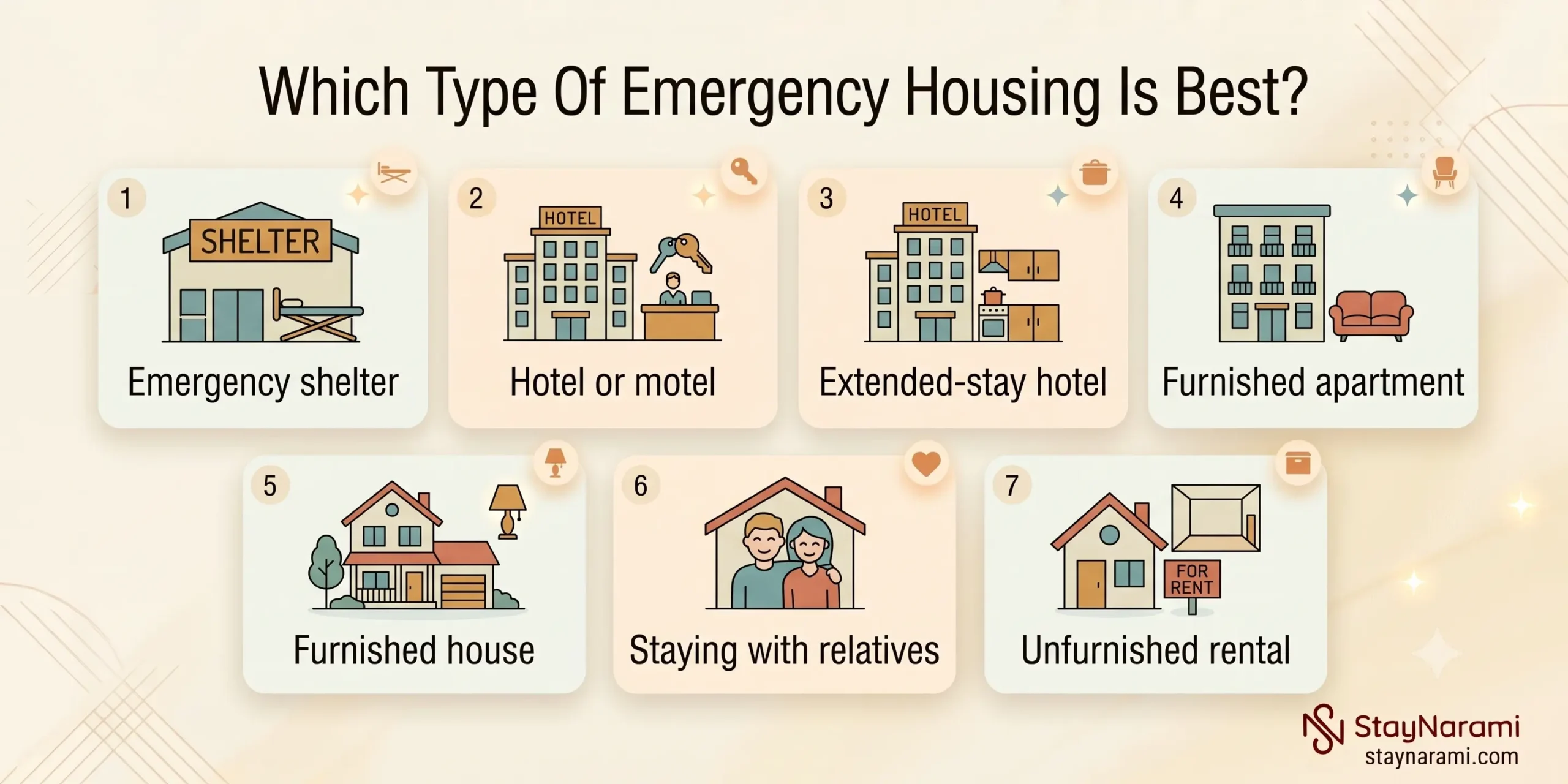
The right option depends on the expected length of displacement and the needs of the household.
Housing option |
Usually works best for |
Main advantage |
Possible limitation |
| Emergency shelter | First hours or days | Immediate safety and basic support | Limited privacy and space |
| Hotel or motel | Several nights to a few weeks | Fast booking and flexible checkout | No kitchen, laundry,y or separate bedrooms |
| Extended-stay hotel | Several weeks | Kitchen and hotel-style services | Daily rates may remain high |
| Furnished apartment | One to six months | Kitchen, laundry and normal living space | May require deposits or minimum stays |
| Furnished house | Families, pets or longer repairs | More space, privacy and parking | Higher cost and limited availability |
| Staying with relatives | Short stays with strong family support | Fast and familiar | Crowding and unclear reimbursement |
| Unfurnished rental | Long rebuilds | Stable housing for many months | Furniture and utility setup may be required |
A Realistic Temporary Housing Cost Example
A family of four must leave their home for three months while repairs are made.
Their normal monthly costs are:
- Mortgage: $2,200
- Groceries: $750
- Transportation: $300
- Utilities: $280
The family decides to rent a furnished house, which costs them $3,400 a month. This house also includes the cost of furniture, utilities, and parking.
But the issue is that the rental home is farther from work and school. Due to this, the family now spends $480 a month extra on transportation. This is $180 more than usual.
They also pay:
- Temporary rent: $3,400
- Extra transportation: $180
- Storage: $160
- Extra laundry and home supplies: $75
Their extra monthly cost is:
$3,400 + $180 + $160 + $75 = $3,815
For three months, the total is:
$3,815 × 3 = $11,445
The family must still pay its normal mortgage. Insurance usually does not pay this bill because the family was already paying it before the fire.
If the family stops paying the normal utility bill at the damaged home, the insurance company may remove that amount from the claim.
The final payment will depend on the policy rules, coverage limit, receipts, and approval from the insurance company.
The family should check how much housing coverage is left before renting a temporary home.
What Should You Check Before Moving In?
Before accepting the keys, confirm:
- The property is clean, secure, and ready to occupy
- Utilities are active
- Smoke and carbon monoxide alarms work
- The kitchen has basic appliances
- Beds and furniture match the agreement
- Doors and windows lock correctly
- Pets are allowed in writing
- Parking spaces are included
- Mail and package rules are clear
- The lease allows an extension if repairs are delayed
- Emergency and maintenance contact numbers are available
Choose the Right Temporary Home!
Share your approved budget, household needs, preferred area, pets, and estimated repair timeline to find suitable furnished accommodations.
Final Thoughts
Finding emergency housing after a disaster is not only about locating an available room. The housing should have a safe environment, be affordable, be appropriate for the household, and be acceptable to the organization providing the rent.
Seek immediate shelter, open an insurance/assistance claim, verify the budget in writing, and then determine housing based on the anticipated recovery time. Always hold onto all receipts and check the repairs schedule frequently.
The best thing you can do this week is to look in your homeowners or renters insurance policy for the loss of use section. Write down the dollar limit, time limit, and claim phone number. That small amount of preparation can make securing temporary housing after a fire or disaster much easier during a stressful emergency.
Frequently Asked Questions
How quickly can I get temporary housing after a house fire?
Emergency shelter and/or some hotel accommodations may be available on the same day. The length of time a furnished apartment or house can take depends on the confirmation of the property, the lease, the payment, and insurance approval, which can take several days.
Does homeowners insurance always pay for temporary housing?
No. The cause of the damage would have to be covered by the policy and the home would have to be deemed uninhabitable. Insurers’ cover limits and exclusions can differ, so check the loss-of-use clause of your policy.
Can renters receive emergency housing after a disaster?
Additional living expense coverage often is included in renters insurance. Typically, a landlord’s insurance covers the structure, not the tenant’s personal goods or hotel bills.
Can I choose my own temporary rental?
Yes, but the cost/terms may require approval in many cases. Never sign the lease or pay a non-refundable deposit without asking the adjuster.
What happens if repairs take longer than expected?
When a delay becomes apparent, reach out to the insurance provider or support scheme. Offer a new repair schedule and write a request for an extension of the house. Be aware that coverage may not be automatic.
Need housing for your team?
Tell us what you need and we'll take care of the rest — anywhere in the U.S., 30+ days.
Request Housing →Related Articles