Housing Solutions for Summer Intern Programs


Bring the Cohort Together Without the Housing Chaos
StayNarami helps employers turn one summer intern roster into a coordinated housing plan built around program dates, office location, roommate needs, commute, and budget.
A strong summer internship can attract future employees, introduce students to your company, and give managers a chance to evaluate talent before making a full-time offer. But when interns are coming from different states, one practical issue can quickly complicate the entire program: where will everyone live for the summer?
Housing is already a meaningful part of internship planning. According to the National Association of Colleges and Employers, about half of employers that responded to its 2026 Internship & Co-op Survey provide financial relocation assistance to interns. Among employers using lump-sum assistance, the average amount reported for housing was $3,310, while travel assistance averaged $1,417. Employers said housing and relocation support can reduce financial barriers and help them compete for qualified interns.
This is especially true when a company sends 20‚ 40, or 100 interns to one city at roughly the same time․ One-off bookings can turn into dozens of leases‚ deposits‚ utility questions‚ roommate issues‚ arrival dates‚ different support questions, and more․
A well-planned intern housing program handles these issues as one coordinated project. This guide explains how companies can choose housing, plan costs, decide between shared and private units, manage a full summer cohort, and build a turnkey program without making HR handle every housing problem itself.
TL;DR (Too Long; Didn’t Read)
- Built for HR teams, internship program managers, campus recruiting teams, and employers responsible for housing groups of summer interns.
- Intern housing is one program‚ not dozens of contracts․ Program dates‚ cohort size‚ commute‚ roommate preference matching‚ furniture‚ Wi-Fi‚ public transport‚ move-in‚ support‚ and move-out logistics impact whether housing is a good experience for participants․
- While the median length of the internship is 11 weeks‚ furnished short-term housing fills the gap between hotel stays and 12-month leases․ For larger intern groups‚ housing multiple interns in one property can simplify billing‚ transportation‚ roommate matching, and upkeep․
- This article helps you determine how to set up a summer intern housing program‚ calculate the cost per intern‚ decide between shared or private housing‚ plan the move-in and move-out schedule‚ and ultimately free up HR to get work done․
What Is an Intern Housing Program and Why Do Companies Need One?
An intern housing program is an organized system for helping interns secure temporary housing during their internship. Instead of leaving every student to find a place alone, this can include providing furnished housing‚ arranging group housing‚ offering a housing stipend or allowance‚ or a combination of the above․
The right model may depend on the company‚ city‚ program duration‚ and the number of interns․
For an employer bringing only two local students into the office, there may be little reason to manage housing directly. Bring 35 students from 12 states into the same city for ten weeks, however, and housing becomes part of program operations.
A structured program can help the company:
- Recruit students who live outside the local area.
- Give interns clearer costs before they accept an offer.
- Keep interns within a reasonable distance of the office.
- Coordinate arrival and departure dates.
- Reduce the number of separate housing vendors and bills.
- Create a consistent standard for furniture, kitchens, Wi-Fi, and other basics.
- Give interns a clear place to go when a housing problem occurs.
This also supports the larger goal of an internship: giving young professionals enough stability to focus on the actual experience.
Richard Branson has put the broader idea behind investing in young talent simply:
“Train people well enough so they can leave, treat them well enough so they don’t want to.”
Housing is not the key to a successful internship‚ but it removes a stressor that will make it easier to succeed․
What Types of Housing Options Are Available for an Intern Housing Program?
Companies generally have several choices.
Housing Option |
Best Fit |
Main Advantage |
Main Issue to Check |
| Furnished apartments | 30+ day summer programs | More residential space and everyday amenities | Availability near the office |
| Corporate housing | Larger or organized cohorts | Furnished, managed, easier to coordinate | Minimum stay requirements |
| University housing | Summer programs near campuses | Often practical for student cohorts | Fixed dates and limited inventory |
| Extended-stay hotels | Smaller or shorter programs | Easy setup and flexible booking | Cost and limited living space |
| Traditional rentals | Longer placements | Wider housing choice | Furniture, utilities, deposits, leases |
| Housing stipend | Small or dispersed cohorts | Less direct administration | Intern carries the housing search burden |
University housing works out in some cases‚ but companies can’t always count on those summer listings not selling out․ A quick glance at 2026 listings shows that some have already sold out in several cities across the United States this summer․
Programs lasting 30 days or more may bypass several of these steps because they may provide housing that includes furniture‚ utilities, and kitchens or other living amenities․
How Do We Design an Intern Housing Program for Summer Cohorts?
Start with the cohort, not the properties. Before searching for apartments, build one housing requirements sheet containing:
- Internship start and end dates
- Earliest arrival date
- Latest departure date
- Number of interns
- Office address
- Preferred maximum commute
- Number of bedrooms required
- Shared or private bedroom policy
- Gender or roommate preferences where appropriate
- Parking requirements
- Public transportation needs
- Required furniture
- Wi-Fi requirements
- Kitchen and laundry requirements
- Accessibility needs
- Housing budget
- Expected headcount changes
- Person responsible for housing decisions
This prevents a common mistake: securing ten attractive apartments and then discovering that four interns need parking, three arrive early, the apartments cannot support the planned roommate setup, and half the group faces an hour-long commute.
1. A Simple Example
Picture a company with 24 interns working over 10 weeks․
For example‚ the company could define furnished two-bedroom apartments within a specified commute radius‚ agree to occupancy limits‚ schedule move-ins all for the same weekend‚ and assign one coordinator for all housing-related communication․
Although the company would still have to deal with individual needs‚ it only had to do so with the basic housing structure․
How Do Companies Manage Housing for Multiple Interns at Once?
It is easier to deal with large cohorts if housing is a group endeavor․ One master roster must include the intern’s name‚ arrival and departure dates‚ unit‚ roommate‚ need for parking‚ process for contacting emergency contacts‚ and accommodation of special need request․
Then separate the work into three stages.
1. Before Arrival
Confirm leases‚ occupancy‚ furniture‚ utilities‚ Wi-Fi‚ key availability‚ parking‚ roommate placements‚ and estimated arrival dates․
2. During the Program
Use one support channel for maintenance, lockouts, internet problems, property questions, and approved unit changes.
3. Before Departure
Give interns written checkout instructions, key-return steps, cleaning expectations, damage-reporting rules, and departure deadlines.
The goal is not to eliminate every housing question. It is to stop every question from becoming a new process.
Should an Intern Housing Program Offer Shared or Individual Units?
There is no universal answer.
Shared units normally reduce the cost per intern and can make it easier for a new cohort to get to know one another. Private housing provides more privacy but can increase the number of units required and the total program cost.
A useful middle ground is a shared apartment with private bedrooms when budget and inventory allow.
Before deciding, compare:
Question |
Why It Matters |
| Does every intern need a private bedroom? | Changes unit count and cost |
| Is bedroom sharing allowed? | Can reduce cost but affects privacy |
| How will roommates be assigned? | Avoids confusion before arrival |
| Can interns request a roommate? | May improve comfort |
| How will conflicts be handled? | Gives HR a process before a problem occurs |
| Are occupancy limits confirmed? | Prevents overcrowding |
Do not plan solely around the cheapest cost per bed. A very dense housing setup may save money while creating avoidable problems during a long summer stay.
How Do Companies Budget for a Summer Intern Housing Program?
There is no reliable national “average cost” for an entire intern housing program because housing prices vary widely by city, unit type, dates, occupancy, and program size.
The $3,310 average housing lump sum reported in NACE’s 2026 survey is useful as a relocation-assistance benchmark, but it should not be presented as the average cost of employer-arranged housing.
For a coordinated program, calculate:
Housing cost per intern = total housing expense ÷ number of housed interns
Then include more than base rent.
Your budget may need to account for:
- Rent
- Utilities
- Furniture
- Internet
- Parking
- Deposits
- Cleaning
- Application or administrative fees
- Transportation
- Early-arrival nights
- Late departures
- Vacancy caused by last-minute withdrawals
- Damage or replacement costs where applicable
1. Illustrative Budget Example
Suppose 20 interns need housing for roughly 2.5 months. If the company needs 10 shared units, first calculate the total cost of those 10 units for the full program period. TAdd in any parking‚ transportation‚ cleaning‚ setup‚ or other fees․
Finally‚ divide the all-in cost by 20․
It’s a much more useful number than just comparing advertised monthly rent․
An extended-stay operation is usually one of the forms that StayNarami takes if the housing is furnished with utilities‚ at a flat‚ all-in price‚ often preferred for longer stays․
Build Intern Housing Around the Program, Not Around Leftover Rentals
StayNarami sources furnished housing for students and interns staying 30+ days, helping employers coordinate practical locations, shared or private setups, and move-in-ready accommodations for summer programs.
What Locations Work Best for an Intern Housing Program Near the Office?
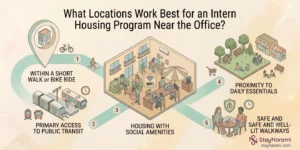
The nearest apartment is not always the best choice.
Measure the real commute during normal work hours, then check how interns will actually travel.
Look at:
- Drive time
- Public transit routes
- Walkability to transit
- Grocery stores
- Parking
- Safe access to and from the property
- Distance from other interns
- Evening transportation options
For a cohort, clustering can also matter.
If 30 interns are spread across 18 unrelated properties, every transportation plan becomes harder. Keeping more interns in the same building, community, or nearby area can simplify roommate coordination, transportation, communication, and move-in.
How Do We Handle Move-In and Move-Out for a Full Intern Cohort?
Do not treat arrival day as 30 individual check-ins.
Create one arrival plan before anyone travels.
Send each intern:
- Full property address
- Check-in date and permitted arrival time
- Key or access instructions
- Roommate information
- Parking or transit instructions
- Housing contact information
- Emergency process
- Basic property rules
- Wi-Fi details
- What is already supplied in the unit
For larger cohorts, stagger arrival windows rather than directing everyone to arrive at once.
Use the same approach for departure: inform interns of check-out time‚ clean-up requirements‚ where/how to drop off keys‚ how to report damage‚ and who to contact if travel gets disrupted․
What Support Should Be Built Into an Intern Housing Program?
The housing program should answer one simple question before move-in: Who does an intern contact when something goes wrong?
Interns shouldn’t have to guess whether to report a broken air conditioner to HR‚ their manager‚ a landlord‚ a recruiter, or a housing provider․ Build a simple escalation system for:
- Maintenance
- Lost keys
- Internet outages
- Safety concerns
- Roommate issues
- Parking problems
- Extension requests
- Early departures
Routine property problems should stay with the housing contact whenever possible. HR should only need to become involved when the issue is actually related to employment, conduct, policy, or intern welfare.
How Do We Set Up a Turnkey Intern Housing Program for Companies?
A turnkey program brings sourcing, property coordination, move-in, and support into one process.
For employers, the setup can be straightforward:
Step 1: Confirm the cohort.
The program runs from 1 May through 15 September‚ with 16 interns expected and more in the future․
Step 2: Define the housing standard.
Decide on private or dormitory-style bedrooms‚ how far you’re willing to commute‚ kitchen‚ laundry‚ parking‚ Wi-Fi‚ etc․
Step 3: Set an all-in budget.
Compare the total cost‚ not just the rent․
Step 4: Source housing as a group.
Look for enough inventory to house the cohort without scattering everyone unnecessarily.
Step 5: Confirm occupancy and roommate plans.
Do this before leases are finalized.
Step 6: Coordinate one move-in process.
Provide addresses, access instructions, support details, and house rules before travel begins.
Step 7: Manage the stay centrally.
Give interns one clear contact for housing issues.
Step 8: Close the program with one departure plan.
Coordinate checkout, keys, final inspections, and any extensions.
For companies whose summer internship lasts 30 days or longer, StayNarami can source fully furnished housing around the cohort size, location, dates, and unit requirements, helping reduce the number of separate housing arrangements HR has to manage.
Have the Housing Ready Before the Welcome Emails Go Out
Give StayNarami your cohort size, program dates, office location, budget, bedroom setup, and transportation needs so your interns arrive with housing already handled.
Conclusion
An intern housing program is not just some apartments available for lease during the summer months․ An intern housing program consists of where interns live‚ what is covered‚ how they are assigned to their apartment‚ how they get to work every day‚ what happens on their arrival day‚ and for their apartment‚ who to contact if something goes wrong after they move in․
After you decide on dates and number of interns‚ you want to determine radius‚ how much communal and private space you want‚ calculate the all-in cost per intern‚ and book inventory for the summer․
When those decisions are made early‚ housing can become a positive part of the internship experience rather than a problem for corporate HR to solve in the summer․
Frequently Asked Questions
1. Do Big Companies Have Intern Housing Programs?
Yes, some larger employers provide coordinated housing, corporate accommodations, or relocation assistance. Others provide a stipend and allow interns to secure their own housing. NACE’s 2026 research found that approximately half of responding employers offered some form of financial relocation assistance.
2. How Do Companies House Dozens of Interns at Once?
Companies can reserve multiple furnished units, group interns by location, assign roommates in advance, centralize leases and billing, and coordinate one move-in schedule. Keeping the cohort in a small number of buildings or neighborhoods can also simplify transportation and support.
3. What Is the Average Cost of Running a Summer Intern Housing Program?
There is no single national average because costs depend heavily on city, dates, unit size, occupancy, transportation, and included services. NACE reported an average $3,310 housing lump sum among surveyed employers using that form of relocation support, but this is not the same as the average cost of a complete group housing program.
4. Should Interns Be Housed Together or in Separate Apartments?
Housing interns together can reduce costs and make it easier for the cohort to connect, but privacy and compatibility still matter. Shared apartments with private bedrooms can offer a practical compromise when the budget and housing inventory support it.
5. How Far in Advance Should Companies Set Up Intern Housing for Summer?
Begin planning as soon as internship dates and a reasonable headcount are known. Waiting until every offer has been finalized can reduce available options in competitive summer markets. Current 2026 listings already show numerous university intern-housing properties as sold out, demonstrating how quickly some seasonal inventory can disappear.
6. Do Intern Housing Programs Include Transportation to the Office?
They can, but transportation is not automatic. Some employers provide shuttles, transit passes, mileage support, or housing close enough for interns to walk or use public transportation. The transportation plan should be decided at the same time as the housing location.
7. Can Companies Get Group Discounts for Large Intern Cohorts?
Sometimes. Larger bookings may give employers more room to discuss group pricing or standardized terms, but savings depend on the market, dates, number of units, property availability, and length of stay. Compare the all-in cost per intern, not simply the advertised rent.
Need housing for your team?
Tell us what you need and we'll take care of the rest — anywhere in the U.S., 30+ days.
Request Housing →Related Articles