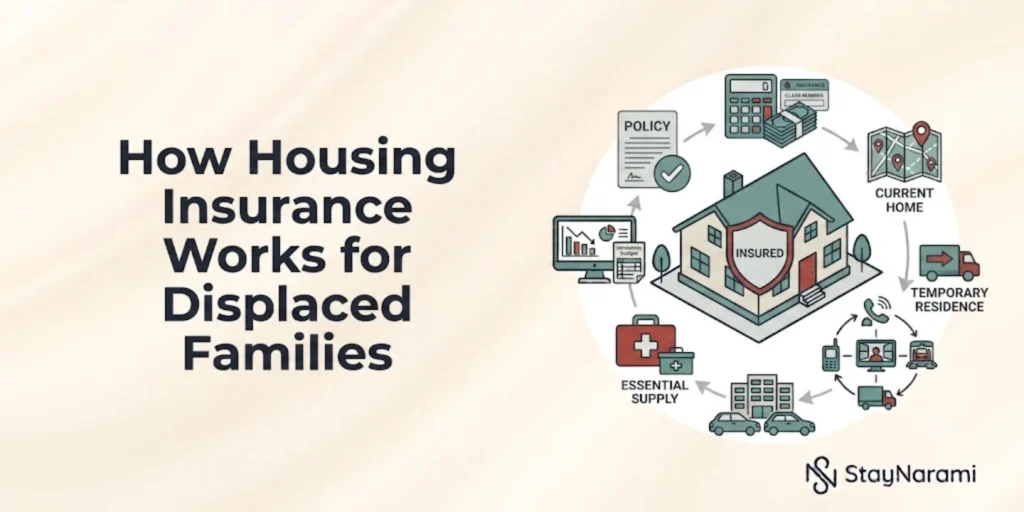
How Housing Insurance Works for Displaced Families

Displaced From Home? Get Temporary Housing
Find furnished temporary housing that fits your household size, location, pets, insurance requirements, and expected repair timeline.
When a home needs major repairs after a fire, storm, burst pipe, or serious water damage, the family may need to live somewhere else for days, weeks, or even months.
First of all, find a safe place. Depending on the policy and the cause of the damage, home or renters insurance may help cover temporary housing costs.
For a short stay, a hotel may be the easiest option. For a longer stay, a home with a kitchen, laundry, bedrooms, and parking may be more practical.
This is where insurance housing for displaced families may help. Many home and renters insurance policies cover temporary living costs through additional living expenses (ALE), also called loss-of-use coverage.
ALE does not pay every bill while you are away from home. It helps pay the extra costs caused by the covered damage. This guide explains how it works, what it may pay for, and how families can find suitable temporary housing.
TL;DR (Too Long; Didn’t Read)
- Built for homeowners, renters, families, and insurance claimants who need temporary housing after a fire, storm, burst pipe, or other covered event makes their home unlivable.
- Answers the most important questions: What is Additional Living Expenses coverage? Which temporary housing costs may insurance pay? How are claims reimbursed? And how can families avoid using up their coverage too quickly?
- The solution: Use ALE or loss-of-use coverage to pay eligible additional expenses, such as a hotel, furnished rental, storage, moving costs, added transportation, and increased meal expenses. Coverage limits, approval requirements, and payment methods depend on the individual policy.
- ALE generally covers the difference between normal household spending and the additional costs caused by displacement. For example, if a family normally spends $800 on food but spends $1,400 while living in a hotel, the potential additional expense is $600.
- In this guide, you will learn how insurance-funded temporary housing works, what ALE may and may not cover, how insurers pay approved expenses, how to select a suitable temporary home, which documents to keep, and what assistance may be available when insurance is not enough.
What Is Insurance Housing For Displaced Families?
Temporary housing insurance coverage is not a separate type of home. It is part of a claim that may help pay for a hotel, apartment, or rental house. Depending on your needs, temporary housing may include the following:
- Hotel or motel
- Extended-stay hotel
- Furnished apartment
- Furnished rental home
- Short-term condominium
- Other approved temporary accommodation
The insurance company may pay the housing provider directly. In other cases, the family pays first and asks for reimbursement.
The exact process depends on the policy and the insurance company. Families should speak with their claims adjuster before signing a lease or making a large payment.
What Is Additional Living Expenses Coverage?
Additional Living Expenses (ALE) pays for all the increased costs of living elsewhere because of an insured occurrence that made a home uninhabitable.
It may be found under the “loss of use” part of a homeowners or renters’ insurance policy. Many policies provide this coverage, but the amount, rules, and time limit can be different for each policy.
The word “additional” is important. ALE usually pays the difference between what you normally spend and what you must spend because you cannot live at home.
A simple ALE example
A family usually spends $800 each month on food. Because the family cannot prepare meals at the hotel, their restaurant costs reach $1,400. The extra cost is:
$1,400 new food cost – $800 normal food cost = $600 ALE claim
The insurance company can accept the additional $600 as the amount for reimbursement as per their policies. Also, do know that the insurer will not normally pay the full amount, i.e., $1,400 in this case, because the family would have spent about $800 on food even if the fire had not happened.
The same principle can be used for housing, traveling, laundry, storage, and more. ALE provides funding or reimbursement for necessary living expenses that are higher than the family’s normal costs and are caused by the covered loss.
When Does ALE Coverage Begin?
ALE may apply when two main conditions are met:
- The damage was caused by something covered by the insurance policy.
- The home is not safe or reasonable to live in.
For example, ALE may apply after covered damage from a fire, windstorm, smoke, or certain types of water damage.
This may not cover damage that occurs as a result of a cause that is not covered by the policy. Standard homeowners insurance doesn’t protect against all types of disasters. Separate coverage may be available, but temporary living expenses are not included in every flood or earthquake policy. For example, temporary housing after a house fire may only be covered when the fire is caused by a covered event under the insurance policy.
A family should not assume that temporary housing is covered simply because the home has damage. The insurance company must first review the cause of the loss and the condition of the home.
In some cases, coverage may also apply when a government order stops a family from entering the area. The exact rule depends on the policy and the reason for the order.
What May Insurance Housing Cover?
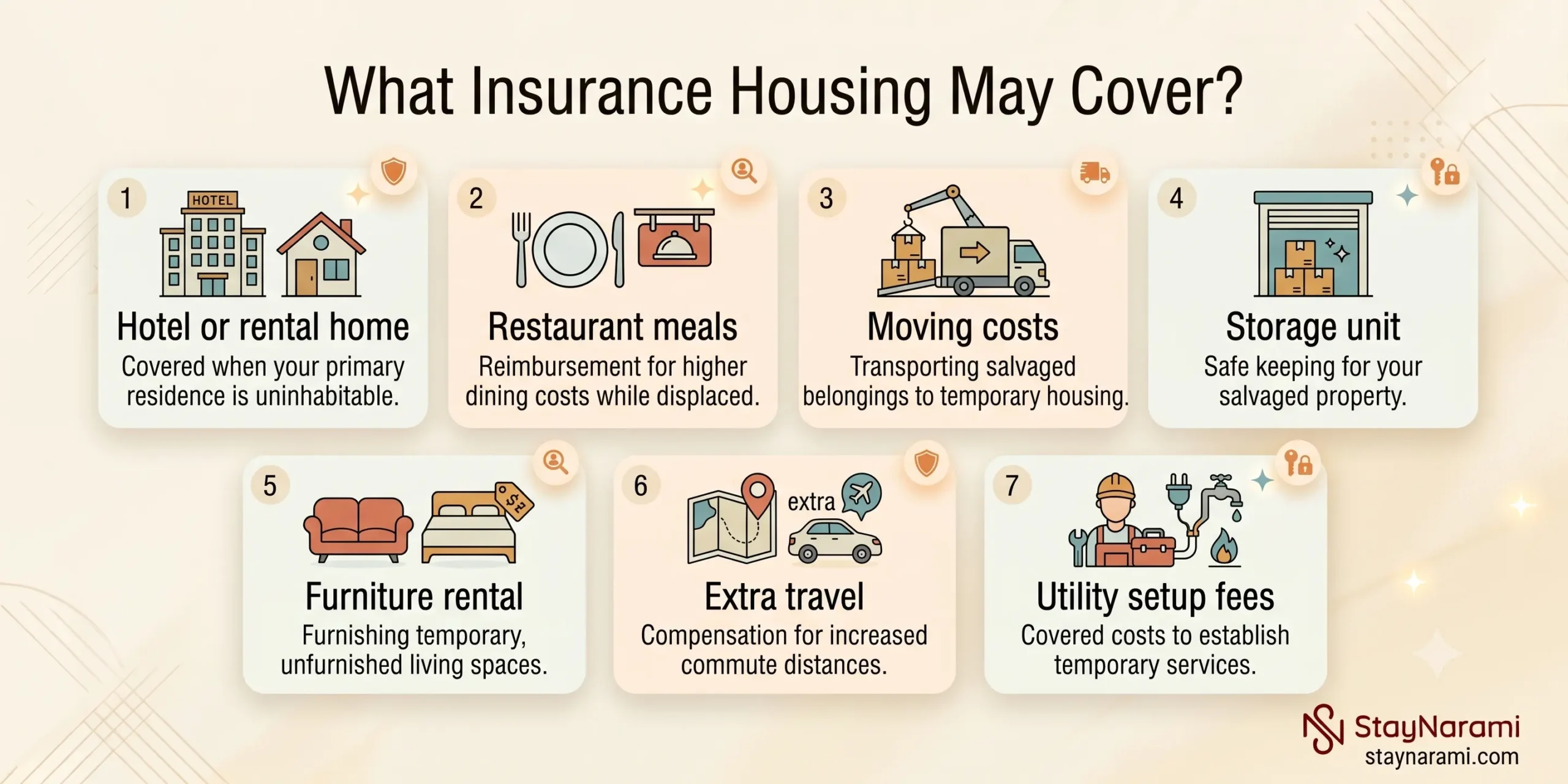
ALE coverage may pay for more than a hotel room. It can help with several extra costs caused by the move.
Cost |
May be covered? |
Important detail |
| Hotel or rental home | Often | The price must usually be reasonable |
| Restaurant meals | Sometimes | Usually only the extra amount above normal food costs |
| Moving costs | Often | Keep the invoice and payment record |
| Storage unit | Sometimes | Will it be covered when your belongings must be moved |
| Furniture rental | Sometimes | Ask for approval before renting |
| Extra travel | Sometimes | This may include added travel to work or school |
| Utility setup fees | Sometimes | This may include internet, electricity, or phone setup |
| Laundry costs | Sometimes | Mainly when the temporary home has no washer |
| Pet boarding | Depends | Coverage varies by policy |
| Parking fees | Depends | Ask the adjuster before choosing the property |
State insurance guidance lists temporary housing, extra food costs, furniture rental, storage, moving expenses, utility setup fees, and added travel as possible ALE expenses. Coverage still depends on the wording and limits in the individual policy.
What Does ALE Usually Not Pay For?
Additional Living Expense (also known as “Loss of Use”) is not an open spending account. ALE will not pay for costs that are not linked to the covered loss.
It may not pay for:
- Your normal mortgage payment
- Normal rent that you were already paying
- Your usual grocery cost
- Luxury upgrades
- Unapproved long-term leases
- Damage caused by an event excluded from the policy
- Costs above the ALE dollar limit
- Costs after the coverage period ends
- Bills without proof or clear records
Suppose a family normally lives in a three-bedroom house. The insurer may agree to a similar three-bedroom rental nearby. It may not agree to pay for a high-end six-bedroom vacation home unless there is a clear need and written approval.
ALE’s mission is to help a family live in a similar way while their home is being fixed. Don’t expect them to pay for a better or more expensive lifestyle.
How Long Will It Take For Insurance To Pay For Temporary Housing?
There is no single time limit for every family. Some policies provide a set dollar amount. Others may have both a dollar limit and a time limit. Coverage may end when one of the following happens:
- The home is repaired
- The home can safely be lived in again
- The family moves into a permanent home
- The policy time limit ends
- The ALE money runs out
Families should ask the adjuster for two numbers at the start of the claim:
- The total ALE dollar limit
- The final date or time limit for using the coverage
A policy may have enough money for a short hotel stay but not enough for many months in a furnished home. Tracking the remaining balance helps prevent a sudden housing problem later.
How The Payment Process Works
The payment process is not always the same. It usually follows one of three methods.
- Direct payment: The insurance company or its housing partner pays the hotel or rental provider directly.
- This can reduce the amount of money the family must pay from its own bank account. The family may still be responsible for personal expenses, damages, or costs that were not approved.
- Repayment after you pay: The family pays the bill and sends the receipt to the insurer. The insurer reviews the cost and pays the covered amount. This method requires the family to have enough money available while waiting for payment.
- An advance payment: Some insurers may provide an advance for early housing, food, clothing, or moving costs. The advance is usually counted as part of the final claim payment. It is not free money added on top of the policy limit. Ask the adjuster which payment method will be used before booking a property.
How To Choose The Right Temporary Home
The cheapest one is not always the best one. An accommodation without a kitchen, laundry, or enough storage may lead to higher food, transportation, laundry, and storage costs in the long run. Before choosing a property, think about the full daily routine.
1. Check The Location
Try to stay within a reasonable distance of:
- Work
- School
- Childcare
- Medical care
- Public transportation
- The damaged home
- Family support
A cheaper rental that is far away may lead to high fuel costs and long drives each day.
2. Check The Basic Living Needs
There should be enough beds, bathrooms, storage, and living rooms in the property.
Ask about:
- A full kitchen
- A washer and dryer
- Internet service
- Parking
- Heating and cooling
- Furniture
- Safety features
- Accessibility needs
- Pet rules
- Lease extension rules
A kitchen can help lower food costs. A washer and dryer can reduce weekly laundry costs. These details can protect the ALE budget.
3. Think About The Repair Schedule
Home repair dates usually vary depending on the hidden damage, permits, delays in materials, the contractor’s schedule, etc.
Look for housing that allows extensions. Avoid signing a long lease with a large early-exit fee unless the insurance company has approved it in writing.
Example Of A Family Housing Claim
A family of four must leave its home after a kitchen fire. The family expects repairs to take three months.
Its normal monthly costs are:
- Mortgage: $2,000
- Groceries: $900
- Gas: $250
- Home internet: $70
The family rents a furnished apartment for $2,800 per month. It also has these new costs:
- Extra rent: $2,800
- Extra restaurant food above normal food spending: $350
- Added travel to school and work: $180
- Storage unit: $140
- Internet setup fee: $80
The possible additional cost for the first month is:
$2,800 + $350 + $180 + $140 + $80 = $3,550
The normal mortgage payment may continue, but ALE does not usually replace or pay that regular bill. The family should provide the temporary housing rental agreement, records of food bills, a proper mileage log, a storage fee receipt, and internet charges to the adjuster.
The amount approved may depend on policy limits, local rental prices, and whether the expenses were reasonable and needed.
Find Stability While Your Home Is Being Repaired
Explore furnished housing for families displaced by fires, storms, water damage, and other emergencies, with options designed for stays lasting weeks or months.
Steps To Take After Leaving Your Home
1. Contact the insurance company
Report the damage as soon as it is safe to do so. Ask for your claim number and the contact details of your adjuster.
Tell the adjuster that the family needs temporary housing.
2. Ask for the ALE rules in writing
Request a clear written answer covering:
- Your total ALE limit
- The length of coverage
- The approved nightly or monthly housing amount
- The payment method
- The types of costs that may be claimed
- The documents needed
- Rules for extending the stay
Written approval can prevent problems later.
3. Keep every receipt
Keep all hotel, rent, food and drink, laundry, parking, moving, storage, utility setup, and any additional transportation receipts. Photocopy each paper receipt in case they get lost or fade.
4. Track normal and new expenses
ALE is based on extra costs. Be sure to record your usual expenditure before the loss and what you spend while living away from home.
A simple sheet can include:
| Date | Expense | Normal cost | New cost | Extra amount | Receipt saved |
| May 5 | Food | $30 | $52 | $22 | Yes |
| May 6 | Parking | $0 | $15 | $15 | Yes |
| May 7 | Laundry | $0 | $18 | $18 | Yes |
This makes it easier for the adjuster to review the claim.
What Happens When Insurance Is Not Enough?
Families may have other options when ALE does not cover the full housing need.
After a federally declared disaster, FEMA may offer rental or temporary housing help to eligible households. However, FEMA cannot pay for the same cost that insurance has already paid. Families may still be able to seek help for eligible needs that insurance did not cover.
Other possible sources of help include:
- Local emergency management offices
- Community housing programs
- Local charities
- Faith-based groups
- School district support
- Employer assistance
- State or county disaster programs
Keep the insurance settlement letter. Other aid programs may ask to see what the insurer covered or denied.
Common Mistakes That Can Delay Payment
Families can protect their claim by avoiding a few common problems.
Do not throw away receipts. Do not assume every expense will be covered. Do not book an expensive rental before checking the policy limit. Do not sign a lease that lasts longer than the expected repair period without discussing it with the adjuster.
It is also important to answer requests from the insurance company. A missing bill, unclear receipt, or late form can slow the review.
From Approval to a Comfortable Stay
Share your approved budget, preferred location, household needs, pets, and estimated repair period to find a suitable temporary home.
Final Thoughts
Insurance housing for displaced families can provide a safe place to stay while a damaged home is repaired. The main source of help is often additional living expenses (ALE) coverage, also called loss-of-use coverage.
The key point is simple: ALE helps with extra living costs caused by covered damage. It does not pay every household bill.
Families should learn their dollar limit, get housing approved in writing, keep every receipt, and track the difference between normal and temporary costs. These steps make the claim easier to review and help the housing money last longer.
Frequently Asked Questions
1. Can ALE pay for a rental house?
Yes, a furnished house or apartment may be covered when it is reasonable for the family’s size and needs. Get approval before signing the lease.
2. Will insurance pay for all restaurant meals?
Usually not. It may pay the extra amount above what the family normally spends on food.
3. Does ALE pay the mortgage?
ALE does not usually pay the regular mortgage. It helps pay the added cost of living somewhere else.
4. What if repairs take longer than expected?
Contact the adjuster before the housing end date. Ask whether the stay can be extended and how much ALE money remains.
5. Can FEMA help when a family has insurance?
FEMA cannot pay for costs already covered by insurance. It may help with eligible unmet needs after a federally declared disaster.
Need housing for your team?
Tell us what you need and we'll take care of the rest — anywhere in the U.S., 30+ days.
Request Housing →Related Articles