What Insurance Companies Look For In Housing Providers


Offer Your Property as a Temporary Home
List your property for displaced families who need safe, comfortable housing while their homes are repaired.
Do you know that about one in every 18 insured homes has a claim each year? Yes, it’s true. In 2023, 5.3% of insured homes had a claim, and the average claim cost was $20,062. And most of these housing claims are caused by wind, hail, water, freezing, fire, and lightning. Some losses are so serious that families cannot safely remain or return to their homes.
In such a case, the affected family will require either hotel accommodation, a furnished apartment, or a rented house. Apart from this, the additional living expenses coverage (ALE) helps with covering the cost of temporary lodging. Many home insurance policies set ALE coverage near 20% of the home’s insured value, but limits are different for every policy.
However, the insurer, adjuster, or housing coordinator may review whether the property is suitable for the family, reasonably priced, and allowed under the policy.
Good temporary housing should help the family feel safe and settled while repairs are being completed.
Understanding what insurance companies look for in housing providers can help landlords and property managers prepare for insurance stays. It can also help families understand why one property may be approved while another is not.
TL;DR (Too Long; Didn’t Read)
- Built for landlords, property managers, temporary housing providers, insurance professionals, and displaced families trying to understand how properties are evaluated for insurance-funded stays.
- Answers the key questions: What makes a property suitable for an insurance claim? Which business and safety documents may be required? How should providers present pricing and lease terms? And why might one property be approved while another is rejected?
- The solution: Offer safe, clean, fully furnished housing with transparent pricing, flexible lease terms, accurate billing, reliable maintenance, and clear documentation. The property must also match the family’s size, location, pets, accessibility needs, and expected repair timeline.
- In 2023, approximately 5.3% of insured homes had a claim, with an average claim cost of $20,062. When families are displaced, insurers look beyond the monthly rent to evaluate the property’s total cost, safety, suitability, and contract terms.
- In this guide, you will learn what insurance companies look for in housing providers, which documents landlords should prepare, how to structure quotes and leases, why flexibility matters, and which issues commonly delay or prevent property approval.
What Is An Insurance-Approved Housing Provider?
The term insurance-approved housing provider does not always mean that a company has passed one national approval program.
In many cases, the insurance company reviews each property for each claim. The adjuster may check the following:
- The condition of the property
- The full rental price
- The lease terms
- The property’s location
- The family’s size and needs
- The expected repair time
- The provider’s insurance and business records
A housing provider may be accepted for one family but not for another.
Why Insurance Companies Review Housing Providers
Additional living expense coverage does not pay for any property at any price. It normally helps pay the added living costs caused by a covered loss.
The housing must be reasonable for the family’s normal way of living. A family that lived in a three-bedroom home may need a similar amount of space. This is why housing for displaced families should provide enough room to support their daily needs without unnecessary costs. However, the insurer may not approve a costly luxury home when a safe and suitable property is available for less.
Insurance companies also need clear records. They must know:
- What the family is renting
- How much it costs
- What is included
- How long the family may stay
- Who receives payment
- What happens if repair dates change
Clear information helps the adjuster approve the housing faster.
What Insurance Companies Look For In Housing Providers
A safe and livable property
Safety is one of the first things an insurance company may review.
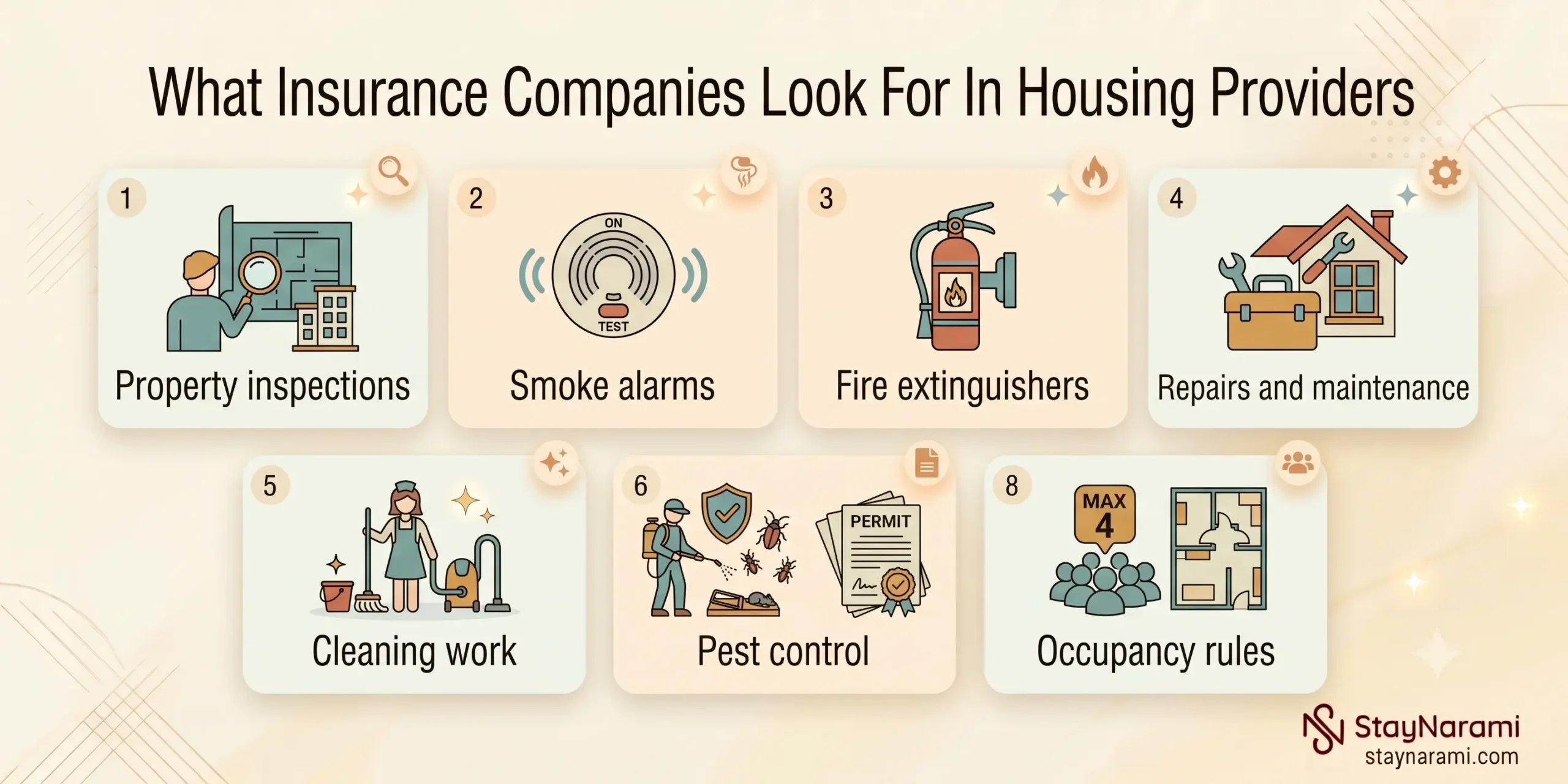
The property should comply with local regulations regarding housing, fire safety, use, and occupancy. Everything in the place should be operational; it means locks on doors, smoke detectors, utility services, heating, cooling, water, and electrical systems.
Housing providers should keep records of the following:
- Property inspections
- Smoke alarms
- Fire extinguishers
- Repairs and maintenance
- Cleaning work
- Pest control
- Local permits
- Occupancy rules
A provider should fix known safety problems before listing the property.
1. The right business and rental insurance
In most cases, a standard homeowners insurance policy does not adequately cover a property used as a short-term rental. The terms and conditions of the insurance policy may become different when the owner charges rent and permits temporary lodging.
The National Association of Insurance Commissioners cautions that many standard homeowners policies are not designed to cover the risks associated with home sharing and short-term rentals. Property owners should notify their insurance company about the property’s intended use and obtain appropriate insurance. This is especially important when offering temporary housing after a house fire, as displaced families may need safe, furnished accommodation while their homes are being repaired.
Insurance agencies/companies may ask a housing provider to show proof of:
- Property insurance
- Landlord or rental property coverage
- General liability insurance
- Workers’ compensation, when staff are employed
- Business registration
- Local rental permits
The exact documents depend on the property, location, and agreement.
A housing provider should not wait for a claim request before checking its own coverage. A property that is not properly insured may create risk for the owner, the guest, and the company managing the stay.
2. Fair and clear pricing
Insurance adjusters must protect the policy limit. They often compare the housing cost with other suitable properties in the same area.
A provider should give a simple price that is easy to review. The quote should clearly show:
Cost |
What the quote should explain |
| Nightly or monthly rent | The basic housing price |
| Taxes | Which taxes apply |
| Security deposit | Whether it is refundable |
| Cleaning fee | What the fee covers |
| Pet fee | One-time or monthly charge |
| Utilities | Included or billed separately |
| Internet | Included or extra |
| Parking | Number of spaces and added fees |
| Furniture | What items are included |
| Extension rate | Cost if the stay becomes longer |
| Early move-out fee | Amount due if the family leaves early |
Hidden charges can slow down approval. They may also cause a payment dispute later.
Consider two furnished homes. The first costs $4,000 per month but adds $600 in utilities, parking, and service fees. The second costs $4,350 and includes everything.
The first home appears cheaper, but its full cost is $4,600. The second home is actually $250 less each month.
Insurance companies want the full cost, not only the number shown at the top of the quote.
3. Flexible stay and extension terms
Home repairs do not always finish on time. Contractors may find hidden damage. Materials may arrive late. Permits and inspections may also slow down the work.
For this reason, insurance housing should offer reasonable flexibility.
A provider should explain:
- The minimum stay
- The move-in date
- The planned move-out date
- How an extension works
- How much notice is needed
- Whether the rate changes
- Whether rent is charged by the day or month
- What happens if the family leaves early
Month-to-month terms or daily prorated billing may be useful for insurance claims because the final repair date can change. Some temporary housing providers also offer flexible check-in and checkout dates for this reason.
A strict 12-month lease may not work for a family that expects to return home in four months. The insurer may not want to pay a large fee when the family leaves before the lease ends.
4. Housing that matches the family’s needs
The temporary property should be similar enough to the family’s normal home. It does not need to be the same, but it should support the family’s daily life.
The adjuster may consider:
- Family size
- Number of bedrooms
- Number of bathrooms
- Children’s ages
- Work and school locations
- Medical needs
- Mobility needs
- Pets
- Parking needs
- Length of stay
- Access to public transportation
For example, a hotel room may work for two adults for one week. It may not work well for two adults, three children, a dog, and a six-month repair period.
A furnished home with a kitchen and laundry may cost more per night than a hotel room. However, it could lower meal, laundry, parking, and storage costs.
The goal is to find housing that is both suitable and reasonable.
5. Furniture and basic household items
A displaced family may leave home with very little. A furnished property should be ready to live in when the family arrives.
Insurance companies may prefer housing that includes the following:
- Beds and clean bedding
- Seating
- A dining area
- Basic cookware
- Plates and utensils
- A refrigerator
- A stove or cooking area
- A washer and dryer
- Internet access
- Window coverings
- Heating and cooling
Housing used for longer stays often needs more than a bed and television. For families seeking temporary housing after fire, a full kitchen can help them prepare normal meals instead of relying on restaurants every day, making the temporary stay more comfortable and practical.
Temporary housing listings should explain exactly what is included. Words such as “fully furnished” are not enough by themselves.
The provider should list the number and size of beds, appliances, kitchen items, furniture, and services.
6. Clean and ready housing
A family may move in soon after a fire or other stressful event. The home should be clean before arrival. Insurance companies and housing coordinators may expect:
- Fresh bedding
- Clean bathrooms
- A clean kitchen
- Working appliances
- Removed trash
- No strong smoke or pet smell
- No active pest problem
- Clear entry instructions
- Working internet and utilities
The provider should have a clear cleaning process between stays.
Photos should show the property’s real condition. Old or heavily edited photos can create problems when the family arrives and finds something different.
7. Fast and clear communication
Insurance claims often move quickly. A family may need housing the same day or within 24 hours.
A provider should be able to answer basic questions without delay:
- Is the property open?
- What is the full price?
- How soon can the family move in?
- Are pets accepted?
- Is the home furnished?
- How many beds are there?
- Is parking included?
- Can the stay be extended?
- Who handles repairs?
- Where should invoices be sent?
Fast replies can make the difference between approval and losing the booking.
The provider should also name one main contact for the family, adjuster, and housing coordinator. This makes it easier to solve problems during the stay.
8. Simple leases and clear rules
The rental agreement should be easy to understand.
It should state:
- Names of the parties
- Property address
- Start and end dates
- Monthly or daily rate
- Deposit amount
- Included services
- Payment due dates
- Pet rules
- Smoking rules
- Guest rules
- Maintenance process
- Extension rules
- Early move-out rules
- Damage charges
- Cancellation terms
Insurance companies may decline or postpone the contract due to unclear terms and conditions.
The lease should not contain any additional fees that have not been indicated in the initial quote. The adjustment should be discussed with the adjuster before the family signs the agreement.
9. Accurate and timely billing
Insurance housing often involves several people. The provider may work with the family, an adjuster, a claim handler, or a housing coordinator.
Invoices should include:
- Claim or reference number
- Family or guest name
- Property address
- Billing period
- Daily or monthly rate
- Taxes and fees
- Deposits
- Credits
- Total amount due
- Payment instructions
The provider should send invoices on time and correct mistakes quickly.
Some insurance companies pay the provider directly. In other cases, the policyholder pays first and asks for repayment. Both payment methods are used in temporary housing claims.
Clear billing helps the family avoid paying high costs out of its own money while waiting for the claim to be reviewed.
10. Reliable maintenance and emergency help
Problems can happen during any stay. A pipe may leak. The heat may stop working. A lock may break. Insurance companies want to know that someone will respond. A provider should have:
- A normal maintenance contact
- An emergency phone number
- Clear repair times
- Local workers or service companies
- A backup plan when the home becomes unsafe
Small problems should not stay open for several days. The displaced family is already dealing with repairs at its main home. It should not have to manage another damaged property.
Make Your Property Ready for Insurance Stays
Learn how the landlord partner program helps property owners connect with temporary housing needs and support longer furnished stays.
A Simple Provider Approval Example
A family of five needs a furnished home for four months after a house fire.
Two providers send quotes.
Provider A
- Three-bedroom home
- $4,100 per month
- Furniture included
- No washer or dryer
- No pets
- 12-month lease
- $3,000 early move-out fee
- Slow replies
Provider B
- Three-bedroom home
- $4,350 per month
- Furniture and laundry included
- Family dog accepted
- Month-to-month agreement
- Daily prorated extension
- One local maintenance contact
- Full price shown in writing
Provider A has a lower monthly rate. However, its lease does not fit the repair period, and the family cannot bring its dog.
Provider B costs $250 more per month, but it fits the family’s needs and has safer contract terms. The insurance company may find Provider B more reasonable for the claim.
This example shows why what insurance companies look for in housing providers goes far beyond rent.
How Housing Providers Can Prepare
Property owners who want to work with insurance claims should prepare a simple information file for each home.
The file can include:
- Property address
- Current photos
- Number of bedrooms and bathrooms
- Bed sizes
- Accessibility details
- Pet rules
- Parking details
- List of furniture and appliances
- Full monthly price
- Taxes and fees
- Deposit rules
- Minimum stay
- Extension terms
- Cancellation policy
- Proof of insurance
- Business license or rental permit
- Maintenance contact
- Sample lease
- Payment details
Keeping this information ready can make the review faster.
Providers should also avoid making promises they cannot keep. Do not claim that a home is accessible, pet-friendly, or ready for same-day move-in unless that is true.
Common Reasons Housing May Not Be Approved
An insurance company may reject a property when:
- The cost is too high for the area
- The home is much larger than the family needs
- The lease is too long
- The cancellation fee is too high
- The home does not meet safety rules
- The provider cannot show proper insurance
- The property does not allow the family’s pets
- The location creates high extra travel costs
- The provider does not give clear prices
- The property is not ready on time
- The home does not meet a medical or access need
- Important bills or documents are missing
A rejection does not always mean the property is poor. It may simply be a bad match for that claim.
Need Suitable Housing for a Displaced Family?
Share the household size, location, pets, budget, accessibility needs, and expected stay to find an appropriate furnished property.
Final Thoughts
Insurance companies want temporary housing that is safe, clean, fairly priced, and suitable for the displaced family.
The strongest insurance-approved housing providers make the process easy. They share full prices, offer flexible terms, send clear bills, respond quickly, and keep the home in good condition.
Property owners should focus on the whole stay, not only the monthly rent. A suitable home with a fair contract is more likely to be approved than a cheaper home with hidden costs or strict lease terms.
StayNarami helps make this search easier by connecting temporary housing needs with furnished options suited to the family’s size, location, length of stay, pets, and daily routine. This can help families and insurance teams find practical housing while the main home is being repaired. Contact us to learn more!
Frequently Asked Questions
1. How does a housing provider become insurance-approved?
There is not always one national approval process. A provider may be reviewed by the insurance company, adjuster, or housing coordinator for each claim. The provider may need to show pricing, rental terms, property details, licenses, and proof of insurance.
2. Do insurance companies pay housing providers directly?
Sometimes. The insurer or housing coordinator may pay the provider directly. In other cases, the displaced family pays the bill and asks the insurer for repayment.
3. Do insurance companies require furnished housing?
Not in every case. However, furnished housing is often useful because displaced families may not have access to their furniture or household items.
4. Can a short-term rental be used for an insurance claim?
It may be used if the insurer approves the price, terms, property, and location. The property owner should also have insurance that allows short-term rental use.
5. Why do insurance companies ask for a full price breakdown?
A full breakdown helps the adjuster see the true cost. It also prevents later problems with taxes, deposits, cleaning, utilities, parking, or pet fees.
Need housing for your team?
Tell us what you need and we'll take care of the rest — anywhere in the U.S., 30+ days.
Request Housing →Related Articles