How to Find Housing in Remote Locations

Working Far From Town? Stay Closer to the Site
Find furnished temporary housing based on your exact worksite, crew size, project dates, vehicle needs, and preferred commute.
A job site may look close to town on a map. But the drive can be much longer than expected. The road may be slow, the nearest hotel may be full, and local rentals may be hard to find.
This can happen on projects in small towns, farming areas, mountains, or other remote places. There may be only a few hotels and rental homes. Some places may also have poor internet, little parking, or rough roads.
However, planning can save your crew hours of driving and help everyone settle in sooner. In fact, having proper knowledge of how to find housing in remote locations can also reduce travel costs and prevent last-minute problems. In this article, we explain how to look for the best remote housing, what to check before booking, and how to choose safe and practical temporary housing in rural areas.
TL;DR (Too Long; Didn’t Read)
- Built for contractors, project managers, workforce coordinators, and operations teams arranging temporary housing for crews working in rural or remote locations.
- Answers the key questions: Where should you search when local rentals are limited? How close should housing be to the worksite? How do you check roads, parking, internet, utilities, and real bed capacity? And how can you avoid paying for unsuitable or empty accommodations?
- The solution is to begin with the exact worksite, search nearby towns in every direction, contact local property owners and organizations, and compare each option using its full cost, including fuel, travel time, utilities, parking, and meals.
- Remote markets can appear to have plenty of vacant housing even when few properties are available to rent. Seasonal homes account for at least half of vacant housing in 645 U.S. counties, making it more difficult than expected to find temporary workforce housing.
- In this guide, you will learn how to search beyond major rental platforms, choose the right housing type, verify road and weather access, confirm work-vehicle parking, test phone and internet service, check beds and bathrooms, and secure flexible rental terms in writing.
Why Is Remote Housing Harder To Find?
Large cities typically have more homes, hotels, and apartments than remote areas. Open land and empty houses do not mean that the houses are available for rent in a town.
The U.S. Census Bureau found that seasonal homes made up at least half of all vacant housing in 645 counties. Seasonal homes outnumbered vacant homes that were on the market or available for rent or sale in 1,313 counties. This can create the impression that many empty homes are available, when comparatively few may actually be available for rent. As a result, hotel alternatives such as extended-stay properties, cabins, RV parks, workforce lodges, and furnished housing may be necessary when traditional rentals are limited.
Housing may also become harder to find during the following times:
- Construction projects
- Harvest seasons
- Energy projects
- Tourist seasons
- Large public events
- Storm repairs
- Road and bridge work
- Mining or forestry projects
Small towns have sufficient accommodation for their residents. Still, they cannot provide accommodation solutions for twenty or thirty staff coming to work on a construction site at the same time.
Dwight D. Eisenhower has a quote that says, “Plans are worthless, but planning is everything.” This idea fits remote housing very well. Your schedule may change, but early planning gives you more choices; in fact, the better ones.
How To Find Housing In Remote Locations In 2026
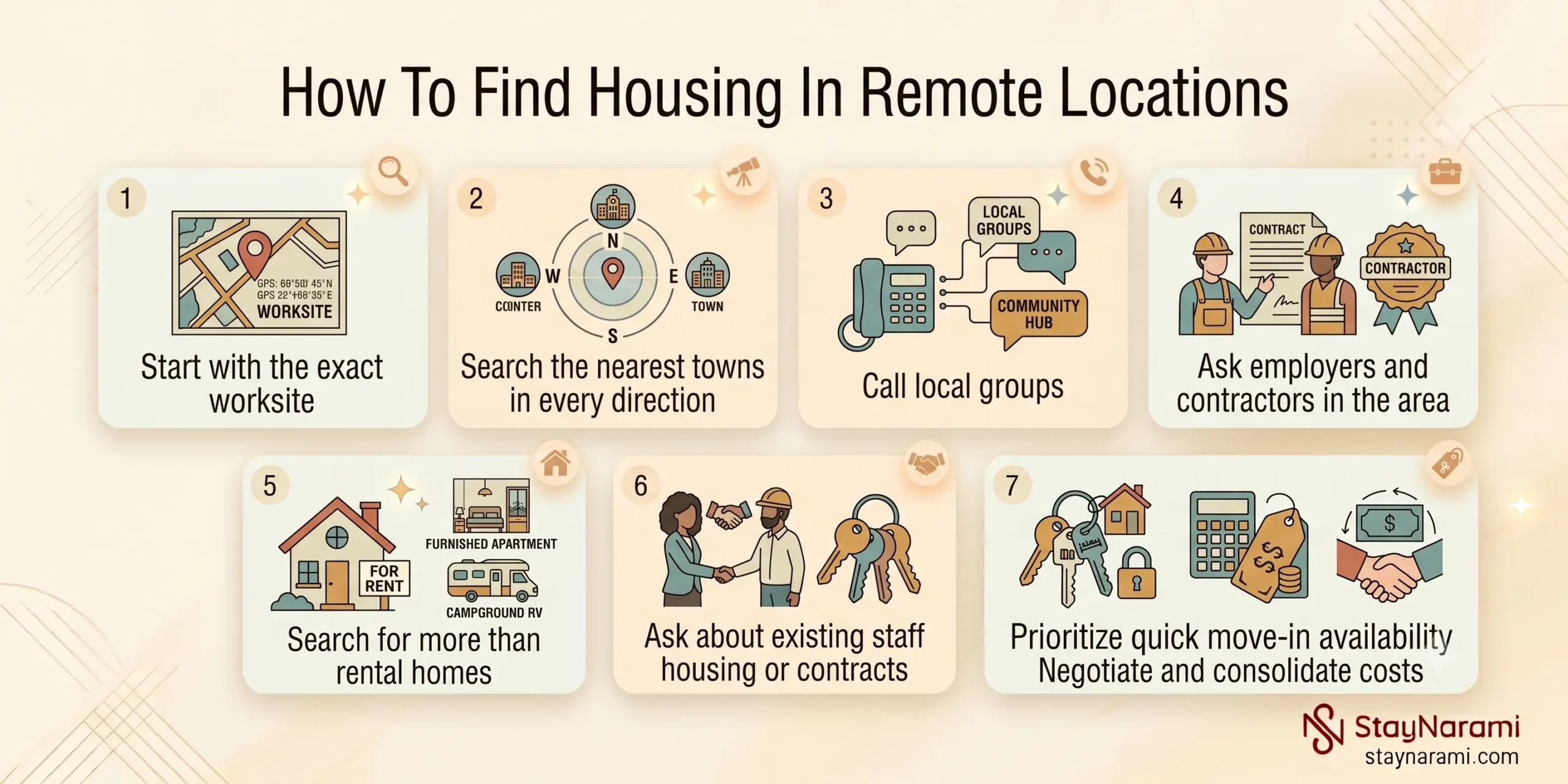
1. Start with the exact worksite
Do not begin your search with only the name of the nearest town. Search for the exact worksite address or map location first.
It is important because a town that may look close on a map can easily turn out to be an hour’s drive from the jobsite because of mountains, rivers, unpaved roads, or limited road access.
Use the worksite as the center of your search and then look at everything around that. Check housing within several driving areas:
Search area |
When it may work |
| 0 to 15 minutes | Best choice when available |
| 15 to 30 minutes | Usually, a reasonable daily drive |
| 30 to 45 minutes | May work when choices are limited |
| More than 45 minutes | Use only after checking the full cost and road safety |
Do not measure only straight-line distance. A property that is 15 miles away may take 40 minutes to reach.
Test the drive during the real shift hours. A quiet road at 2:00 p.m. may be busy with school traffic, farm vehicles, or shift workers early in the morning.
2. Search the nearest towns in every direction
Don’t look for a big city that is close. There may be a smaller town further in another direction which may offer better housing and a quicker road to the site.
Make a list of all towns within a reasonable drive. Search each one for:
- Hotels
- Motels
- Extended-stay rooms
- Furnished apartments
- Rental homes
- Cabins
- RV parks
- Campgrounds
- Workforce lodges
Some rural properties do not appear on large rental websites. A local motel, cabin owner, or landlord may only take bookings by phone.
3. Call local groups
Local people often know about housing that is not listed online.
Contact:
- The local chamber of commerce
- County offices
- Real estate agents
- Property managers
- RV park owners
- Campground managers
- Local hotels
- Large employers
- Hospitals
- Colleges
- Churches
- Hardware and building supply stores
A real estate agent may know an owner who is willing to rent a furnished home for three months. A hotel manager may know of nearby cabins or apartments. So it is best to approach them and ask for the space. Make sure you provide them with detailed information about your needs, including the number of people, dates, pets, and duration of your stay.
4. Ask employers and contractors in the area
Companies that often bring workers into the area may already know which housing options work.
Ask a local:
- Construction firms
- Utility companies
- Energy companies
- Farm operators
- Road crews
- Hospitals
- Factories
- Mining companies
They may know where to find hotels that offer extended stays, companies that provide parking for trucks, or landlords who provide accommodation for workers of temporary companies.
This is usually quicker than searching each listing one by one.
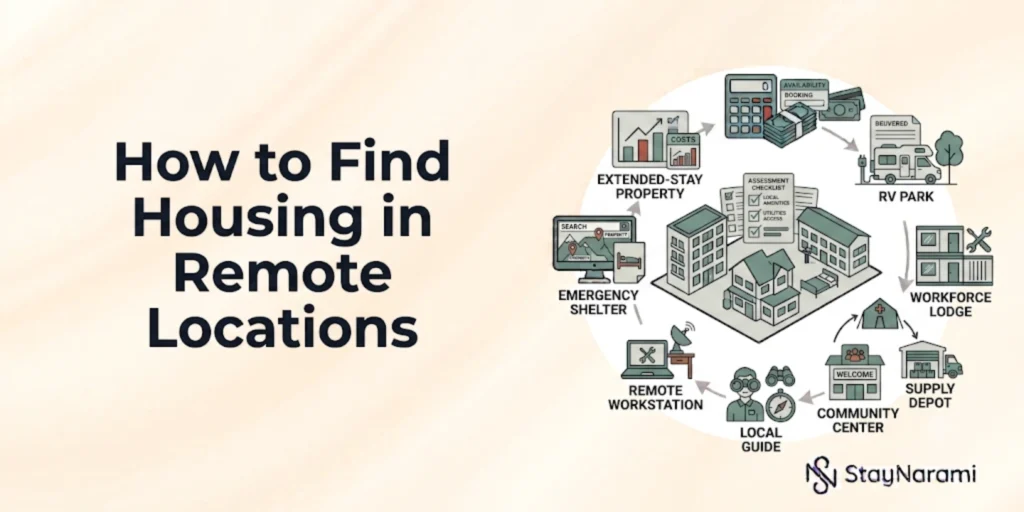
5. Search for more than rental homes
A standard rental home is not the only choice for temporary housing in rural areas.
The best option depends on the number of people and the duration of stay.
Housing type |
Best for |
Main benefit |
Main problem |
|---|---|---|---|
| Hotel or motel | A few days to two weeks | Easy to book | Can cost more over time |
| Extended-stay room | Two weeks to several months | May include a kitchen | Limited space |
| Furnished apartment | One to six months | More privacy | May have a minimum stay |
| Furnished home | Stable groups and families | Kitchen, laundry, and parking | Fewer choices in small towns |
| Cabin | Small teams in rural areas | May be close to the site | Internet may be weak |
| RV park | Mobile workers | Flexible and often close | Needs an RV and hookups |
| Workforce lodge | Larger work teams | Built for long worker stays | Not available in every area |
| On-site housing | Large, long projects | Removes most of the commute | Needs land, utilities, and setup |
A mix of housing types may work better than one option.
For example, the main crew may stay in two furnished homes. Short-term workers may use hotel rooms during the busiest weeks.
Book The Core Group First
Workforce numbers often change during a project. Ten workers may arrive first, six more may join later, and only four may stay for the final work.
Do not place every worker in a long lease before the schedule is firm.
Book stable housing for the core group first. Use flexible hotel or extended-stay rooms for people whose dates may change.
This lowers the risk of paying for empty beds.
Example
A project expects 14 workers for three months. Only eight workers are certain to stay for the full period.
A safer plan may be:
- One furnished home for eight core workers
- Three hotel rooms for the other six workers
- A plan to release the rooms when those workers leave
This gives the main crew stable housing without locking all 14 workers into a long rental agreement.
Remote Project, Limited Housing Options?
Explore furnished housing solutions for crews working in rural areas, small towns, and hard-to-reach locations where traditional rentals are limited.
Check The True Cost, Not Only The Rent
A low rental price can hide other costs.
Add all likely expenses before comparing properties:
- Rent
- Taxes
- Deposits
- Cleaning fees
- Utilities
- Internet
- Parking
- Laundry
- Furniture
- Fuel
- Tolls
- Meal costs
- Early move-out fees
An apartment with a kitchen may cost more than a motel. But workers can cook their own food and wash their clothes there. This may save money.
A home closer to the jobsite may also cost less in the end.
For example:
- Property A costs $3,400 per month. It is 35 miles from the jobsite.
- Property B costs $3,900 per month. It is 12 miles from the jobsite.
Property A is $500 cheaper. But it is 23 miles farther away.
For two vehicles traveling to work and back for 22 days:
23 miles × 2 trips × 2 vehicles × 22 days = 2,024 extra miles
If each vehicle gets 20 miles per gallon, the crew will use about 101 extra gallons of gas.
At $3.50 per gallon, the extra gas will cost about the following:
101 gallons × $3.50 = $354
After paying for the extra gas, Property A saves only about $146. It also adds more driving time and wear on the vehicles.
This is why you should compare the full cost, not only the monthly rent. The longer drive would also add vehicle wear and worker travel time. After these costs, the cheaper property may not save much.
Check The Road Before Booking
Remote roads can change with the weather. A road that is easy in summer may be difficult during snow, heavy rain, or freezing weather.
Before signing, ask:
- Is the road paved?
- Is it open all year?
- Does it flood?
- Is it cleared after snow?
- Can work trucks use it?
- Are there low bridges?
- Are there weight limits?
- Can trailers turn around?
- Is four-wheel drive needed?
Ask the property owner for a current video of the road and parking area. Listing photos may not show steep hills, mud, narrow gates, or low tree branches.
Check state and county road websites during bad weather.
Confirm Parking For Work Vehicles
Parking is one of the most common problems with remote worker housing.
A home may have enough bedrooms but space for only two cars. Your group may have pickups, vans, trailers, or large service trucks.
Ask for:
- Number of parking spaces
- Driveway size
- Trailer space
- Street parking rules
- Weight limits
- Commercial vehicle rules
- Space to turn around
- Safe tool storage
Do not accept “plenty of parking” as the full answer. Ask for exact measurements or a video.
A large pickup with a trailer needs more space than a normal car.
Test Phone And Internet Service
Don’t fully trust the internet’s availability claim. The availability of the internet and networks is very limited in remote areas. According to the statistics in the USA, around 15% of households did not have access to high-speed internet in 2023. The internet and network issues still exist and can get even worse in remote or rural areas.
Ask the owner to run an internet speed test inside the property itself to get a better understanding of the internet network.
Also ask:
- Which cell companies work at home?
- Does service work inside or only outside?
- Is Wi-Fi included?
- Is there a monthly data limit?
- Does the speed fall at busy times?
- Is there a backup internet option?
Reliable service may be needed for project reports, video calls, scheduling, payroll, and safety messages. Do not rely only on the words “internet available.” A weak connection may not support several workers at once.
Check Water, Power, And Basic Services
Some remote houses might have wells, septic tanks, propane tanks, etc. Although such systems might work properly, the rental party needs to understand how they work.
Ask the following questions:
- Is the water drinkable?
- Does the property have enough water for a large group of people?
- Who refills the propane tank?
- Is electricity included?
- Are power outages common?
- Is there a backup generator?
- How is trash collected?
- Who handles septic problems?
- And more about the things you’ll be needing.
Keep in mind that a house that is built for a family of 4 might not be a good choice for 12 people who’re going to live there, take showers, wash their clothes, etc. To avoid conflict, make sure the owner knows the number of guests beforehand.
Look Closely At The Beds And Bathrooms
Do not count bedrooms. Count real beds.
A three-bedroom home may have:
- One king bed
- One queen bed
- One twin bed
- One sofa
This does not always work for six workers.
Ask for a written list of every bed and its size. Also ask whether workers must share rooms or beds.
Bathrooms and restrooms matter too. One bathroom for eight workers may cause delays before an early shift. So, do check if they have the good bathroom facilities required for a group of people.
Ask About Kitchens And Laundry
A kitchen is very useful during long stays. It allows workers to make normal meals instead of eating at restaurants every day.
Check whether the property has:
- A full refrigerator
- A working stove
- A microwave
- Pots and pans
- Plates and cups
- Basic cooking tools
- Enough food storage
- A dining area
Laundry is an important issue too. Check if the washing machine and dryer can be used together by the crew on a daily basis.
If there is no laundry in the house, the best option will be to look for a nearby laundromat and hire them according to the need.
Review Safety And Emergency Needs
Remote housing should be safe, even when it is far from town.
Check for:
- Smoke alarms
- Carbon monoxide alarms
- Fire extinguishers
- Working door locks
- Outside lighting
- Safe stairs and railings
- Heating and cooling
- Emergency exits
- First-aid supplies
- A clear street address
Make sure emergency services can find the property. Some cabins and rural homes use private road names that do not appear correctly on every map.
Save the nearest hospital, urgent care center, fire department, and police contact before the group moves in.
Get The Terms In Writing
Verbal promises can be forgotten. Put every important detail in the rental agreement.
The agreement should explain:
- Full rental price
- Move-in and move-out dates
- Deposit amount
- Utility costs
- Cleaning fees
- Number of guests
- Parking rules
- Pet rules
- Extension process
- Early move-out fees
- Repair contact
- Cancellation terms
Ask whether the rent can be extended by the day, week, or month.
Remote projects often change because of weather, inspections, or material delays. Flexible terms can prevent a large fee later.
A Simple Remote Housing Checklist To Help You
Before booking, confirm:
Item |
Checked? |
| Real drive time to the worksite |
|
| Road and weather conditions |
|
| Number of real beds |
|
| Number of bathrooms |
|
| Parking for all vehicles |
|
| Kitchen and laundry |
|
| Phone and internet service |
|
| Water, power, and heating |
|
| Emergency services nearby |
|
| Full price and all fees |
|
| Extension and exit rules |
|
| Property ownership or rental rights |
|
Do not send a large payment until the main items have been checked.
Find the Right Housing Before the Crew Arrives
Share your worksite location, staffing schedule, required beds, vehicle details, and essential amenities to find practical nearby options.
Final Thoughts
Learning how to find housing in remote locations starts with good planning. Use the exact worksite as the center of the search, contact local people, compare several nearby towns, and look beyond normal hotels.
The best temporary housing in rural areas should provide safe roads, real beds, useful parking, working utilities, and a fair drive to the site. A slightly higher rent may be the better choice when it lowers fuel, meal, and travel costs.
StayNarami helps construction crews, project teams, contractors, and workforce managers with furnished temporary housing based on location, group size, length of stay, vehicle needs, and other daily needs. This can make the search easier when normal rental choices are limited. Contact us to learn more about your requirements.
Frequently Asked Questions
1. How early should I search for remote housing?
Start as soon as the worksite and expected dates are known. Large teams and long stays may need several weeks or months of planning.
2. Is it better to stay near the site or in a larger town?
It depends on the full cost. A larger town may have more services, but the daily drive may add fuel costs and worker travel time. Compare both choices.
3. What should I check before renting a rural home?
Check road access, parking, beds, bathrooms, internet, phone service, water, heating, laundry, emergency services, and all rental fees.
4. How can I avoid paying for empty beds?
Book long-term housing only for the core group. Use flexible hotel or extended-stay rooms for workers whose dates may change.
5. What if there is no housing close to the worksite?
Expand the search to towns in every direction. You may also need to combine rental homes, hotel rooms, cabins, RV spaces, or on-site units.
Need housing for your team?
Tell us what you need and we'll take care of the rest — anywhere in the U.S., 30+ days.
Request Housing →Related Articles