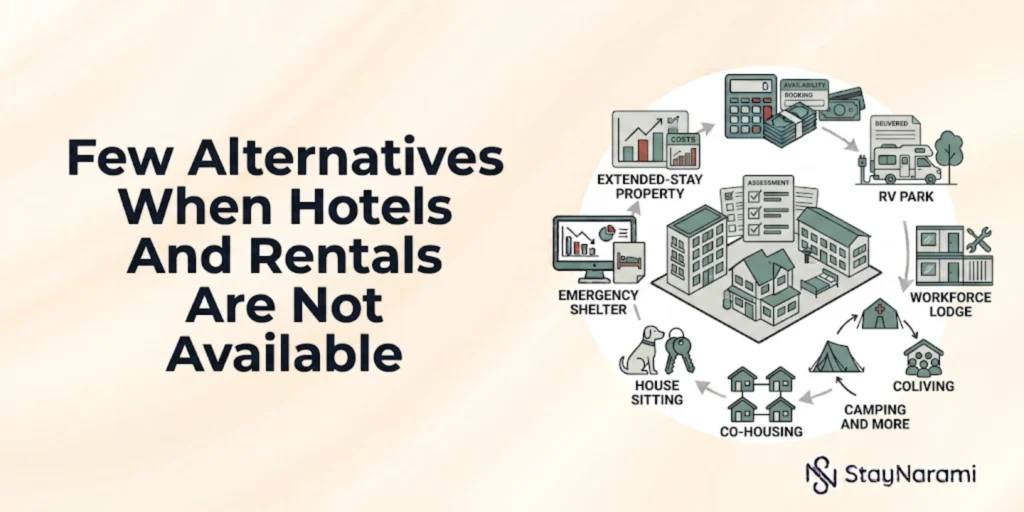
9+ Alternatives When Hotels And Rentals Are Not Available

No Hotels or Rentals Left Nearby?
Share your location, dates, group size, vehicle needs, and essential amenities to find practical furnished housing alternatives.
Hotels and rental homes are the top choices when it comes to finding a place for a temporary stay. But in a small town, remote area, or busy work location, they can fill up quickly. In May 2026, U.S. hotel occupancy reached 65.7%, and the average daily rate was $168.51, according to CoStar’s U.S. hotel performance report. However, national averages do not show what is happening in one small town, disaster area, or busy project market, where available rooms may fill quickly.
Benjamin Franklin once said, “An ounce of prevention is worth a pound of cure.” Looking at backup housing before you need it can make a difficult situation much easier.
When hotels and rental properties are fully booked or sold out, alternative housing options may still be available. Starting the search early can save time, lower stress, and help you avoid costly last-minute choices.
TL;DR (Too Long; Didn’t Read)
- Built for construction managers, workforce coordinators, displaced families, insurance teams, and anyone searching for temporary accommodation when hotels and traditional rentals are unavailable.
- Answers the key questions: What alternatives are available when local rooms are fully booked? How far should you expand the search? Can cabins, RV parks, workforce lodges, dormitories, shared homes, or modular units provide suitable housing? And how do you compare their true costs?
- The solution is to widen the search beyond the main town, contact local property owners and organizations, consider a mix of housing types, and compare every option based on safety, commute time, amenities, flexibility, and total cost.
- U.S. hotel occupancy reached 65.7% in May 2026, with an average daily rate of $168.51. However, availability can be far more limited in small towns, disaster areas, seasonal markets, and locations supporting major projects.
- In this guide, you will explore more than nine hotel and rental alternatives, learn how to calculate additional travel costs, avoid housing scams, verify safety, split larger groups between properties, and create a backup plan before local vacancies disappear.
Why Normal Housing May Not Be Available
Understand that with lots of visitors coming at the same time during peak seasons, hotels and rental homes can get booked up really fast. This can occur due to:
- A large construction project
- Road, bridge, or utility work
- A sports event or festival
- Tourist season
- Farm or harvest work
- A military move
- A factory shutdown or repair project
- College events
- Local housing shortages
Small towns/cities have accommodation limitations; they might have space with 1 or 2 rooms, but that’s not enough for a crew. A town may also have many vacation homes, but the owners may not offer them for rent.
When the normal choices are full, expand the search before accepting a long daily drive or an unsafe place to stay.
The U.S. Census Bureau recently reported that 7.3% of all rental dwellings were vacant in the first quarter of 2026. But these houses were not distributed evenly throughout the nation. There can be numerous rentals within one town. Either may be practically zero or none at all.
Quick Comparison Of Housing Alternatives In 2026
Housing choice |
Best for |
Main benefit |
Main concern |
| Extended-stay property | Stays of several weeks | Kitchen and flexible terms | May be outside the town |
| Cabin or lodge | Rural and outdoor areas | Often near remote jobsites | Internet may be weak |
| RV park | Workers with RVs | Flexible and sometimes close | Needs safe hookups |
| College dorm | Summer or school breaks | Can hold larger groups | Limited dates |
| Workforce lodge | Construction and project teams | Made for longer worker stays | Not found in every area |
| Modular housing | Large and long projects | Can be placed near the site | Needs setup and approval |
| Shared home or rented rooms | Small teams and individuals | May open more choices | Less privacy |
| Nearby town | Families and work teams | More housing choices | Longer travel time |
| Emergency shelter | Urgent family needs | Fast help during a crisis | Short-term only |
Best Alternatives When Hotels And Rentals Are Not Available In 2026
1. Search outside the main town
The first step is to widen the search area. Do not search only in the town named on the job order, insurance claim, or event notice. Check every town within a reasonable drive. Test the route during the real travel time.
Do not choose a town just because it looks closer on the map. The road matters too. A distance shown on the map can be misleading sometimes. A place farther away may still be a quicker drive if the road is better. When searching for remote housing, check towns in every direction from the job site, hospital, school, or damaged home. Focus on actual travel time and look for housing that can be reached in about 15 to 60 minutes.
A road that is clear in the afternoon may be blocked during the morning shift or during school hours. Before booking, inquire about winter snowfall, flooding, roadworks, bridges, tolls, and unpaved roads.
2. Look for extended-stay housing
Extended-stay properties are like a hotel, with the added distinction that they are designed for longer stays.
Rooms may include:
- A small kitchen
- A refrigerator
- A microwave or stove
- Laundry access
- A work area
- Prices per week/month
Also, check other nearby towns near the airports and workplaces. Though hotels may be fully booked, there may still be room left at an extended-stay hotel.
Before making your reservation, ensure that there are no additional costs. For instance, parking, Wi-Fi, cleaning, laundry services, and taxes may not be included in the quoted rate. These little charges can quickly mount up.
3. Contact cabin and lodge owners
Open space is available at cabins and fishing lodges, hunting lodges, guest ranches, and vacation parks, not during the busy season. The amenities may be convenient in a rural setting where there is less hotel accommodation. Before booking, check:
- Safe water
- Kitchen access
- Real beds
- Bathrooms
- Laundry
- Road conditions
- Phone service
- Internet speed
- Parking
- Access to shops and healthcare facilities
4. Check RV parks and campgrounds
As a family or an employee, if you already have an RV, you may choose to use RV parks as an option. Several parks have weekly/monthly rentals. They may provide:
- Electricity
- Water
- Sewer hookups
- Showers
- Laundry
- Internet
- Parking
- Propane service
Ask whether the park is open during the full stay. Some campgrounds can be closed during the winter or limit how long a guest may remain.
Add up every cost before choosing an RV. This includes the RV payment, campsite fee, fuel, propane, insurance, repairs, and utilities. Planning to park on private land? Ask the owner first. You should also check local parking and zoning rules before staying there for a long time.
5. Search for workforce lodges
The construction housing facilities accommodate workers who come to work in construction, energy generation, mining, agriculture, and industry. They may offer:
- Private or shared rooms
- Meals
- Laundry
- Parking for work vehicles
- Weekly cleaning
- Internet
- Long-stay prices
There is a high chance that these properties may not even be listed online on websites. Search for terms such as:
- Workforce lodging
- Crew housing
- Worker accommodation
- Project housing
- Man camp
- Industrial housing
Ask local contractors, utility companies, and large employers whether they know of workforce housing nearby.
6. Consider modular or on-site housing
For a large project lasting several months, temporary modular units may be placed near the worksite.
These units may include:
- Bedrooms
- Bathrooms
- Kitchens
- Dining rooms
- Laundry areas
- Office space
Living near the jobsite could save a lot of time, although a lot of preparation would be necessary. First, the site would need to be cleared. Electricity, water, sanitary facilities like toilets and sewage systems, firefighting facilities, cleaning, and waste disposal would also be required.
This option usually works best for a large and stable group. It may cost too much for only a few people.
7. Rent rooms instead of a full home
A full rental home may not be open, but separate rooms may still be available.
Search for:
- Rooms in private homes
- Guesthouses
- Basement apartments
- Accessory dwelling units
- Farm stays
- Bed-and-breakfast rooms
- Boarding houses
Room rent is an option worth considering if there is only one or a few workers in the crew. Room rent may be inconvenient for families who need greater privacy or multiple rooms.
Check local rental rules and read the written agreement before signing it.
Split The Group Between Several Properties
A large team does not always need to stay in one building.
For example, a 16-person crew may not find one large rental. It may be easier to book:
- One cabin for six people
- One house for six people
- Two extended-stay rooms for four people
This plan takes more work, but it may solve the housing problem faster.
It would be wise to group workers who will be working together on the same shift in the same place. Those working on the night shift would need a quiet place to sleep during the day.
It is a good idea to appoint one person as a point of contact managing all the addresses, payments, check-in dates, etc.
Contact Local Groups For Unlisted Housing
Some housing is never posted online. Local people may know about empty homes, cabins, rooms, or apartments.
Contact:
- Real estate agents
- Property managers
- The chamber of commerce
- County offices
- Local employers
- Churches
- Hospitals
- Colleges
- Campground owners
- Building supply stores
- Community groups
Be upfront about your visit. Provide information on the number of occupants, dates of travel, animals, transportation, budget, and your housing reasons.
A property owner may be willing to offer a short lease when they understand that the stay has clear dates and payment terms.
Compare The True Travel Cost
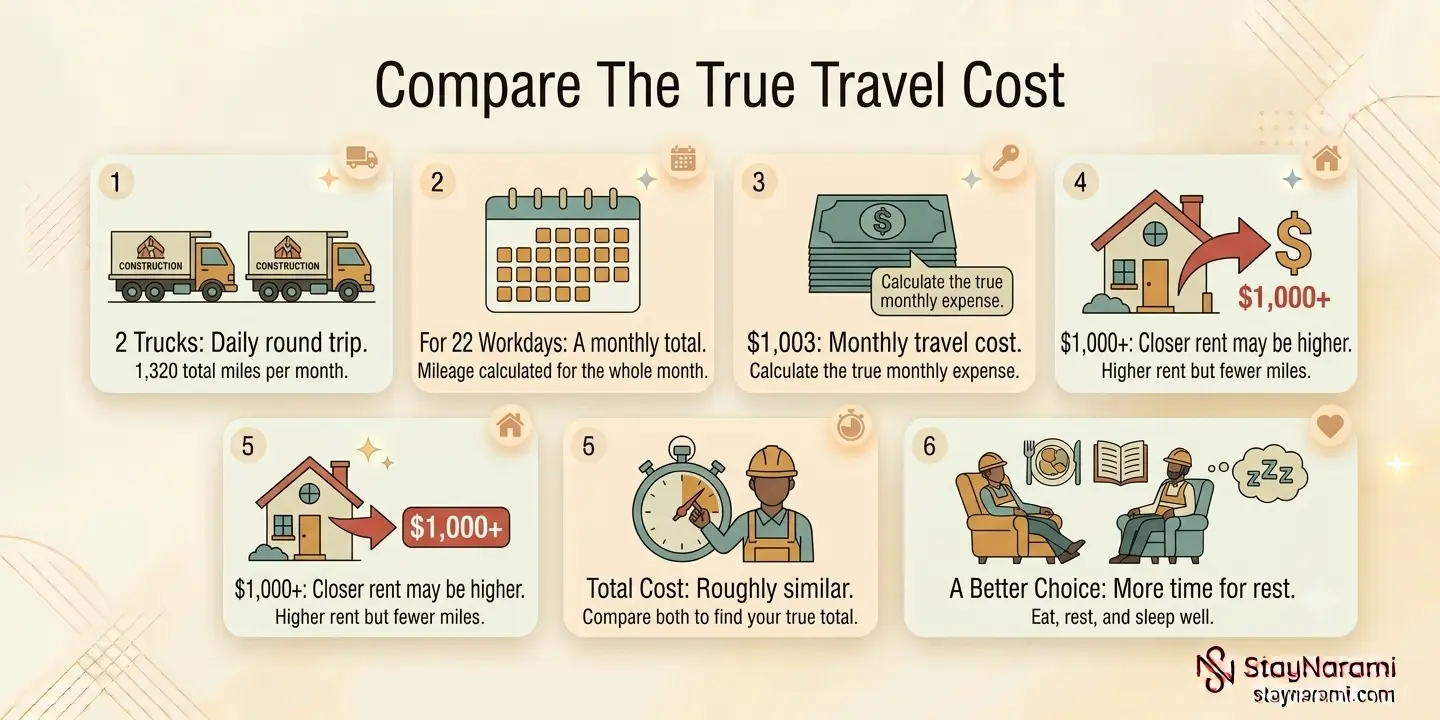
Housing in another town may seem like the only choice. Before booking it, calculate the full travel cost.
The federal business mileage rate is 76 cents per mile. This rate does not show the exact cost of every truck. It can still help you estimate travel costs.
For example, suppose the longer drive adds 30 miles to each truck’s daily round trip. Two trucks make this trip for 22 workdays.
30 miles × 2 trucks × 22 days = 1,320 miles
Now multiply the miles by 76 cents:
1,320 miles × $0.76 = $1,003.20
The longer drive may cost about $1,003 per month.
A closer home may cost $1,000 more in rent. Even so, it may be the better choice. The total cost would be about the same, and workers would spend less time driving.
A shorter drive also gives workers more time to eat, rest, and sleep.
Limited Availability Shouldn’t Mean Longer Commutes
Explore temporary housing solutions for small towns, rural communities, and hard-to-reach locations where standard accommodation is limited.
Check Safety Before Booking
A housing shortage should not lead to an unsafe choice.
Before paying, check:
- Smoke alarms
- Carbon monoxide alarms
- Working door locks
- Safe water and power
- Heating and cooling
- Clean bathrooms
- Fire exits
- Parking
- Road access
- Number of real beds
- Number of guests allowed
- Local rental rules
Hotels and motels listed on the federal Hotel-Motel National Master List meet certain fire safety rules, including smoke alarm requirements. Buildings four or more stories high must also have automatic sprinkler systems in guest rooms to qualify for the list.
For homes, cabins, dorms, and RV parks, ask the owner for safety records and current photos.
Watch For Housing Scams
Housing scams become more common when people are under pressure.
Be careful when:
- The price is far below other choices
- The owner will not speak by video
- You cannot confirm the address
- The photos appear on several listings
- The owner will not provide an agreement
- Payment must be made by gift card or wire transfer
- You are pushed to pay within minutes
- Important questions are ignored
Check public property records when possible. Use a payment method that creates a clear record.
Never send a large deposit based only on photos and text messages.
A Simple Backup Housing Plan
Imagine that 12 workers need housing for eight weeks. All hotels and normal rentals near the site are full.
The project manager finds:
- One cabin with beds for four
- Four spaces at a nearby RV park
- Two furnished rooms in a private guesthouse
- Two rooms at an extended-stay property 35 minutes away
This mixed plan is not as simple as one large rental, but it gives every worker a safe bed.
The manager keeps the core workers in the cabin and RV park. The extended-stay rooms are used for workers whose dates may change because they are easier to cancel.
This is often the best way to handle housing alternatives when no vacancy is available in one property.
Find a Backup Before Every Room Is Taken
Tell us where you need to stay, how many people are traveling, and how long housing is required to explore suitable nearby options.
Final thoughts
If standard hotels and rental homes are full, widen the search to extended-stay properties, cabins, RV parks, workforce lodges, college dorms, shared rooms, on-site units, and nearby towns.
The ideal distance is determined by safety, distance, time away, daily needs, and cost. Go from drilling the easier questions first. Widen the map. Call local people. Ask for referrals. Look at the total price, rather than just the room cost.
This week, make a small backup list before you need it. Save two nearby towns, three local motels, one furnished housing contact, 211, the nearest shelter finder, and a few RV or cabin options. It may feel unnecessary today. On a no-vacancy day, it can save hours.
StayNarami can help families, insurance teams, and traveling work crews search for furnished housing based on their location, dates, group size, pets, and daily needs. This can be useful when normal hotel rooms and rental homes are already full. Contact us for more information; we’re here to help you with the best.
Frequently Asked Questions
1. Can a work crew stay at an RV park?
Yes, when workers have suitable RVs and the park allows long stays. Check water, power, sewer, laundry, parking, and stay limits.
2. Do colleges rent dorm rooms to outside groups?
Some colleges rent dorms during summer or school breaks. Contact the school’s housing or conference office.
3. Can several smaller properties be used for one group?
Yes. A large group can be split between homes, cabins, RV spaces, or extended-stay rooms. Keep people on the same work shift together when possible.
4. Where can a displaced family get emergency housing help?
Families can use HUD’s Find Shelter tool or call 2-1-1. After a declared disaster, eligible families may also receive certain types of FEMA housing help.
5. What is the best housing alternative for a long project?
A furnished home, workforce lodge, modular unit, or RV park may work well for a long stay. The best choice depends on the group size and local services.
Need housing for your team?
Tell us what you need and we'll take care of the rest — anywhere in the U.S., 30+ days.
Request Housing →Related Articles