How to Optimize Housing Costs for Large Teams

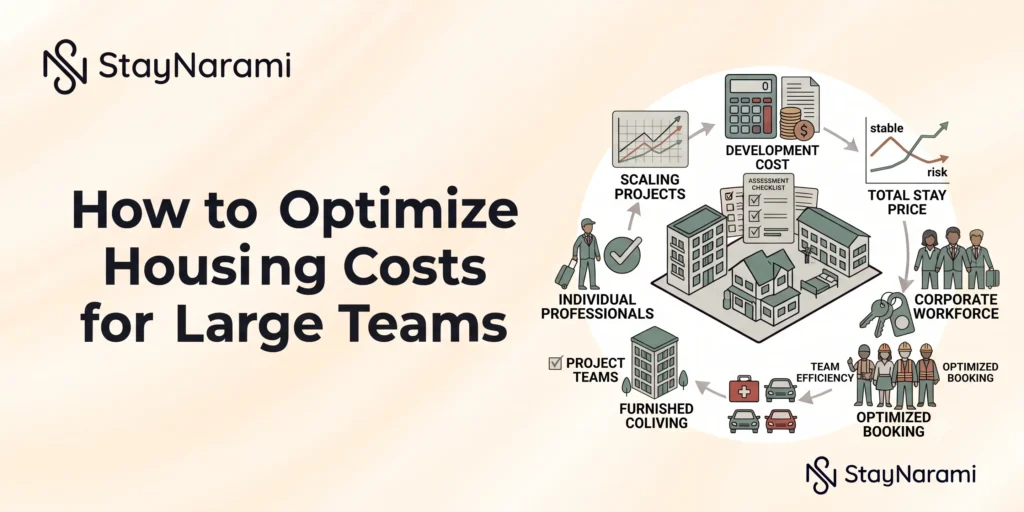
Stop Paying for Empty Beds and Extra Miles
StayNarami helps you plan team housing around actual headcount, project phases, worksite location, and vehicle needs so more of your budget goes toward occupied housing.
Housing ten‚ twenty‚ or fifty employees that are only temporarily out of town for work can be costly․ In many cases‚ room rates are the least of a company’s worries․ The high costs are often a result of things like parking‚ utilities‚ housekeeping‚ taxes‚ vacancies‚ last minute date changes‚ and commute times․
That is why a cautious approach is needed.
The average daily rate for a U․S․ hotel in May 2026 was $ 168.51, according to CoStar’s U.S. hotel performance data․
At that rate‚ 10 rooms for 30 days would have cost $50‚553‚ excluding parking‚ taxes‚ laundry‚ utilities, and other fees․
Lodging is usually the largest category of business travel spending․
In 2023‚ the Global Business Travel Association estimated US501billion(37%)ofglobalbusinesstravelspendingwenttolodging‚outoftotal2023spendingofUS 1.34 trillion.
For employers moving construction workers‚ contractors‚ government employees‚ consultants‚ or a whole project team‚ corporate housing costs per employee begin with a different question: not “What is the cheapest room?” but rather “What is the lowest practical total cost for every worker we need to house?”
TL;DR (Too Long; Didn’t Read)
Built for project managers, operations teams, finance teams, and employers trying to control housing costs for groups of 10, 20, or even 50+ workers.
The biggest savings rarely come from choosing the cheapest room. They come from improving bedroom utilization, reducing unnecessary commutes, booking the team together, negotiating longer stays, and avoiding repeated fees across scattered properties.
At May 2026’s average U.S. hotel rate of $168.51 per night, just 10 rooms for 30 nights would cost about $50,553 before taxes, parking, laundry, and other expenses.
This guide shows you how to calculate corporate housing cost per employee, compare all-in vendor pricing, reduce unused housing, and build a more efficient budget for large project teams.
What Is the Average Corporate Housing Cost Per Employee?
There is no dependable national average that applies to every corporate housing stay.
The price of a furnished apartment in a small Texas market can differ substantially from another furnished apartment in an area adjacent to job sites‚ such as Boston‚ New York‚ or San Francisco․ Prices depend on the number of bedrooms‚ desired length of stay‚ parking‚ utilities‚ furniture‚ pet policies‚ the season‚ and total units booked․
One recent National Corporate Housing cost worksheet estimated that a 30-day self-managed business stay in a mid-range market could total $4,705 to $11,575+, including housing, utilities, fees, parking, internal administration, and changes. The example included one pet and one itinerary change, so it should be treated as a planning example rather than a national average.
Another useful benchmark comes from the federal government. For FY2026, the GSA standard lodging allowance is $110 per night in most continental U.S. locations, although roughly 300 higher-cost areas use separate rates.
However‚ for companies‚ the more useful measure is:
Corporate housing cost per employee = Total housing-related cost ÷ Number of employees housed
If a furnished apartment for the month costs $7‚500 and parking and other expenses total $500‚ and five employees share‚ then:
$8,000 ÷ 5 employees = $1,600 per employee per month
This number lets you compare very different types of housing on equal terms․
Why Do Housing Costs Increase When Managing Large Teams?
Housing prices‚ however‚ have not always risen with team populations․ A group of 10 could‚ for example‚ rent five two-bedroom apartments at a lower cost per person‚ instead of 10 hotel rooms‚ if put together poorly. However, poor planning can produce the opposite result.
Large-team costs usually rise because of:
- Employees being booked separately instead of as one group
- Empty bedrooms in poorly matched units
- Different rates across multiple properties
- Daily parking charges
- Cleaning and move-in fees on every unit
- Long drives between housing and the worksite
- Early departure or cancellation penalties
- Project extensions booked at higher last-minute rates
- Staff time spent handling several landlords, invoices, and problems
National Corporate Housing estimates that parking alone may run $10 to 20+perday<spanstyle=”font-weight:400;”>insomeself-managedhousingsituations,whilecleaningmaycost90 to $250 per month. Those costs become meaningful when repeated across many employees or units.
How Do I Calculate Corporate Housing Cost Per Employee for My Team?

Start with the full housing bill rather than rent alone.
Use this formula:
Total monthly housing cost = Rent + utilities + internet + parking + taxes + cleaning + deposits or fees + transportation + housing administration
Then divide that figure by the number of employees actually using the housing.
Cost |
Monthly Amount |
| Furnished housing | $24,000 |
| Parking | $1,200 |
| Utilities/Wi-Fi | Included |
| Cleaning | $800 |
| Housing administration | $500 |
| Transportation related to housing | $1,500 |
| Total | $28,000 |
If 14 employees use that housing:
$28,000 ÷ 14 = $2,000 per employee per month
This approach also exposes unused capacity. If the same $28,000 setup houses only ten workers, the corporate housing cost per employee rises to $2,800.
Rent is largely determined by occupancy levels․
What Factors Affect Corporate Housing Cost Per Employee at Scale?
Several variables have an outsized effect when dozens of workers are involved.
1. Length of Stay
Longer assignments may make monthly furnished housing more practical than paying a nightly hotel rate.
Unlike temporary hotel housing‚ the GSA’s long-term housing program provides accommodation for stays of 30 days or more‚ mainly in the form of furnished apartments‚ buildings‚ and condominiums․
2. Location
Therefore‚ a property ten minutes from the site of work may be more expensive than a property 45 minutes from the worksite‚ after factoring fuel‚ mileage‚ vehicle, and paid travel-time costs․
3. Bedroom Use
Your price per person goes up right away for every bedroom you’re paying for that sits vacant․ Too many workers under one roof can create a strain on privacy‚ rest‚ occupancy‚ and scheduling․
4. Included Services
Always check whether the quoted rate includes:
- Furniture
- Electricity and water
- Internet
- Parking
- Laundry
- Housekeeping
- Cleaning
- Maintenance
- Taxes or fees
Two properties with the same advertised rent can have very different final costs.
5. Schedule Flexibility
Projects move. Workers may arrive late, leave early, or stay longer.
StayNarami’s own housing model focuses on furnished housing for 30 days or longer, with terms designed around project timelines and team requirements.
How Can I Reduce Corporate Housing Costs for Large Teams?
These savings are mainly achieved by planning the entire group together․
First, map your headcount by date. You may have 24 workers during the busiest phase but only 10 during the first month and 12 during closeout. Booking housing for the peak number throughout the entire project wastes money.
Next, calculate the cost per occupied bedroom rather than only the cost per property.
Then compare locations using total commuting cost. Saving $1,000 per month on housing is not a saving if vans, fuel, mileage, and labor time increase by $1,500.
You should also negotiate based on the total value of the booking. A company booking several units for three months gives a housing provider more predictable occupancy than one person booking one apartment for 30 days.
Finally, centralize bookings. Keeping employees in the same property or a small group of nearby properties makes transportation, invoicing, check-ins, extensions, and communication easier. StayNarami already recommends this approach for construction crews because scattered housing can create different commute times, multiple invoices, transportation problems, and uneven living arrangements.
Find Where Your Housing Budget Is Really Going
StayNarami helps you look beyond room rates and understand how occupancy, parking, transportation, utilities, cleaning, and stay length affect your true temporary housing cost.
Should I Choose Shared Housing or Individual Units to Optimize Costs?
Shared housing usually lowers corporate housing cost per employee when bedrooms are used efficiently, but the cheapest possible layout is not always the right one.
Every unit affords more privacy‚ but also adds more rent ‚ utility accounts‚ parking spaces‚ cleaning fees‚ and move-ins over time․
Shared accommodation can allow costs to be divided among several workers․
Ten individual accommodations‚ at a cost of $3000 each per month‚ would cost $30‚000 per month․
However‚ if the ten workers could share five suitable two-bedroom units worth $4500 each‚ then the cost is $22‚500․
That is:
- Individual arrangement: $3,000 per worker
- Shared arrangement: $2,250 per worker
- Difference: $750 per worker per month
For ten employees on a three-month assignment, the difference becomes $22,500.
This is only an illustration, since actual market rates will vary, but it shows why bedroom utilization deserves attention.
How Do Group Bookings Help Lower Corporate Housing Cost Per Employee?
Group bookings give you something individual travelers usually do not have: volume.
Instead of asking, “What does this apartment cost?” ask providers to quote the whole housing requirement.
Provide:
- Number of workers
- Required bedrooms
- Arrival and departure dates
- Possible extension period
- Vehicle count
- Worksite location
- Maximum commute
- Required amenities
A provider may be able to combine several employees into larger units, negotiate monthly terms, reduce repeated fees, or place several properties close together.
Dwellworks reported after the 2026 CHPA conference that professionally managed furnished accommodations can offer up to 20% savings compared with hotels in some longer-stay markets, although actual savings depend on location and booking requirements.
How Do I Compare Vendors to Get the Best Rates for Large Team Housing?
Do not compare only the headline rent.
Compare the all-in cost per employee using the same assumptions for every vendor.
Ask each provider for:
- Total monthly price
- Number of employees the property can reasonably house
- Utilities included
- Parking charges
- Cleaning charges
- Deposits
- Taxes
- Extension terms
- Early-departure terms
- Cancellation rules
- Distance from the worksite
- Support when something goes wrong
Benjamin Graham’s well-known lesson, quoted by Warren Buffett, fits housing decisions surprisingly well:
“Price is what you pay; value is what you get.”
A property which costs $300 more but provides parking‚ internet usage‚ utilities‚ laundry‚ and a shorter commute‚ could be more helpful than a property which does not include them․
What Mistakes Should I Avoid When Budgeting Housing for Large Teams?
The most common mistake is to multiply the nightly rate times the number of workers to get the housing budget․
That leaves out the costs that appear later.
Watch for unused nights, empty bedrooms, parking charges, duplicate bookings, deposits, nonrefundable terms, transport costs, cleaning fees, and internal time spent fixing housing problems.
National Corporate Housing found that administrative overhead, itinerary changes, cancellations, and issue management can add meaningful amounts to a single stay. At scale, those small charges are repeated across the workforce.
Another issue is that every employee is scheduled for the same dates as locked dates․ Project staffing throughout the life of the project usually builds up and tapers down․
How Do I Track and Manage Housing Costs Across Multiple Employees?
Use one simple housing sheet or system for the entire project. Track the property‚ employee‚ starting date‚ end date‚ monthly cost‚ fees‚ number of occupied bedrooms‚ and cost per worker․
The most useful numbers are:
- Monthly housing spend
- Cost per occupied bedroom
- Corporate housing cost per employee
- Unused housing cost
- Transportation cost per employee
- Total project housing cost versus budget
Review these numbers whenever headcount changes. You should always be able to look at these numbers whenever the headcount changes so you can quickly tell whether you can eliminate or reassign their bedrooms‚ or allocate them elsewhere․
Lower the Cost Per Employee, Not the Comfort
Share your team size, project dates, worksite, budget, and housing requirements with StayNarami to find furnished options that use your housing spend more efficiently.
Conclusion
Housing a large team can mean more than just finding the lowest posted price: each housing dollar can be stretched further․
To economize: tally the costs‚ divide by the number of employees actually staying‚ align the number with the space‚ minimize travel‚ negotiate with a group rate‚ and avoid paying for unused rooms or being stuck with set dates․
When those decisions are made in advance‚ corporate housing cost per employee can be more precisely estimated even for a project that may last for several months or have a fluctuating employee population.
Frequently Asked Questions
1. What is the average cost of corporate housing per employee?
There is no standard rate. A month in Houston can cost very differently from a month in San Francisco, and the price changes again when several employees share a home. The simplest way to compare options is to look at the total housing cost per worker.
2. Is shared housing cheaper for large teams?
It often is․ Having three or four workers share a multi-bedroom home means splitting rent and utilities‚ and Wi-Fi costs among multiple people․ It is sensible given the crew‚ given the bedroom layout‚ given the number of people․
3. How can companies spend less on workforce housing?
Start the search early. The more time you have to look‚ the more property options you have and the less pressure․ Sharing‚ renting by the month‚ and getting as close to the jobsite as possible are other options that may help․
4. What should companies check before booking housing for a traveling team?
Don’t just think about the rent: commute times‚ parking availability‚ laundry facilities‚ access to a kitchen‚ utilities, and how flexible they can be about you leaving when your project is done can matter․
5. Can companies negotiate better rates for larger bookings?
Sometimes․ A provider knows the full requirement up front: headcount‚ date‚ location‚ number of properties‚ expected length of stay‚ etc․ Longer stays or a greater number of units may mean a better deal from providers․
Need housing for your team?
Tell us what you need and we'll take care of the rest — anywhere in the U.S., 30+ days.
Request Housing →Related Articles