How We Source Housing Nationwide

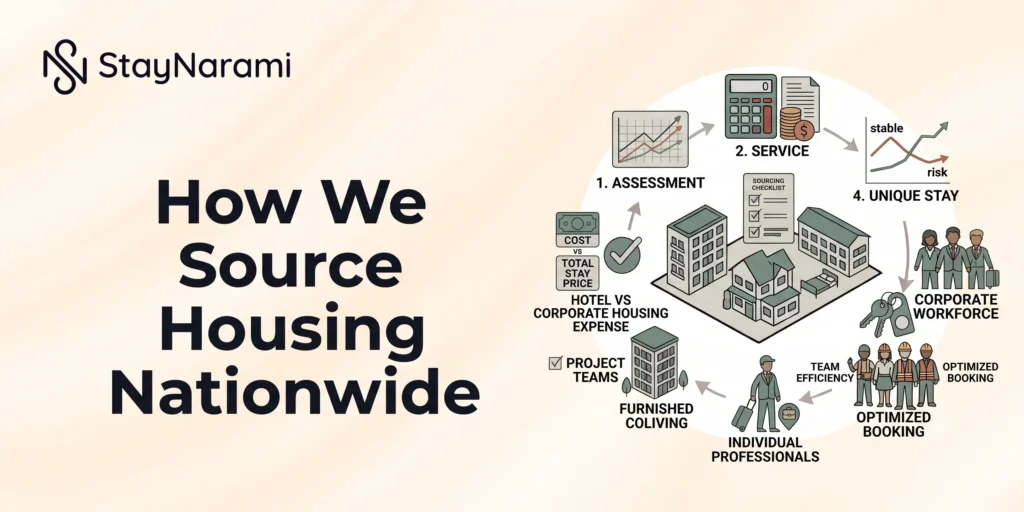
One Housing Request, Wherever Work Takes You
StayNarami sources furnished 30+ day housing around your project location, team size, dates, vehicles, budget, and commute requirements across the U.S.
A project can begin in Dallas this month and send another crew to a small town in Ohio next month. A government contractor may have employees working in three states at the same time. A corporate team may know the city where people need to stay, but not which neighborhood makes sense, what furnished homes are actually available, or whether those properties can support a three-month assignment.
This is the real challenge behind nationwide housing. Having a long list of properties is not enough. Housing has to be found around the actual people, place, dates, vehicles, budget, and work they are traveling for.
And there are a lot of people moving around the country for work. The Global Business Travel Association found that nearly 488 million business trips were taken across the United States in 2024, with business-travel activity reaching every state.
TL;DR (Too Long; Didn’t Read)
- Built for construction companies, government contractors, corporate teams, and operations managers who need furnished housing in different cities or states.
- Nationwide housing works best when the search starts with the actual assignment: location, headcount, dates, budget, vehicles, commute, amenities, and possible extensions. StayNarami then sources suitable 30+ day housing around those requirements rather than relying on a fixed list of properties.
- The real value is consistency. Companies can use one repeatable housing process even when the next project moves from a major city to a small or hard-to-find market.
- This guide explains how StayNarami sources properties, evaluates housing partners, matches homes to different project needs, coordinates move-ins, and supports multi-state housing requirements.
For construction companies, the pressure can be even greater. A 2025 Associated General Contractors of America workforce survey found that 92% of construction firms that were hiring had trouble finding qualified workers, while 45% said labor shortages had caused project delays.
AGC Chief Economist Ken Simonson put the issue plainly:
“Construction projects of all types are being delayed because there aren’t enough qualified workers available for firms to hire.”
Criteria for construction housing include distance to site‚ type of vehicle‚ number of workers‚ and available lodging․
That is where a nationwide corporate housing provider becomes useful. StayNarami sources furnished housing across all 50 states for construction crews, government agencies, corporate teams, and other clients needing stays of 30 days or longer. The location may change, but the goal stays the same: find housing that works for the assignment rather than making the assignment work around whatever housing happens to be available.
What Makes Us a Nationwide Corporate Housing Provider?

Being nationwide does not mean keeping the same type of apartment in every U.S. city.
That would not work.
A four-person corporate team working in downtown Boston may need two furnished apartments within a short commute of an office. A 16-person construction crew in rural Indiana may care far more about separate beds, kitchens, laundry, truck parking, and access to the project site. A government team may have its own documentation and housing requirements.
The housing has to change with the assignment.
StayNarami deals directly with property owners in the U.S. and obtains homes depending on current needs of clients. Its property program accepts furnished apartments, townhomes, and single-family homes, provided they meet the requirements of the stay. Properties are matched against active or upcoming housing needs rather than being accepted simply because they are available.
That request-based approach matters.
Large nationwide providers often operate in a similar way. They combine established housing relationships with local market searches instead of relying only on properties they own. Sirva, for example, operates a nationwide provider database and can send housing requests to network properties in a market, while National Corporate Housing describes using vetted inventory and local teams to secure housing near client worksites.
For the client, the important part is simple: you should not need to become a housing expert in every city where your company works.
How Do We Source Housing Across Different US Cities?
Search begins when you are assigned a rental list to consult for your next inquiry․ Before practical housing can be found‚ several details must be resolved․
What We Need to Know |
Why It Changes the Search |
| Exact work or project location | Determines the practical search area |
| Number of people | Determines beds, bedrooms, and unit count |
| Arrival and departure dates | Removes properties that cannot cover the full stay |
| Expected length of stay | Helps determine suitable lease terms |
| Monthly budget | Keeps the search financially realistic |
| Number and type of vehicles | Affects parking requirements |
| Preferred commute | Prevents unsuitable properties too far from the site |
| Required amenities | Helps confirm kitchens, laundry, Wi-Fi, furniture, and other needs |
| Possible project extension | Helps avoid problems if the assignment runs late |
StayNarami’s housing request process already asks for core information such as location, number of people, start date, length of stay, and monthly budget. For construction housing requests, it may also include distance to site‚ vehicle type‚ crew size and number‚ and housing type․
Once those details are known, the search can be built around the actual project area.
That distinction becomes important outside major cities. If a crew is working 50 miles from Nashville, finding a beautiful apartment in downtown Nashville does not necessarily solve the housing problem. The commute may be too long, parking may be difficult, and the team may spend unnecessary time on the road every day.
When these details are known, the search can begin to focus on the project area․
What Criteria Do We Use to Select Housing Partners and Properties?
Availability alone does not make a property suitable for a working team.
StayNarami publicly lists several requirements for property partners. The housing should be furnished, clean, safe, functional, well-maintained, and suitable for working professionals. Utilities and Wi-Fi need to be active or capable of being set up before occupancy, and properties generally need to be available for at least 30 days.
Pricing matters too. A property priced far above the surrounding market may not make sense simply because it meets the other requirements. StayNarami states that it looks for pricing aligned with local market conditions.
Communication also counts.
A good property can still create problems when the owner cannot be reached while move-in details are being confirmed or when something needs attention during a stay. For that reason, clear and timely communication is part of StayNarami’s stated partner criteria.
In practical terms, the first check looks something like this:
- Does the home fit the people?
- Does it fit the project?
- Does it fit the dates?
- Does it fit the budget?
- Can it be ready when the team arrives?
If one of those answers is no, the search needs to continue.
How Do We Ensure Quality and Consistency Across Every Location?
Consistency does not mean every property looks identical.
A furnished house in Oklahoma and a city apartment in New Jersey are naturally going to be different. The useful standard is whether both can meet the basic needs promised for the assignment.
For StayNarami, that starts with move-in-ready furnished housing and active utilities. Before occupancy, the company states that it confirms the unit is prepared, including furniture and utility readiness, and then coordinates the move-in process.
There is another reason this matters for 30+ day stays. The U.S. General Services Administration defines long-term lodging as fully furnished residential accommodations for stays of 30 nights or more. Its current program uses pre-vetted vendors that source furnished apartments and condominiums for federal travelers rather than treating a long assignment exactly like an ordinary hotel stay.
The lesson carries beyond government travel. When someone will be away from home for several weeks or months, the small details become daily issues.
They need a real bed. They need somewhere to wash clothes. They may need a kitchen. They need reliable internet. Their vehicle needs somewhere practical to park.
Quality checks should focus on whether the housing can support everyday life for the length of the assignment, not simply whether the listing photos look good.
See How the Housing Process Comes Together
StayNarami’s corporate housing process shows how a request moves from sourcing and property matching to lease coordination, move-in, and ongoing support.
How Do We Match Housing to Different Industries and Project Needs?
Different teams can be heading to the same city and still need completely different housing.
1. Construction Crews
Construction housing usually begins with the jobsite.
The search may need to account for a changing crew size, separate beds, shared homes, kitchens, laundry, early work hours, truck parking, and the possibility that the project will run beyond its original completion date.
StayNarami’s construction guidance specifically recommends planning around crew phases, jobsite location, vehicle requirements, housing amenities, and extension needs.
Consider a simple example.
A project starts with six electricians, grows to 14 workers during installation, then falls back to five during closeout. Booking housing for 14 people for the entire six months would be easy, but it could leave paid bedrooms sitting empty for large parts of the project.
The best search changes with the workforce.
2. Government and Contract Teams
Government assignments can place greater weight on documentation, professional standards, location, and the exact rules attached to the assignment.
StayNarami states that it supports government agencies and contractors and understands the documentation and compliance needs that can come with these stays.
Long stays are also a recognized part of government travel. GSA’s current long-term lodging program is specifically built for assignments, rotations, relocation, training, and other needs lasting 30 nights or longer.
3. Corporate Teams
Corporate teams may care more about office distance, privacy, Wi-Fi, neighborhood access, unit type, and whether employees need individual or shared housing.
A two-bedroom apartment five minutes from the office could make sense for one assignment. For another, two smaller units near different client sites might work better.
This is why the property type should come after the requirements, not before them.
How Fast Can We Set Up Housing in a New City or Market?
There is no responsible nationwide answer such as “every request can be housed in 24 hours.”
Housing availability does not work that way.
StayNarami states that housing requests typically receive a response within one business day, but the time needed to secure the actual property will depend on the location, dates, team size, budget, required number of bedrooms, vehicle needs, and current local supply.
A request for one furnished apartment in a large city will normally be easier to solve than housing 30 workers near a rural project with parking for 15 work trucks.
Timing can also change during high-demand periods.
For that reason, companies should send the housing request as soon as the project location and rough staffing schedule become known. You do not need every worker’s final travel date before starting the conversation.
Early information gives the sourcing team more room to compare properties instead of settling for whatever remains at the last minute.
How Do We Support Companies With Housing Needs in Multiple States?
Multi-state housing gets difficult when each location becomes a separate project for the company’s operations team. Imagine a contractor with crews heading to Pennsylvania, Texas, and Colorado over the next four months.
Without a nationwide corporate housing provider, someone inside the company may have to research three rental markets, contact three groups of landlords, explain the company’s requirements repeatedly, compare different lease terms, and coordinate separate move-ins.
The housing itself is only part of the workload. A nationwide process gives the company a repeatable starting point. The location changes, but the basic information does not:
- Who needs housing?
- Where are they working?
- When do they arrive?
- How long are they staying?
- What type of housing will work?
- What vehicles are coming?
- What is the budget?
- What happens if the project changes?
StayNarami says it manages the process from property sourcing and lease coordination through move-in support and remains involved during the stay. It also states that it works directly with property owners throughout the United States.
That means the client does not have to design a completely new housing process every time the next job crosses a state line.
Keep Multi-State Housing Under One Process
Tell StayNarami where your teams are going, how many people need housing, and how long they will stay to simplify sourcing across multiple markets.
Conclusion
Nationwide corporate housing is not really about having thousands of pins on a map.
It is about being able to start with a project in an unfamiliar place, understand exactly what the people traveling there need, search the local market, qualify suitable properties, coordinate the lease and move-in, and repeat that process when the next assignment happens somewhere else.
That is what companies should expect from a nationwide corporate housing provider.
For StayNarami, the process begins with a real housing need and works outward from there: location, people, dates, property type, commute, vehicles, budget, and length of stay. The home in one city may look nothing like the home sourced in another, but both should solve the same problem: giving the team a practical place to live while they get the work done.
Keep Multi-State Housing Under One Process
Tell StayNarami where your teams are going, how many people need housing, and how long they will stay to simplify sourcing across multiple markets.
Frequently Asked Questions
1. What is a nationwide corporate housing provider?
A nationwide corporate housing provider helps companies arrange furnished temporary housing in multiple U.S. markets rather than limiting service to one city or region. The provider may work with property owners, apartment operators, housing partners, or other local sources to find housing around each assignment. StayNarami currently states that it sources housing across all 50 states for stays of 30 days or longer.
2. How do corporate housing companies find properties in new cities?
The process normally combines an existing property network with a new search based on the client’s request. Nationwide providers may use property-owner relationships, local housing partners, available apartment inventory, and market searches to find a match. Current nationwide providers such as Sirva similarly describe using provider databases and market-based sourcing rather than depending on a single fixed collection of properties.
3. Can one provider handle housing for employees in multiple states?
Yes, if the provider has nationwide sourcing capabilities. StayNarami states that it sources housing across all 50 states and works with property owners throughout the United States. The company can therefore receive housing needs for different project locations through the same process.
4. How quickly can corporate housing be arranged in a new location?
It depends on the market and the request. Team size, dates, budget, property type, parking, commute limits, season, and local availability can all affect sourcing time. StayNarami currently says it typically responds to housing requests within one business day, but this should not be confused with a guaranteed move-in time.
5. What should I look for in a nationwide housing provider?
Look beyond the number of cities advertised. Ask how properties are sourced, what standards are used, who coordinates leases and move-ins, whether the provider can handle changing project dates, what happens when inventory is tight, and whether you can use the same process for multiple locations. A provider should also be clear about what is included in the housing before you commit.
6. Do nationwide corporate housing providers offer consistent pricing across cities?
Not usually in the sense of one fixed national price. Housing costs vary by city, neighborhood, property type, season, length of stay, number of units, and local supply. A good nationwide process should make the way pricing is presented and compared consistent, even when the actual rate changes from one market to another.
Need housing for your team?
Tell us what you need and we'll take care of the rest — anywhere in the U.S., 30+ days.
Request Housing →Related Articles