How to Lease Your Property to a Corporate Housing Provider

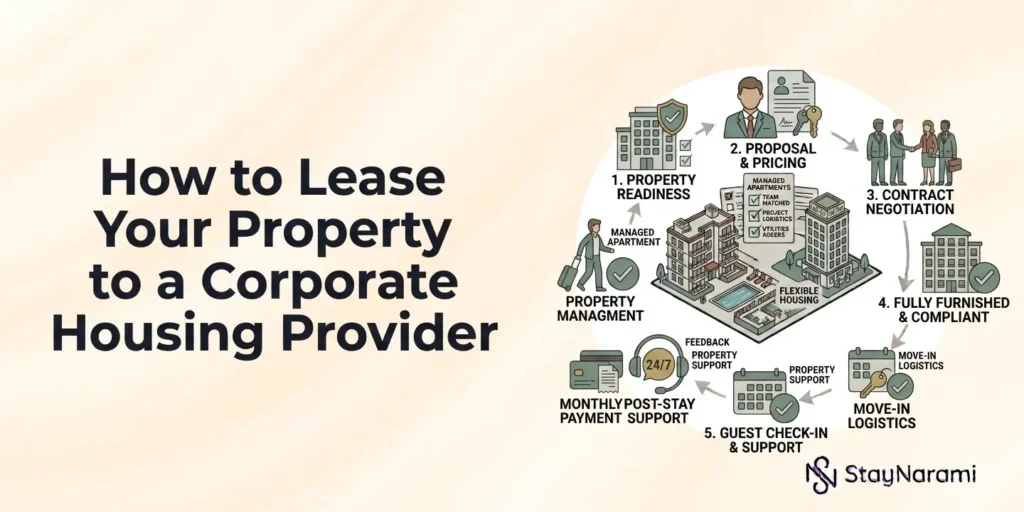
Turn Vacancy Into More Predictable Rental Income
StayNarami connects suitable furnished properties with corporate teams, construction crews, relocating employees, and displaced families needing stays of 30 days or longer.
Empty units cost more than they used to. The U.S. Census Bureau put the national rental vacancy rate at 7.3% in the first quarter of 2026, and national rent data shows it took a median of 41 days in February 2026 to go from listing a unit to signing a lease. On a $2,000 rental, six weeks of quiet is close to $2,800 in rent you will never get back. Add cleaning, paint, photos, and listing fees, and most owners are looking at $1,000 to $5,000 per turnover. It’s exactly this kind of financial drag that pushes many landlords to explore corporate housing by owner arrangements instead of relisting to individual tenants over and over again.
Payment risk is climbing too. Late payments at independently owned rentals also rose from 8.8% in mid-2024 to 11.7% by June, 2025, while a survey of rental investors asked for rent in December 2025 revealed that 41% of them were more concerned about late rentals compared to the previous year.
Because of soft demand and shaky collections, owners are moving to an alternate channel. They do not rent it out to one person at a time but rather rent it out to a business that provides living quarters for crews, contractors, families relocating, or families that have been displaced.
TL;DR (Too Long; Didn’t Read)
- Built for landlords and property owners considering leasing furnished homes or apartments to a corporate housing provider.
- Under a corporate master lease, a business becomes the tenant, pays the agreed rent, and places approved occupants in the property for stays generally lasting 30 days or longer. This can reduce vacancy gaps, repeated tenant screening, marketing, and turnover work.
- The right arrangement depends on the provider’s financial strength, payment terms, insurance, occupant-screening process, maintenance responsibilities, and early termination rules. Owners should verify the company carefully and place every responsibility in writing.
- This guide covers how to lease your property to a corporate housing provider from start to finish: what the agreement is, how to check out the company signing it, what makes a unit attractive, which lease terms matter most, and what still stays your job after the ink dries.
What Is a Corporate Housing Master Lease?
A corporate housing master lease is a rental agreement between you and a business, not you and a person. The company becomes your tenant. It pays you rent every month, and it places its own approved occupants in the unit during the lease term.
The people living there change. Your tenant does not. That single difference is what makes corporate leasing for landlords feel so different from a normal tenancy. You are no longer chasing individual renters, screening applications, or wondering who will cover August rent.
Stays are also longer than most people expect. Industry reports put the average stay somewhere between 83 and 96 nights, and the trade group for the sector draws a firm line at the 30-day mark to separate this business from nightly rentals. A construction project might run six months. An insurance placement can run a year while a home is rebuilt.
“CHPA advocates for stays of 30 days or more.” — Corporate Housing Providers Association
Here is how the three main options stack up:
Comparison Point |
Standard 12-Month Lease |
Corporate Housing Master Lease |
Nightly Short-Term Rental |
| Who signs | One person or family | A business entity | Rotating guests |
| Who pays rent | The renter | The company | The platform, per booking |
| Furnished? | Usually not | Yes, almost always | Yes |
| Typical occupancy | One tenant, 12+ months | 30 days to 12+ months per placement | 2 to 6 nights |
| Your marketing job | Every turnover | Once, at signing | Constant |
| Rent predictability | Good, until they leave | Set by contract | Swings by season |
| Local rule risk | Low | Low, since stays run 30+ days | High in many cities |
Benefits of Leasing to a Corporate Housing Provider
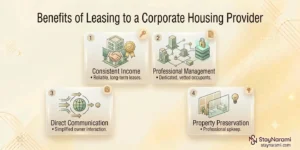
The pitch is simple. You trade a little control for a lot less work and a steadier check.
1. Guaranteed Rent and Fewer Vacancies
When you rent property to corporate housing company partners, the rent obligation sits with the business. If the unit is empty between placements, that is the provider’s problem to solve, not yours, as long as the lease is written that way. Read that clause closely, because it is the whole reason this model appeals to owners.
Units that are furnished receive a premium as well. On average, furnished mid-term rentals generate 20-50% higher revenue than if they were sold as bare rentals in the industry. A unit that rents for $2,000 bare-base will typically end up renting in the $2,400 to $3,000 range for corporate housing. A provider assuming a master lease might be able to pay a little less than that top rate, because they assume the risk of vacancy and manage the guest service, but the number typically outcompetes a simple long-term lease.
The math is worth doing on paper. One month empty wipes out roughly 8% of your yearly rent, and two months is closer to 17%. That is the quiet appeal of corporate leasing for landlords: a lease that keeps paying through slow stretches protects your return in a way a higher headline rent never can.
2. Reduced Tenant Turnover Management
Turnover is where small owners lose their weekends. Showings, background checks, deposit disputes, move-out inspections, and the awkward call about the carpet. In a landlord corporate housing arrangement, most of that shifts to the company.
Task |
Standard Lease |
Master Lease |
| Marketing and showings | You | Provider |
| Screening occupants | You | Provider |
| Rent collection | You, from the renter | You, from one business |
| Cleaning between stays | You | Provider |
| Guest questions at 11 p.m. | You | Provider |
| Furniture and housewares | Not applicable | Provider or you, per the lease |
| Property taxes and insurance | You | You |
| Roof, HVAC, plumbing | You | You |
You still own a building, so you still fix the big things. What disappears is the churn.
Build a Stronger Corporate Leasing Partnership
StayNarami’s landlord partner program helps property owners understand property requirements, placement opportunities, communication, and longer furnished stays.
How to Find and Vet Corporate Housing Providers
Before you can rent property to corporate housing company operators, you need to know which ones work in your area. Start with the demand. These firms buy where their clients work, so look for hospitals, big employers, government facilities, military bases, utility and highway projects, data center builds, and regions that see storm or fire damage. If any of those sit within a short drive of your unit, providers are probably already sourcing in your zip code.
Then get in front of them:
- Search for corporate, furnished, and temporary housing firms serving your metro, and check whether they have a property submission page.
- Call the housing coordinator at a large nearby employer and ask which providers they use.
- Watch local permit and public bid records. The contractor who won a big job needs beds for a crew.
- Look for trade association membership, which signals a code of ethics and some years in business.
Very few but well-vetted clients are better than many but poorly vetted ones. Look at the fundamentals first and then discuss terms. Check for registration and ensure good standing with the Secretary of State. Inquire about its length of existence and its ultimate consumers. Ask for a certificate of insurance and note the limits of insurance. Request a background on the landlords and follow up with them, and the only thing that counts is the question: Did they pay rent on time/on time, no matter if it was empty?
A master lease is only as strong as the company behind it. A great rent number from a shaky operator is not a great deal.
1. Questions to Ask Before Signing
Bring this list to the first real conversation:
- What legal entity is on the lease and has a parent company or officer guarantee it?
- Do you pay rent whether or not the unit is occupied?
- What types of people do you usually have in the house, and how do you determine who’s going to be there?
- Who will be housed in the unit, and how many per unit?
- Who supplies it, and who ends up with the furniture at the end?
- How do you cover utilities, internet, and yard maintenance, and take out snow accumulations?
- How much of a dollar amount do you maintain yourself, and how do you do it?
- How often may I inspect, and with how much notice?
- What happens if a project ends early? Is there a termination clause and a fee?
- Can I see a sample lease before we get serious?
If a company dodges the first two questions, you have your answer.
What Providers Look for in a Property
Providers are not browsing for a dream home. They are matching a client request, and the request usually reads like a checklist.
1. Location, Furnishing, and Condition Requirements
What they check |
What earns a yes |
| Location | Within about 20 to 30 minutes of a job site, hospital, office park, or agency facility |
| Size | 1 to 3 bedrooms, and single-family homes when a crew needs beds and parking |
| Furniture | Complete and durable, not leftovers. Beds, sofa, dining table, dressers, desk |
| Kitchen | Fully stocked. Pots, dishes, silverware, coffee maker, microwave |
| Internet | Fast and already active, or ready to activate before move-in |
| Utilities | On, with a clear answer on who pays and who holds the account |
| Parking | On-site or reliable street parking, ideally more than one space |
| Laundry | In-unit washer and dryer is a strong plus |
| Condition | Clean, safe, and well-maintained. Working smoke and CO detectors |
| Availability | Open for 30 days or longer, with flexible start dates |
| Price | In line with local market rates, not aspirational |
Two things get properties skipped fast: unfurnished units and pricing that ignores comparable listings. Sit well above market, and providers move on to the next owner on their list.
Negotiating the Master Lease Agreement
This is the part worth slowing down on. A master lease looks like a normal residential lease with a few extra pages, and those extra pages carry the risk.
Come in knowing your floor. Total up your mortgage, taxes, insurance, HOA fees, and a maintenance reserve, and determine the smallest number that can go each month. If possible, negotiate a longer lease duration, like 12 or 24 months, as this option is a renewable lease so you will have the predictability you are looking for.
1. Key Lease Terms to Review
Lease term |
Why it matters |
What to push for |
| Rent and due date | The heart of the deal | Fixed monthly rent, due on a set day, paid whether or not occupied |
| Lease length and renewal | Controls your planning | 12 months or longer, with clear renewal notice windows |
| Occupancy and sublease rights | The provider must be able to place guests | Spell out who may occupy, the maximum headcount, and no nightly rentals |
| Furnishing responsibility | Big cost swing | Put it in writing: who buys, who repairs, who removes at the end |
| Maintenance split | Prevents arguments | A dollar threshold. Provider handles small repairs, you handle systems and structure |
| Damage and wear | Protects your asset | Normal wear defined, plus liability for anything beyond it |
| Security deposit | Your cushion | One to two months where local law allows |
| Insurance | Often overlooked | The provider carries commercial liability and names you as additional insured |
| Utilities and services | Small bills add up | Assign every account by name, including internet and yard care |
| Early termination | Projects end | Notice period plus a fee, so you are not left with a sudden gap |
| Inspections | Your peace of mind | Quarterly or twice-yearly walkthroughs with reasonable notice |
| Condition report | Ends disputes | Dated photos and a signed inventory at move-in and move-out |
Some housekeeping tips before signing. Be sure to inform your insurance company before a business takes over the lease, as a typical homeowner policy might require an endorsement. Review your mortgage and any HOA regulations for clauses that involve subletting. Have a local real estate attorney read the draft. A few hundred dollars now wins over a dispute later.
Furnishing and Preparing Your Property
Some providers furnish the unit themselves. Many prefer a turnkey home, and those units get matched faster, so ask early because the answer changes your budget.
When picking up the bill for furnishings, allow about $6,000 to $15,000 if it is a one- or two-bedroom. Purchase on quality, not points. If a guest is there for 90 days, he/she will use everything.
- Bedrooms: Solid frames, good-quality mattresses, bedside tables, chests of drawers, 2 sets of bed linen per bed, blackout curtains
- Living room: stain-resistant sofa, coffee table, real lamps, mounted TV
- Workspace: Desk and a good chair because most guests are able to work from their unit.
- Kitchen: all items to serve 6, silverware, knives, coffee maker, toaster, storage containers
- Bath/utility: towel sets, shower curtain, plunger, vacuum, broom, iron, laundry basket, and basic tool kit.
- Safety: Check that smoke detectors and carbon monoxide detectors are tested, fire extinguishers are checked, and locks on all outside doors are working.
Before moving in, take pictures of all items and append a signed inventory to the lease. An hour, and it straightens out nearly all disputes to come.
Ongoing Landlord Responsibilities
A landlord corporate housing deal is lighter, not a hand-off. You are still the owner, and a few duties never transfer.
You continue to make mortgage and property tax payments along with any homeowner’s association fees and your insurance. Roof, foundation, and HVAC, water heater, electric, and plumbing are handled by you. Additionally, you will remain liable for local regulations, licenses, building permits, and habitability laws.
Beyond that, a short routine keeps the relationship healthy:
- Answer maintenance calls quickly. Providers reward responsive owners with repeat leases.
- Do your scheduled inspections. Skipping them is how small problems turn expensive.
- Keep clean records of rent, repairs, and messages for taxes and any future dispute.
- Set a reminder 90 days before the lease ends so renewal talks happen early.
- Save part of each payment for furniture replacement. Sofas and mattresses wear out.
Do those five things, and this becomes one of the quietest income streams you own.
Put Your Furnished Property in Front of Active Housing Needs
Share your property’s location, availability, bedrooms, amenities, parking, and lease terms with StayNarami to be considered for matching temporary housing requests.
Final Takeaway
Understanding how to lease your property to a corporate housing provider comes down to careful screening and clear paperwork. The right provider can reduce vacancy gaps and turnover work, but the value depends on realistic income math, suitable insurance, and a lease that clearly assigns every major duty.
Ready to Put Your Unit to Work? Vacancy and turnover are the two costs that quietly eat rental income, and both are avoidable with the right tenant on the lease. StayNarami signs the lease directly with owners and places verified construction crews, government personnel, corporate teams, and insurance-displacement guests in furnished homes across all 50 states.
Frequently Asked Questions
1. How much can you earn leasing to a corporate housing company?
Rates vary by location. Master leases may pay market rent or more, while furnished mid-term rentals can earn 20% to 50% above unfurnished rates. Compare guaranteed rent with expected vacancy and turnover costs.
2. What types of properties do corporate housing providers prefer?
They often prefer clean one- to three-bedroom homes near business areas, hospitals, transit, and project sites. Parking, fast internet, laundry, and flexible layouts add value.
3. Do I need to furnish my property?
Not always. Some providers furnish the property, while others expect it to be move-in ready. Clearly state furniture responsibilities in the lease.
4. What happens if the provider damages my property?
The lease should cover deposits, maintenance, insurance, and damage beyond normal wear. Take move-in photos and keep a signed inventory.
5. How long does a corporate housing master lease run?
Most agreements last 6 to 24 months, often with renewal options. Longer terms provide more stable income.
6. Do I need a special license?
Usually not for stays of 30 days or longer. However, local laws and HOA rules vary, so check them before signing.
Need housing for your team?
Tell us what you need and we'll take care of the rest — anywhere in the U.S., 30+ days.
Request Housing →Related Articles