Temporary Housing Solutions for Healthcare Workers

Give Your Medical Team a Better Place to Land
StayNarami helps healthcare professionals find furnished housing around their facility, schedule, commute, budget, and daily needs, so the assignment starts with one less problem to solve.
Taking a healthcare assignment away from home brings an immediate question: where are you going to live while you work?
That question matters more than it may seem. The U.S. Bureau of Labor Statistics projects about 1.9 million openings in healthcare occupations each year from 2024 to 2034, driven by both job growth and the need to replace workers leaving their occupations. (Bureau of Labor Statistics)
For workers taking temporary assignments, finding housing is only part of the problem. The property must fit the assignment dates, budget, commute, work schedule, parking needs, and daily routine. This becomes even more important for people working nights or long shifts.
CDC/NIOSH reports that more than 50% of night-shift healthcare workers in national 2010 data said they slept six hours or less per day. (CDC/NIOSH)
TL;DR (Too Long; Didn’t Read)
- Built for hospitals‚ staffing agencies‚ healthcare organizations‚ and medical personnel who required furnished housing for 30 days or more․
- Temporary housing that fulfills the project requirements and budget may be most suitable․ For healthcare workers‚ rapid commutes‚ shift flexibility‚ sufficient parking‚ the ability to sleep during the day‚ and furnishings including utilities‚ laundry‚ and flexible leasing may be important to consider․
- StayNarami also assists with arranging for furnished housing around the facility‚ assignment dates‚ group size‚ budget, and daily needs‚ and provides a range of housing options between 30 days and longer․
- This article outlines the main types of housing‚ discusses pricing considerations‚ how close to the facility workers should stay‚ what lease length is appropriate‚ and how companies can make housing more accessible for multiple medical professionals․
“The very first requirement in a hospital is that it should do the sick no harm.” — Florence Nightingale, Notes on Hospitals.
A healthcare worker’s apartment is obviously not part of the hospital. Still, reliable rest, a manageable commute, and a stable place to live can make an assignment far easier to manage.
What Is Temporary Housing for Healthcare Workers?
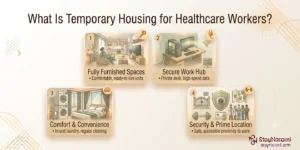
Temporary housing for healthcare workers is furnished accommodations for nurses‚ physicians‚ technicians‚ therapists‚ and others employed in health care‚ away from their primary home․
Temporary housing is designed for a worker’s use as his or her primary residence‚ so the worker does not have to purchase furniture‚ commit to a year-long lease‚ or set up an entire household․
Depending on the property‚ a monthly fee may include:
- Furniture and basic household items
- Electricity, water, and other utilities
- Wi-Fi
- Kitchen appliances
- Laundry access
- Parking
- Building or community amenities
It is important to separate the everyday meaning of “temporary housing” from its tax meaning. The IRS generally considers an assignment in one location temporary when it is realistically expected to last one year or less, but individual tax circumstances vary. (IRS) Healthcare workers receiving stipends should speak with a qualified tax professional rather than assuming their housing payment is automatically tax-free.
Who Needs Temporary Housing in the Healthcare Industry?
Travel nurses are probably the most well-known group to use temporary housing‚ but certainly not the only group to do so․ Housing may be needed for:
- Travel nurses
- Certified nursing assistants
- Physical and occupational therapists
- Respiratory therapists
- Radiologic and imaging technicians
- Laboratory professionals
- Locum tenens physicians
- Nurse practitioners
- Medical technicians
- Healthcare consultants
- Temporary hospital support teams
- Staff transferred between facilities
- Healthcare workers responding to short-term staffing shortages
If hiring several employees at once‚ accommodations may need to be made to house the employees․
For example‚ it may be easier for a hospital to rent a few furnished apartments or houses near the hospital for a three-month project where six allied health professionals are coming to this small market than finding housing for six employees․
What Types of Temporary Housing Solutions Are Available for Healthcare Workers?
No one type of housing is suitable for every assignment․
Housing option |
Usually works best for |
Main consideration |
| Furnished apartment | One worker or couple | Privacy and full residential setup |
| Furnished house | Families or several workers | More space, parking, and shared areas |
| Shared furnished housing | Workers trying to reduce costs | Bedroom and bathroom privacy |
| Extended-stay hotel | Very short or last-minute stays | Nightly cost can become expensive |
| Employer-arranged housing | Groups or repeated assignments | Less housing work for employees |
| Month-to-month rental | Assignments with uncertain end dates | Check extension and cancellation terms |
For longer stays of several months or more‚ a furnished apartment or home may offer amenities which can far exceed those of a hotel‚ such as a full kitchen‚ separate living space‚ laundry‚ and room to live․
If they are unable to find a short-term home before beginning a longer-term housing option‚ extended-stay hotels are still available․
What Should I Look for in Temporary Housing as a Healthcare Worker?
Provide the work schedule first‚ not photos or other information about the property․ A beautiful apartment that creates an hour-long commute after every 12-hour shift may be a poor choice.
1. Check the True Commute
Search from the exact hospital, clinic, or facility address instead of simply looking for housing in the same city.
Test the drive during your actual shift-change times whenever possible. Because of traffic‚ bridges‚ toll roads‚ and access to highways‚ an eight-mile (13 km) drive from your location may take longer than a twelve-mile (19 km) drive at certain times․ It may be helpful to try the drive at the times you would be leaving or arriving from your shift․
2. Make Sure the Property Supports Rest
The CDC/NIOSH associate sleep loss‚ tiredness‚ errors‚ injuries‚ and other effects with shift work‚ long work hours‚ and extended work shifts․ Night-shift workers may therefore want to check:
- Street and building noise
- Bedroom location
- Window coverings
- Nearby construction
- Shared walls
- Roommate schedules
3. Confirm What “Furnished” Actually Includes
Don’t assume furnished means fully equipped‚ though․Does it include cookware‚ dishes‚ linens‚ a desk‚ a television‚ a washer and dryer‚ Wi-Fi‚ utilities‚ and parking?
4. Review Every Extra Charge
When comparing two properties‚ rather than comparing rent‚ calculate total cost․ It includes deposits‚ utility fees‚ pet fees‚ parking fees‚ cleaning fees‚ application fees‚ and other monthly fees․
How Much Does Temporary Housing for Healthcare Workers Cost?
There is no meaningful nationwide price for temporary housing for healthcare workers because housing costs can change greatly between cities and even neighborhoods.
The main cost factors are:
- Location
- Assignment dates
- Length of stay
- Number of bedrooms
- Number of occupants
- Furnishings
- Utilities
- Parking
- Pets
- Local housing availability
For context, the federal government’s standard FY2026 CONUS lodging allowance is $110 per night in areas without a separate local rate. That equals $3,300 across 30 nights before lodging taxes. Some higher-cost destinations have much higher federal rates. (GSA)
That figure should not be treated as the market price for healthcare housing. It simply shows why comparing monthly housing with nightly lodging can be useful.
When comparing options, calculate:
Monthly rent + utilities + parking + fees + expected commuting cost = realistic monthly housing cost
How Close Should My Temporary Housing Be to My Facility?
There is no perfect mileage number.
The real issue is not how far your commute is‚ but rather your estimated commute time‚ especially if you work 10- or 12-hour shifts․ You want a reasonable commute during your commuting hours․
As noted by NIOSH‚ shift overruns may reduce sleep opportunities and contribute to drowsy driving․
The search should be close enough to the facility so as to only need to be extended if price‚ availability‚ safety‚ or quality are prohibitive․
How Do I Book Temporary Housing for a Short-Term Healthcare Assignment?
First‚ collect information to help narrow down the search when contacting housing providers:
- Exact facility address
- Move-in date
- Expected move-out date
- Number of occupants
- Monthly housing budget
- Preferred number of bedrooms
- Work schedule
- Vehicle and parking requirements
- Pet information
- Required amenities
- Possible contract-extension period
Then compare listings based on their total price‚ commute distance‚ lease flexibility‚ and what is included in rent․
Having this information in a single housing request helps avoid employees signing leases under different conditions‚ such as deposits and move-in dates‚ which would otherwise be a meaningful issue with many placements․
Housing Built Around Healthcare Assignments
StayNarami sources furnished housing for traveling medical professionals with practical commutes, kitchens, laundry, Wi-Fi, and flexible 30+ day stays designed around demanding work schedules.
What Lease Terms Work Best for Healthcare Contract Lengths?
The lease should follow the assignment as closely as possible. Look for terms covering:
- 30-day or month-to-month stays
- Exact start and end dates
- Extension options
- Early termination
- Delayed assignment starts
- Security deposit refunds
- Utility limits
- Additional occupants
- Pet conditions
- Prorated first or final months
Contract extensions deserve special attention. A worker scheduled to leave on June 30 may later be asked to remain through July or August. Knowing whether the property can be extended before signing can prevent another housing search halfway through the assignment.
Conversely‚ if a worker or employer terminates a rental contract before its end date‚ a fixed rental contract may require either party to pay for the uninhabited rental space․
How Do We Help Healthcare Workers Find Temporary Housing Fast?
Searching one listing at a time becomes harder when the assignment is approaching, several employees are relocating, or the facility is in a market with limited furnished inventory.
StayNarami’s housing process is designed for temporary assignments lasting 30 days or longer. Clients provide the location, group size, dates, and housing requirements, and StayNarami sources furnished properties from its nationwide owner network. The company also organizes the lease‚ move-in‚ and other housing support during their stay there․
StayNarami also provides furnished apartments with leases ranging from 30 days to 12+ months‚ which are suitable for healthcare assignments that are difficult to fulfill with a standard year-long lease across the country․
For example‚ if eight healthcare workers need housing for up to 90 days‚ with the same address‚ headcount‚ stay dates‚ number of bedrooms‚ parking needs‚ and budget‚ they can find each other and coordinate housing together rather than solving the problem independently eight times․
Make the Assignment Easier Before the First Shift
Share the facility, dates, headcount, budget, parking, and housing requirements with StayNarami, so your team can arrive with a practical place to live already arranged.
Conclusion
The most appropriate temporary housing for healthcare workers is not the cheapest room but rather the one best suited to the assignment․
An ideal living environment would be a reasonable distance to commute‚ a space to rest after hours of hard work‚ furniture to bring comfort‚ known bills‚ and a flexible lease․
Health professionals should comparison shop for the overall monthly cost and read the lease before signing it․ Hospitals‚ staffing firms‚ or healthcare groups with multiple employees on assignment should plan housing ahead of time and provide advance assignment information to make it easier to match housing․
Frequently Asked Questions
1. What is considered temporary housing?
Temporary housing is a type of short-term housing‚ including furnished apartments‚ houses‚ extended-stay hotels‚ and other forms of short-term rental housing․
2. How long can healthcare workers stay in temporary housing?
It depends on the property type and the lease‚ but in StayNarami‚ it provides furnished stays from 30 days upwards‚ with potential lease periods of 12 months or more depending on the housing need․
3. Is temporary housing furnished for healthcare workers?
Most temporary accommodations are furnished‚ but the provided furniture varies․ Before reserving‚ check what furniture‚ kitchen equipment‚ linens‚ utilities‚ internet‚ and laundry are included․
4. Can hospitals arrange temporary housing directly for staff?
Yes․ Hospitals‚ staffing firms‚ or other employers may provide housing rather than each individual healthcare worker finding their own housing․
5. What is the difference between temporary housing and an extended-stay hotel?
The units may be similar to apartments with separate bedrooms‚ full kitchens, and living areas‚ and month-to-month leases‚ rather than an extended-stay hotel‚ which is better suited for shorter-term stays․
6. Do healthcare workers get a housing stipend or company-paid housing?
In some cases‚ a company or staffing agency provides worker housing․ In others‚ the company provides an allowance, and the worker selects their own housing․ Workers should discuss the terms and the tax treatment with their employer and with a tax advisor․
7. Is temporary housing pet-friendly for traveling healthcare staff?
Not all properties are pet-friendly‚ so be sure to provide information about the number‚ size, and type of your pets to the housing provider prior to booking‚ so that pet deposits‚ monthly pet fees, or breed restrictions can be applied․
Need housing for your team?
Tell us what you need and we'll take care of the rest — anywhere in the U.S., 30+ days.
Request Housing →Related Articles