Temporary Housing for Interns and Students

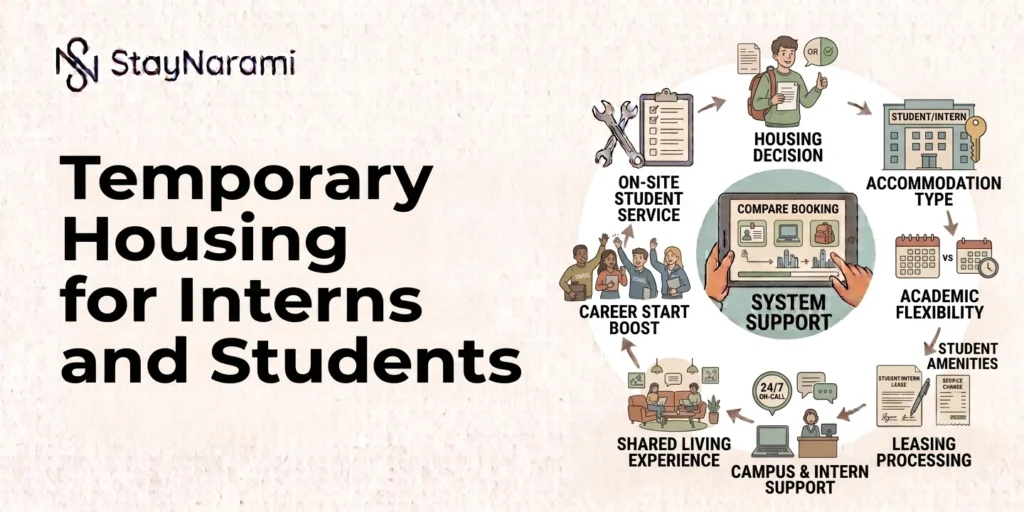
Bring the Interns In Without Sending Them on a Housing Hunt
StayNarami helps employers source furnished 30+ day housing around internship dates, work location, headcount, budget, and commute so students can focus on the opportunity instead of chasing short-term rentals.
Landing an internship in another city can be a major opportunity for a student. Finding somewhere affordable and practical to live for only a few months can be the harder part.
The timing itself creates the problem. The National Association of Colleges and Employers’ 2026 Internship & Co-op Report puts the median internship length at 11 weeks. That is far too short for most standard 12-month apartment leases, yet long enough for weeks in a regular hotel room to become inconvenient.
Employers are paying attention.
According to NACE’s 2026 employer survey, about half of responding employers provide financial relocation assistance to interns. Among employers using lump-sum assistance, the average amount reported for housing was $3,310.
This kind of help with internships is especially important as internships have increasingly become the most likely path to hiring․ The National Association of Colleges and Employers (NACE) reports the full-time offer rate to the class of 2024-25 interns at 63․1%‚ the highest in five years․
As NACE President and CEO Shawn VanDerziel puts it:
“For employers, internships are a way to ‘recruit once, hire twice.’”
For companies bringing students in from other cities or states, temporary housing for interns therefore deserves more thought than simply handing someone a hotel recommendation. This guide explains what works, what it can cost, which amenities matter, and how employers can make intern housing easier to arrange.
TL;DR (Too Long; Didn’t Read)
- It was intended for employers‚ internship program managers‚ human resource professionals‚ and students‚ to find furnished housing for internships or for short-term stays for employment opportunities of a few weeks to months․
- Intern housing has distinct needs‚ as a 12-month residential lease does not match the time span, and a hotel would be too costly for a longer period․ According to NACE’s 2026 data‚ the median length of an internship is 11 weeks‚ so flexible furnished spaces are desired by interns․
- The right option should match the program dates, commute, budget, furniture, laundry, internet, transportation, and whether interns will live alone or share housing. For employers bringing in several interns, arranging housing together can also reduce scattered bookings and last-minute problems.
- It’s a guide to the best intern housing options‚ how much housing costs for interns on a temporary basis‚ when it’s worth using a shared intern housing option‚ and what types of amenities to look for․
What Is Temporary Housing for Interns and Students?
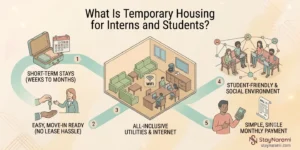
Temporary housing for interns is furnished accommodation that matches the limited period of an internship, training program, rotation, research project, or other short-term placement.
Depending on the city and length of stay, options may include:
- Furnished apartments
- Furnished houses or condos
- University summer housing
- Student residences
- Extended-stay hotels
- Approved subleases
- Shared furnished accommodation
The key difference from a normal apartment is commitment.
Someone coming to stay in your area for an 11-week summer internship is not going to want to buy furniture‚ set up utilities‚ sign a year-long lease‚ and then try to get out two or three months later․
Adequate temporary property would allow the intern to bring personal property‚ live during the required internship period‚ and leave upon completion of the internship․
Then furnished housing becomes useful for interns coming from out of state or for employers who hire a group of students into one city․
Why Do Interns and Students Need Temporary Housing Instead of Dorms or Hotels?
Both dorms and hotels can work‚ but neither is necessarily the best choice for any given internship․
1. University housing
College summer housing can be useful when dates match the internship and the intern meets the university’s eligibility rules. It may also place interns near public transportation and other students.
Availability can be the limitation. Summer housing dates may follow the academic calendar rather than the company’s internship calendar, and room types or locations may be limited.
2. Hotels
A hotel is convenient when someone needs somewhere to stay for several nights or arrives before longer-term accommodation is ready.
Eleven weeks is different.
Even when an extended-stay property offers a kitchen and laundry, an intern may still be living and working mainly from one hotel-style space. Costs also need to be compared over the complete stay rather than by the nightly rate.
3. Furnished temporary housing
Furnished apartments or homes can fill the middle ground. The intern receives a residential place to live without having to set up a permanent apartment.
This becomes especially useful when several interns arrive together or when the company knows the program dates months in advance.
Housing Type |
Strongest Use |
Main Issue to Check |
| University housing | Summer programs near participating campuses | Eligibility and exact dates |
| Hotel | Very short stays or last-minute arrivals | Cost and living space over longer stays |
| Extended-stay hotel | Short to medium stays | Room size and total cost |
| Furnished housing | 30+ day internships and placements | Availability and minimum stay |
| Standard apartment | Long programs or permanent moves | Lease length, furniture and setup |
| Sublease | Budget-focused individual interns | Verification, dates and lease permission |
What Should Interns Look for When Choosing Temporary Housing?
Price matters, but it should not be the only filter.
An apartment that is $250 less a month‚ but requires an hour commute every day‚ is not a good deal․ A cheap room that the intern would have to furnish and share with someone else for the next ten weeks is also not a good deal․
Before booking, check these seven areas.
1. Exact dates
Make sure the lease covers arrival before the first workday and departure after the final day. An internship ending August 15 does not help if the housing contract ends August 1.
2. Total cost
Check what the quoted price includes: rent‚ electricity‚ water‚ internet‚ parking fee‚ cleaning fee‚ application fee‚ deposits, and whatever else is required to move in․
3. Commute
Actual commute time differs depending on public transit schedules‚ parking availability‚ traffic‚ and the time needed to traverse the distance‚ which may differ from a short distance on a map․
4. Furniture
At a minimum‚ the intern should ascertain whether the intern will be furnished with beds‚ seating‚ a dining/work area‚ and basic kitchen equipment․
5. Laundry
Laundry can be a pressing issue for a two- or three-month stay‚ so it is worth finding out whether laundry facilities are in-unit‚ in the building‚ or off-site․
6. Internet
This software is necessary for university work‚ company meetings‚ remote work days‚ and personal use․
7. Safety and property verification
Interns should be told who owns or operates the property‚ how payment is done, and who to contact with a problem․
How Much Does Temporary Housing for Interns Typically Cost?
There is no useful single national price for intern housing.
A furnished room in a small Midwestern city may be a different market from a furnished apartment in Manhattan․ Rental price is determined by number of bedrooms‚ season‚ neighborhood‚ public transport‚ furniture availability‚ utilities‚ and lease duration․
A more useful benchmark comes from employer assistance.
According to NACE‚ employers providing lump sum relocation benefits provided an average housing benefit of $3‚310‚ and an average travel benefit of $ 1,417. Factors controlling the amount of relocation benefits offered by employers to interns were linked to cost of living‚ distance from the job‚ length of the internship‚ and type of program offered․
The $3‚310 is a benchmark for relocation assistance‚ rather than an average rent figure․
Employers setting a housing budget should price the actual destination and calculate:
Rent + utilities + internet + parking + furniture + fees + transportation = true intern housing cost
Cheapest rent does not mean the lowest total cost for tenants․
Should Companies Provide Housing or a Stipend for Summer Interns?
Both approaches can work.
1. Housing stipend
Under this arrangement‚ the intern is provided a stipend and required to find their own accommodation․ This freedom can be especially helpful if the intern is familiar with the city or wants to room with friends․ The downside is that in a short period of time the student must locate a property‚ read the lease‚ see the apartment, pay the deposits, and determine if legitimate․
2. Company-arranged housing
With company-arranged housing, the employer or its housing partner handles some or all of the property search.
This can be particularly useful when:
- Interns are moving from several states.
- The company is bringing in a large summer class.
- Students are unfamiliar with the city.
- Internship dates are fixed.
- The employer wants interns reasonably close to the office.
- Multiple interns can share suitable housing.
NACE’s 2026 survey found that employers offering relocation support believed it helped reduce financial barriers and made internship programs more competitive when attracting candidates.
There is also a middle option. The employer can provide approved furnished housing up to a set amount while allowing an intern who wants something different to make their own arrangements.
Give Interns a Place That Fits the Program
StayNarami provides furnished housing for students and interns with practical options for multi-week placements, shared living, manageable commutes, and the everyday essentials needed beyond a short hotel stay.
What Amenities Matter Most for Student and Intern Housing?
Intern housing does not need luxury features. It needs to work every day.
The most useful amenities tend to be:
A real bed and basic furniture. The intern should not have to buy furniture that will be used for only a few weeks.
Kitchen access. Preparing meals can make everyday living easier than relying entirely on restaurants and takeout.
Laundry. Easy laundry access matters during a stay measured in months rather than days.
Wi-Fi. Internet access should be confirmed before move-in.
Workspace. A desk or usable table is valuable when interns have remote days, assignments, or university coursework.
Transportation access. Housing should make it practical to reach the office without an expensive daily ride.
Parking when needed. If interns are bringing vehicles, verify parking costs and the number of spaces available.
Amenities should follow the internship itself. Someone working long hours at a hospital may care more about commute and laundry than a building gym.
How Close Should Intern Housing Be to the Office or Campus?
There is no ideal number of miles.
Ten miles in one city might take 15 minutes. Ten miles somewhere else might take an hour.
Employers should set a commute goal in minutes, then consider the transportation method.
For example, housing may be practical if the intern can reach work in around 30 minutes by reliable public transit, even though the property is several miles away. A cheaper unit that requires two buses and 75 minutes each way creates a very different experience.
Employers arranging housing for a group should also consider whether everyone works at the same site. Housing the entire intern class together makes little sense if half the group then has a difficult commute.
The strongest approach is to map the actual work locations before properties are selected.
Can Interns Share Housing to Save on Costs?
Yes, and shared housing can make larger furnished properties more practical.
If two interns were amenable to sharing a two-bedroom apartment‚ rather than finding two separate accommodations‚ the price would be less․ Companies should still handle roommate arrangements carefully․ Confirm:
- Each person’s bedroom arrangement
- Number of bathrooms
- Parking needs
- Property occupancy limits
- Lease requirements
- Different arrival or departure dates
- Whether interns actually agree to shared housing
The fact that two people are interns does not mean they should share a room․
As an example‚ a company bringing four interns in from out of town for an 11-week program in Denver may be able to secure four studio apartments or two furnished two-bedroom apartments․ If the latter option is acceptable to the students and permitted by the properties‚ it saves money and decreases the number of leases needed․
How Do We Help Companies Arrange Temporary Housing for Interns?
StayNarami’s current model is built around furnished U.S. housing for stays of 30 days or longer, which fits many summer internship and extended student-placement timelines. StayNarami says its properties are fully furnished and that stays can run from 30 days to 12 months or longer.
The process starts with basic information:
- City or work location
- Number of interns
- Start date
- Length of stay
- Monthly budget
- Bedroom requirements
- Preferred commute
- Vehicles
- Other housing needs
StayNarami then sources furnished properties matching those requirements and coordinates move-in and the stay. Its current service covers all 50 states.
For employers, the biggest advantage is consistency.
A company bringing in eight interns would have the interns search completely independently for short-term leases for 12 weeks‚ resulting in eight locations‚ eight sets of questions‚ and eight problems‚ long before they even began the internship program․
A planned housing request allows the employer to set the budget‚ commute distance‚ room sharing‚ type of housing‚ and amenities before the interns arrive․
This way‚ the interns get to focus on preparing for the internship‚ rather than becoming experts in short-term rentals․
Get the Housing Sorted Before Orientation Day
Share your internship location, program dates, number of students, budget, bedroom needs, and preferred commute with StayNarami to find housing that is ready when the program begins.
Conclusion
Temporary housing for interns is most effective when it matches the structure of an internship‚ which‚ unlike a business trip‚ is longer in duration but shorter than a normal residential lease․
For one student‚ this includes not only rent and dates‚ but also commute‚ furnishings‚ utilities‚ internet‚ laundry‚ transport and terms of the rental contract․
For employers, the decision is larger. Intern housing can affect who is realistically able to accept the internship in the first place.
With about half of employers in NACE’s 2026 survey already providing financial relocation assistance, housing support is not an unusual benefit. It is one of the tools companies can use to make an out-of-state internship possible for candidates who otherwise have to solve a difficult short-term housing problem on their own.
The best approach is simple: confirm the program dates early, price housing in the actual market, decide whether the company or intern will arrange it, and make sure the property fits the person’s daily life once the internship begins.
Frequently Asked Questions
1. Do companies provide housing for summer interns?
Some do. Others provide stipends, reimbursements, relocation assistance, or no housing benefit. NACE’s 2026 survey found that about half of responding employers provided financial relocation assistance to interns.
2. How much should I budget for intern housing?
Budget according to the destination, length of stay, bedrooms, furnishings, utilities, and transportation. NACE reported an average $3,310 housing lump sum among surveyed employers using this form of intern relocation assistance, but this is an assistance benchmark rather than an average market rent.
3. Is temporary housing cheaper than a dorm for interns?
Not necessarily. University summer housing can be affordable, but pricing and eligibility vary by school. Compare the complete cost, dates, commute, furnishings, and included services before choosing.
4. Can interns get roommates to split housing costs?
Yes, if the property allows it and the interns agree. Confirm bedrooms, occupancy limits, lease terms, payment responsibility, and different arrival or departure dates before booking.
5. What is the average length of an internship housing stay?
NACE’s 2026 data places the median internship length at 11 weeks, although individual programs can be much shorter or longer.
6. Is furnished housing available for short-term student stays?
Yes. Furnished apartments, university residences, extended-stay properties, and other temporary options may be available. StayNarami specifically works with fully furnished U.S. housing for stays beginning at 30 days.
7. What documents do interns need to rent temporary housing?
Requirements depend on the property. Common requests can include photo identification, an internship or employment offer letter, proof of ability to pay, an application, and a security deposit or other payment information. Some properties may also require a guarantor. A current intern-housing guide similarly identifies ID, an internship offer letter, financial documentation, and deposit funds among common application requirements.
Need housing for your team?
Tell us what you need and we'll take care of the rest — anywhere in the U.S., 30+ days.
Request Housing →