Corporate Housing vs Extended Stay Hotels for Relocation

Don’t Let a Temporary Move Feel Like Hotel Living
StayNarami gives relocating employees a furnished, residential place to settle in while they start work, learn the area, and make permanent housing decisions at the right pace.
Relocating an employee creates an awkward housing gap. The employee needs to start work in the new city, but their permanent home may not be ready. They may still be selling a house, comparing neighborhoods, waiting for a lease to begin, or moving a family several weeks after their own arrival
The housing chosen for that gap matters more than it may seem. The 2026 Atlas Corporate Relocation Survey found that 59% of surveyed companies had at least one employee decline a relocation in 2025, while 28% cited concerns about housing or mortgages at the new location as a reason for declined moves. As companies dealt with housing costs and limited availability, 38% offered extended temporary housing benefits
That puts a practical question in front of HR teams‚ relocation managers, and employers: what kind of temporary accommodation should they provide?
Comparing corporate housing vs. extended-stay hotels may not be a fair comparison․ Extended stay hotels can provide kitchens‚ Wi-Fi‚ laundry‚ pets‚ weekly or monthly rates, and other options that can be cheaper than corporate housing․ Instead‚ corporate housing falls into a middle ground‚ being more residentially focused for longer stays‚ though renting a regular apartment may be cheaper, albeit with a longer process․
Other factors that may be considered are: length of stay‚ who will be accompanying the employee‚ certainty of end date‚ and what is included in the cost․
TL;DR (Too Long; Didn’t Read)
- Built for HR departments‚ mobility managers‚ or employers to determine if corporate housing‚ an extended stay hotel‚ or an apartment is best suited for their employees․
- Both have their place‚ but extended stay hotels are preferable for people who may not know how long they will be at their new job․ Corporate housing is better for employees who will be in their new city for more than thirty days‚ and want more space‚ privacy‚ a full kitchen‚ laundry facilities, and a home-like atmosphere․
- The best option depends not just on the nightly or monthly rate of the temporary accommodation but the total cost․ Depending on household size‚ parking availability‚ pets‚ commuting distances‚ furniture‚ utilities‚ and future housing‚ the most cost-effective option will vary․
- This guide contrasts corporate housing and extended-stay hotels with the standard apartment to assist the employer in determining a best fit based on the actual move rather than defaulting to what is easy to book․
What Is the Difference Between Corporate Housing and Extended Stay Hotels?
Corporate housing is a furnished residential space for long stays․ The Corporate Housing Providers Association defines corporate housing as professionally managed‚ fully furnished housing․ Usually offered as apartments‚ condos, and houses‚ in most cases for a stay of 30 days or more‚ the type of furnished accommodation can include furniture‚ housewares‚ utilities‚ and other apartment-related services․
An extended-stay hotel is a hotel where the rooms are designed for people who are staying longer than a business trip․
The exact setup varies by brand. For example, Extended Stay America says its properties provide apartment-style suites with full kitchens and free Wi-Fi, along with guest laundry and pet-friendly accommodations. It also offers weekly and longer-stay pricing
The biggest difference is therefore not simply whether you can cook dinner
Corporate housing places the employee in a residential property. Extended-stay housing keeps the employee within a hotel environment
The difference may be small in a five-night stay‚ but in two or three months it can affect privacy‚ family time‚ work environment‚ storage‚ parking space, and how settled the employee feels․
Corporate Housing vs Extended Stay Hotels vs Apartments: How Do They Compare?
The inclusion of a regular apartment makes the decision straightforward, as each option solves part of the relocation problem in different ways․
Factor |
Corporate Housing |
Extended Stay Hotel |
Regular Apartment |
| Best suited for | Temporary stays measured in weeks or months | Short to medium stays and uncertain arrival dates | Longer, more settled living |
| Furniture | Usually included | Included | Often not included |
| Kitchen | Usually full residential kitchen | Varies; some have full kitchens | Full kitchen |
| Utilities | Often included or bundled | Usually built into hotel rate | Often partly separate |
| Wi-Fi | Commonly included | Commonly included | May require setup |
| Laundry | In-unit or property-based, depending on housing | Often shared hotel laundry | In-unit or community laundry varies |
| Privacy | Residential setting | Hotel setting | Residential setting |
| Lease commitment | Temporary terms | Usually highly flexible | Fixed lease terms |
| Move-in setup | Low | Very low | Can be much higher |
| Family suitability | Often strong because larger homes can be sourced | Depends heavily on room size and layout | Strong once permanent location is known |
| Billing | Can be consolidated | Hotel billing | Rent plus separate household bills may apply |
No column wins every row
An extended-stay hotel can be useful when an employee must arrive tomorrow, and HR does not yet know whether the stay will last two weeks or two months. A traditional apartment can become sensible once the employee knows where they want to live and is ready for a longer lease
Corporate housing‚ then‚ is somewhere between those two categories․ It gives the employee a residential situation without immediately requiring them to make a home․
Which Option Is More Cost-Effective for Long-Term Relocation?
There is no absolute national answer on whether corporate housing or an extended-stay hotel will always be more cost-effective․
The nightly rates of rooms at a given property vary by city‚ season‚ size of room‚ taxes‚ length of stay‚ parking rate, and availability of rooms․ Extended-stay hotels‚ in particular‚ can provide discounted weekly and monthly rates‚ so the monthly base room rate is not always a multiple of the nightly base room rate․
Employers should also realize the cost of living there‚ rather than just the price of a room or rent․
Include:
- Housing or room rate
- Lodging taxes where applicable
- Utilities
- Internet
- Parking
- Laundry
- Cleaning
- Pet charges
- Furniture
- Kitchen equipment
- Application fees or deposits
- Meals
- Early departure fees
- Extension costs
- Transportation caused by the housing location
Consider a simple hypothetical example
An extended-stay hotel might charge $3600 a month‚ while furnished corporate housing can be $ 4,000. Hotels can appear cheaper at first glance․
However‚ if the corporate housing also comes with parking‚ in-unit laundry‚ a full residential kitchen‚ utility coverage, and two bedrooms‚ and if the hotel charges for parking‚ laundry‚ requires the use of two hotel rooms for the family, and these people spend more money on prepared foods‚ this comparison is less useful․
Conversely‚ a person in need of three weeks of continuous lodging could likely find a hotel offering extended stays more easily than a furnished apartment available for exactly 21 days․
This is why employers should ask for an all-in monthly figure before deciding․
Regular apartments worthy of consideration are․ Zillow reported a typical U․S․ asking rent of $1910 rent in March 2026‚ which is rent and not a fully furnished relocation package for furnished apartments including utilities‚ Wi-Fi‚ furniture‚ household goods‚ flexible departure date, and relocation assistance․
Hence‚ it would be misleading to compare a quote of $1‚910 for an apartment to the all-in furnished housing quote․
How Do Space and Privacy Compare Between Corporate Housing and Extended Stay Hotels?
If the suite has only one main room‚ work‚ meals‚ watching television‚ telephoning, and sleeping all occur within it‚ which can become stale after a few weeks and can be particularly so if a spouse or child is along․
Corporate housing is a type of leased residential apartment or house․ Units can include separate bedrooms‚ living or lounge areas‚ kitchens‚ bathrooms‚ and workspaces․ According to the Corporate Housing Providers Association (CHPA)‚ corporate housing provides increased living space‚ privacy‚ and family-friendly living arrangements․
Not all corporate properties are large, nor are all suites at extended-stay hotels small‚ so determining the layout of the accommodation is worth the time for the employer․
Ask:
- How many real bedrooms are there?
- Is the employee expected to work from the property?
- Is there a separate living area?
- How many bathrooms does your home need?
- Where would luggage and household goods have been stored?
- Will there be a reasonable place for children to sleep?
For a 60-day family relocation, those questions often matter more than whether the building has a lobby or free breakfast
Which Offers Better Amenities for Relocating Families: Corporate Housing or Extended Stay?
Extended stay hotels have evolved to provide longer-stay guests with many of the features required by relocating employees․
For example‚ Extended Stay America guests’ rooms are equipped with full kitchens‚ complimentary Wi-Fi‚ guest laundry‚ and are pet-friendly as standard offerings․
Corporate housing often provides those needs in a different way. Instead of hotel-style facilities, the employee may have a residential kitchen, a normal living room, separate bedrooms, residential parking, and laundry either inside the unit or within the property
For families, the most valuable amenities are usually ordinary ones:
- Enough actual beds
- A full kitchen
- Laundry access
- Reliable internet
- Parking
- Separate sleeping areas
- Storage
- Pet acceptance when required
- Space for children
- A reasonable commute
- Access to the neighborhoods the family is considering for permanent housing
A pool can be nice. A second bedroom may make a much larger difference after six weeks
How Do Lease Flexibility and Move-In Timelines Compare?
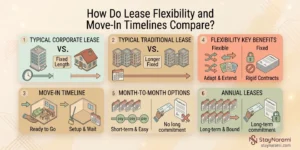
Longer-stay hotels are generally preferable when time is the only consideration‚ but a hotel-style reservation can be helpful if the employee needs to book travel with very short notice‚ or does not know how long they will be away․
Corporate housing often has more requirements since the residential property has to be matched to the relocation․ Generally‚ the employer is required to provide the destination‚ dates‚ household size‚ number of bedrooms‚ parking‚ pets‚ and preferred commute because the property must be located before the relocation․
The tradeoff is that the employee receives housing built around the longer stay rather than simply the fastest available room
StayNarami, for example, focuses on fully furnished housing throughout the U.S. for 30 days or longer, with stays that can run from 30 days to 12 months or more depending on the need. Its process begins with the team or employee’s location, size, and timeline before suitable furnished properties are sourced
An ordinary apartment is also at the opposite end of the spectrum‚ and while it is more stable once the lease is signed‚ the employee has to deal with the application‚ deposits‚ utility bills‚ internet‚ furniture‚ household goods, and lease․
Give the Move More Room to Work
StayNarami’s relocation housing is built for 30+ day transitions, giving employees the space, privacy, kitchens, and flexibility that can matter once a short hotel stay turns into several weeks or months.
Which Option Is Better for Relocating With Pets or Children?
The answer depends much more on the household than on the housing label
While a traveling employee with a small dog may be adequately housed in a pet-friendly extended-stay hotel‚ a family moving with two children‚ a large dog‚ two cars‚ and several months of belongings may require a different solution․
The importance of family needs is not theoretical. In Atlas’ 2026 survey, family issues or ties were the most commonly cited reason employees declined relocation, at 34%. Concerns about destination housing followed at 28%, and moving children between schools entered the survey’s top five barriers
Jack Griffin, Chairman and CEO of Atlas World Group, summarized the broader lesson by saying relocation must be “tailored to individuals’ unique needs.”
This is why employers should check what an actual family household requires before booking․
Example: An employee with a spouse and two children and a dog who relocates to Nashville starts working on July 1․ The family does not want to sign a permanent lease until they have had a chance to assess school areas and test travel times․
A week in a hotel suite might be OK‚ but a furnished two- or three-bedroom apartment for the next two months might give the family the chance to start living more normally and help them decide where they want to live․
The point of temporary housing in this situation is not luxury. It is to give the family enough time to make a permanent decision without living in limbo
When Should You Choose an Apartment Instead of Corporate Housing or an Extended Stay Hotel?
A traditional apartment becomes more attractive when the temporary part of the move is effectively over
Consider it when:
- The employee expects to remain in the city for a long period
- The preferred neighborhood is known
- The commute has been tested
- The employee is comfortable making a fixed lease commitment
- The permanent household has arrived
- The employee is willing to arrange furniture and utilities if needed
- There is little chance the assignment dates will change
If you want to stay six or twelve months‚ and your money will last that long‚ the math works․ The mistake is signing a long-term lease simply because of the relatively low monthly rent․
If the employee discovers after three weeks that the neighborhood is wrong, their children’s school is too far away, or the commute takes an hour, the lower base rent may have bought the wrong home
Temporary furnished housing is most useful while those questions are still unanswered
Why Do We Recommend Corporate Housing Over Extended Stay Hotels for Relocation?
For short, uncertain stays, we do not believe corporate housing automatically beats an extended-stay hotel
Hotels have a clear role. They are usually easy to reserve‚ require little set-up‚ and in the case of modern extended-stay hotels, may include kitchens‚ Wi-Fi‚ laundry, and pets․
When relocations last longer than 30 days and need a place to live‚ a case for corporate housing could be made․
At that point, employers should start thinking about:
- Separate living and sleeping areas
- Household size
- Family privacy
- Normal meal preparation
- Laundry
- Residential parking
- Work-from-home space
- Pets
- Location
- Extension options
- One clear housing cost
This is also where StayNarami’s model fits. StayNarami sources fully furnished homes and apartments around the employee or team’s needs and handles the process from property sourcing through move-in. Its current service is designed around 30+ day temporary housing across the United States
For finance and relocation teams, StayNarami also uses all-in quoting designed to make the housing cost easier to compare without piecing together multiple hotel incidentals and separate charges
The goal is not to put every relocated employee into the same kind of property. A person moving alone for 32 days and a family of five relocating for four months should not receive identical housing simply because both moves appear on the same relocation spreadsheet
The housing should match the move
Choose Housing for the Move, Not Just the First Night
Tell StayNarami the destination, household size, dates, budget, pets, parking, and expected timeline to find furnished housing that fits the relocation from arrival through the next step.
Conclusion
The decision between corporate housing vs extended stay hotels becomes much easier once employers stop asking, “Which one is better?” and start asking, “Which one fits this relocation?”
An extended-stay hotel can be a strong choice when the stay is short, arrival is immediate, or the departure date is uncertain. Corporate housing becomes more useful when the employee will stay for 30 days or longer and needs residential space, privacy, a normal kitchen, family-friendly layouts, and a place that feels practical for everyday life
A traditional apartment deserves consideration once the employee knows where they want to live and is ready to accept a longer lease and the setup that comes with it
When comparing corporate housing vs extended stay hotels vs apartments, use the all-in cost rather than the advertised rate. Then look at stay length, bedrooms, family size, parking, pets, commute, utilities, furniture, flexibility, and setup work
The cheapest line item is not always the least expensive relocation
The best option is the one that gives the employee suitable housing for the period between arriving in the city and being ready to call it home
Frequently Asked Questions
1. Is corporate housing cheaper than an extended stay hotel?
It can be, particularly on longer stays, but there is no universal rule. Extended-stay hotels may offer discounted weekly and monthly rates, while corporate housing may bundle furniture, utilities, internet, parking, and other costs. Compare actual quotes for the same location and dates instead of relying on a national average
2. What’s the difference between extended stay and corporate housing?
An extended-stay property is still a hotel, even when it offers a kitchen and longer-term rates. Corporate housing generally uses furnished residential apartments, condos, or homes intended for temporary stays, commonly longer than 30 days
3. Is it better to rent an apartment or stay in corporate housing during relocation?
Corporate housing can make more sense while the employee is still learning the city or waiting for permanent housing. A regular apartment may become more economical once the location and length of stay are certain and the employee is comfortable taking on a longer lease
4. Do extended stay hotels have kitchens like corporate housing?
Some do. Kitchen facilities vary by hotel brand and property. Extended Stay America, for example, states that its suites include full kitchens with refrigerators, stovetops, and microwaves. Employers should confirm the actual kitchen setup before booking
5. Which option is best for relocating with a family?
Corporate housing is often worth considering for longer family relocations because residential properties can provide multiple bedrooms, living space, kitchens, and greater privacy. However, household size, location, budget, pets, and length of stay should determine the final choice
6. How long can you stay at an extended stay hotel before it becomes cheaper to rent?
There is no fixed break-even date. Hotel discounts, local rents, taxes, furniture, utilities, lease terms, deposits, and the cost of ending a lease early all change the calculation. Once the stay becomes several months long and the dates are stable, compare a regular apartment’s complete setup cost against both furnished corporate housing and the hotel’s long-stay quote
7. Is corporate housing more private than an extended stay hotel?
Corporate housing generally provides a residential environment instead of a hotel environment, which can give employees more separation from other guests and more normal living space. The actual level of privacy still depends on the property type and layout
Need housing for your team?
Tell us what you need and we'll take care of the rest — anywhere in the U.S., 30+ days.
Request Housing →Related Articles