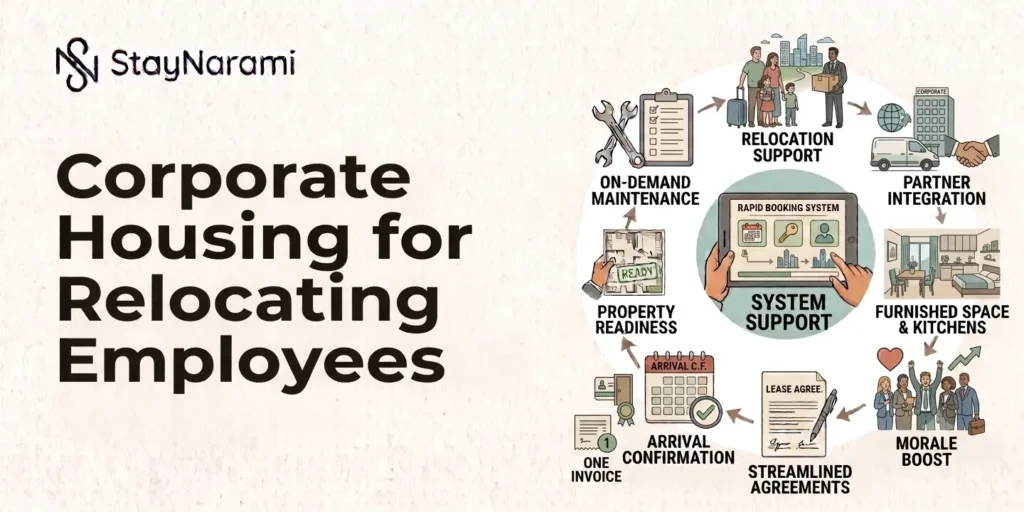
Corporate Housing for Relocating Employees

Give Them a Place to Land Before They Choose Where to Stay
StayNarami helps relocating employees settle into furnished housing while they start the new job, explore neighborhoods, and make permanent housing decisions without unnecessary pressure.
Relocating for work rarely happens in a neat sequence. Employees may need to start before selling a home, explore an unfamiliar city before signing a lease, or give their families time to compare schools, commutes, childcare, and housing costs.
The need for flexibility is growing. The 2026 Atlas Corporate Relocation Survey of 549 relocation decision-makers found that more than half of companies reported increased employee moves, while housing concerns and family ties remained leading reasons employees declined relocation opportunities.
A 2025 Ipsos study of 10,574 workers across 19 countries also found that 67% would be more likely to consider relocating internationally if temporary housing were provided.
This is where corporate housing for relocating employees can help. Furnished temporary housing gives employees time to start work, settle into a new area, and make permanent housing decisions without unnecessary pressure.
TL;DR (Too Long; Didn’t Read)
- Built for HR teams‚ mobility managers‚ employers‚ and relocation teams that arrange temporary housing for employees moving to a new city․
- Corporate housing may support employees relocating to an assignment‚ awaiting a home purchase to close‚ or finding a permanent residence․ An ideal corporate housing unit would be customized with the employee’s household size‚ commute to work‚ move in date‚ budget‚ pets‚ parking‚ and proclivity for requiring an extension to the stay․
- So for the employer part‚ it’s not about the corporate housing versus the hotel or extra stipend option‚ it’s about making sure that there’s enough stability for the employee to start a new job without having to make a housing decision․
- This guide will tell you how to select relocation housing‚ compare total costs‚ compare providers and family/house-hunting considerations‚ and create a repeatable relocation process for future employees․
What Is Corporate Housing for Relocating Employees?
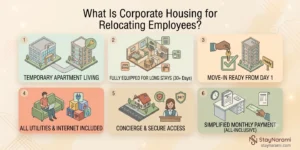
Corporate housing is furnished temporary housing that is provided by businesses for employees to stay in while waiting to move to a new location or find permanent housing․
This can be a furnished apartment‚ condo‚ townhouse, or house‚ depending on the location and the household‚ in which the property is already set up‚ and ready for normal use․ Furniture may be provided‚ as well as other amenities such as utilities‚ internet access‚ kitchen access‚ and others․
For employee relocation, the stay may cover several situations:
- A new hire starts work before their permanent apartment is available.
- An employee transfers to another city but wants time to explore neighborhoods before buying.
- A family arrives before the closing date on its new home.
- The employee’s existing home has not yet sold.
- A longer relocation requires temporary accommodation while permanent housing is arranged.
- A company needs housing for an employee whose start date cannot move with the real estate timeline.
Corporate housing fills the gap between “I need to be in the new city now” and “I know where I want to live permanently.”․
That distinction matters. Temporary housing should not force someone to make a permanent housing decision faster. It should buy them enough time to make a better one.
Why Should Companies Choose Corporate Housing Over Hotels for Relocations?
Hotels still have a useful place in relocation. If an employee needs four nights in a hotel to get their keys‚ a hotel might be the best option․
The calculation changes when four nights becomes four weeks.
In a standard hotel room, one can sleep and spend a short time‚ but when an employee is transferred for weeks or months‚ the employee may work all day‚ contact real estate brokers‚ view apartments‚ fill out forms‚ help the children adapt‚ and keep tabs on dozens of other details․
Corporate housing provides more of the things needed for ordinary daily life.
Factor |
Typical Hotel Stay |
Corporate Housing |
| Kitchen | Often limited or unavailable | Usually a full kitchen |
| Living space | Mainly one room | Separate living and sleeping areas may be available |
| Laundry | May be shared or paid separately | In-unit or property laundry may be available |
| Length of stay | Best suited to shorter stays | Designed for extended temporary stays |
| Family use | Can become restrictive | Larger layouts can better fit families |
| Work-from-home space | Often limited | More room for working may be available |
| Meal options | Greater dependence on restaurants | Employee can prepare normal meals |
| Residential feel | Hotel environment | More similar to everyday home life |
| Extension needs | Depends on hotel availability and changing rates | Can be arranged around longer temporary stays, depending on terms |
It is not our goal to prove corporate housing is cheaper than a hotel․ Prices vary widely by city‚ property‚ time of year‚ taxes‚ parking availability, and the length of stay․
Employers should include the room rate‚ but also taxes‚ parking‚ laundry‚ meals‚ internet‚ deposits for equipment‚ cleaning‚ pet fees‚ transportation‚ and extension of stay in the stay cost․
A $150 hotel room may not be comparable to a furnished apartment even if the nightly rental value of the apartment exceeds the hotel’s nightly rate‚ if the former has restaurant meals‚ parking, and laundry fees‚ while the latter may have a kitchen‚ parking‚ utilities, and space․
What Makes a Corporate Housing Solution the Best Fit for Relocated Employees?
The best corporate housing solutions for relocated employees may not be the newest apartment complex or even the building with the most amenities․
A better test is whether the property works for that person’s actual relocation.
Employers should start with five questions.
1. How long is the employee likely to need temporary housing?
Do not use only the ideal permanent move-in date.
Ask what happens if a home closing is delayed by three weeks or an apartment is not ready on schedule. Flexible extension terms can be more valuable than saving a small amount on the original monthly rate.
2. Where does the employee need to be each day?
A property should be evaluated using real commute time rather than straight-line distance.
Housing eight miles from an office may be less practical than housing twelve miles away if one route regularly takes twice as long.
3. Who is relocating?
A person moving alone has different needs from an employee relocating with a spouse, two children, and a dog.
Consider:
- Number of bedrooms
- Number of bathrooms
- Pet requirements
- Parking
- Accessibility
- Childcare and school location
- Grocery stores
- Public transportation
- Work location
- Healthcare access
4. What does the employee need while searching for a permanent home?
Someone who expects to buy a home may want temporary housing near several neighborhoods they are considering rather than directly beside the office.
That can make weekend house hunting much easier.
5. What is included in the price?
Ask the total cost before you agree on housing․ The quote must include the utilities‚ internet‚ parking‚ furniture‚ cleaning services‚ taxes‚ deposits‚ pets‚ any extension/break/cancellation fees‚ and early departure․
What Should Employers Look for When Choosing a Corporate Housing Provider?
A housing provider is not simply supplying a bed. During relocation, the provider becomes part of a process that can last several weeks or months.
Look closely at the following areas.
1. Clear property information
Employees should know where they are staying‚ what is in the property, and what is included before arriving․
Should accurately reflect current photos‚ number of bedrooms‚ parking‚ pet restrictions‚ laundry‚ and utilities included․
2. Flexible dates
House closings change. Construction on a new apartment can run late. Employees may find permanent housing faster than expected.
Ask how extensions and early departures are handled before booking.
3. A realistic location
Near downtown or close to the office may be vague․You should consider the employee’s commute and where they might actually be going at the time․
4. One clear contact
When a lock stops working, or the internet fails, employees should know exactly who handles it. HR should not have to become the maintenance department.
5. Straightforward billing
The employer should be able to see the full housing cost without searching through several separate charges and reimbursements.
6. Ability to support different household needs
Relocation housing may not necessarily find housing that accommodates all employees as singles‚ afamilies ly‚ pet needs‚ accessibility‚ vehicle transport needs‚ and alternate work arrangements may be involved․
How Does Corporate Housing Support Employees During the House-Hunting Phase?
One of the biggest benefits of temporary housing is something employers may not see on an invoice: time.
Imagine an employee transferring from Chicago to Dallas with a spouse and two children. Their job begins September 1, but they know little about the area.
Without temporary housing, they may fly in for one weekend, tour six homes, and feel pressured to choose one because the start date is approaching.
With six or eight weeks of furnished housing, the decision changes. They can drive the commute during actual rush hour. The family can visit neighborhoods on weekends. They can compare school travel times, grocery access, housing prices, and the parts of the city that fit how they live.
Temporary housing does not remove the work involved in moving. It gives the employee room to do that work without making every decision before the first day on the job.
That idea is supported by broader relocation research. In the Ipsos study, workers considering international moves placed importance not only on pay but also on cost of living, healthcare, work flexibility, and other parts of everyday life.
CERC President and CEO Stephen Cryne summarized the broader challenge well:
“Businesses must go beyond offering financial incentives—adopting a holistic strategy that supports employees both professionally and personally is essential.”
Housing is one practical part of that support.
What Amenities Matter Most for Relocating Employees in Corporate Housing?
A rooftop lounge looks good in property photos. During a relocation, a washing machine may matter much more.
Employers should prioritize amenities according to daily use.
1. Full kitchen
A kitchen lets employees prepare normal meals rather than relying on restaurants or takeout for several weeks.
2. Laundry
Easy laundry access becomes increasingly important as a temporary stay gets longer.
3. Reliable internet
Internet may be required for work or school research‚ searching for a home‚ paperwork‚ banking‚ and communicating with real estate agents․
4. Comfortable sleeping arrangements
Just because a place says “sleeps six” doesn’t mean six people could live there for two months․ Check the number of beds and bedrooms․
5. Parking
Check how many vehicles can park‚ where permitted‚ and whether there is an additional fee for parking․
6. Workspace
Staff working from home may appreciate having enough space to hold virtual meetings (not having to use their bed as a desk) and work at a computer․
7. Pet accommodation
If the employee has a pet‚ confirm fees‚ breed or size restrictions‚ deposits‚ and policies prior to booking․
8. Household space
For family travel‚ places with separate bedrooms and at least some common living space may be preferable to adjacent rooms in a hotel․
How Do Companies Set Up Corporate Housing for Employees Moving to a New City?
However‚ where there is a repeatable process‚ this can lessen the burden on HR and the employee․
1. Step 1: Confirm the basic move details
Collect:
- Destination city
- Work location
- Move-in date
- Expected stay
- Number of occupants
- Children
- Pets
- Vehicles
- Accessibility requirements
- Monthly housing budget
2. Step 2: Set an acceptable commute
Define the employee’s preferred commute before searching.
A housing search based only on a city name can return properties far from the places that matter.
3. Step 3: Separate needs from preferences
A two-bedroom property may be required. A gym may simply be preferred.
This distinction becomes especially useful when housing inventory is tight.
4. Step 4: Review complete costs
Do not approve the accommodation using base rent alone.
Compare everything the employer is expected to pay during the proposed stay.
5. Step 5: Confirm extension and cancellation rules
Get both in writing.
6. Step 6: Give the employee complete move-in information
Before the employee’s arrival‚ the employee should have the property address‚ property access instructions‚ parking instructions‚ WiFi instructions‚ emergency contact information‚ maintenance contact information, and rules and regulations․
7. Step 7: Check in after arrival
A brief follow-up can catch a practical problem early instead of allowing it to affect the employee’s first weeks in a new role.
Make the Move Easier From Day One
StayNarami’s temporary housing for job relocation gives employees a move-in-ready home for 30+ day transitions, with options matched to their destination, household, commute, and relocation timeline.
How Do We Provide Corporate Housing for Relocating Employees?
At StayNarami, the housing search starts with the details of the move rather than a fixed list of properties.
StayNarami currently provides temporary housing in the United States and specializes in fully furnished housing for 30 days or more․ Rental requests submit their location‚ number of people‚ desired start date‚ desired length of stay‚ and monthly budget․ Based on the submitted criteria‚ StayNarami will then source housing for the requester․
For an employee moving‚ that would mean searches beginning with questions such as:
- Where is the employee’s new workplace?
- When must the employee arrive?
- How long is temporary housing likely to be required?
- Is the employee relocating alone or with family?
- Are pets coming?
- How many vehicles need parking?
- What is the employer’s housing budget?
- Is the stay likely to need an extension?
Once those details are clear, suitable furnished properties can be sourced around the requirement rather than asking the employee to sort through unrelated short-term listings.
This can be particularly useful when the employer is relocating people to different markets. It makes it easy for HR to re-use this information checklist when an employee moves to another city‚ but changes the requirements of the property that is needed․
For instance‚ one employee may need a 45-day rental of a one-bedroom apartment close to a downtown office‚ while another employee may need a 90-day rental of a fully furnished three-bedroom house while relocating with children and pets․ Both relocations are employee relocations‚ but they require different approaches to a housing solution․
That is the point of a needs-based approach.
Corporate Housing vs. a Relocation Stipend
Corporate housing and a relocation stipend solve different problems.
A stipend gives the employee money and leaves some or all of the housing search to them. Corporate housing gives the employee an arranged place to live for a defined period.
Corporate Housing |
Relocation Stipend |
| Employer or provider can arrange the accommodation | Employee generally arranges accommodation |
| Housing cost can be reviewed before booking | Employee decides how allowance is spent |
| Easier to apply housing standards | Property quality depends on employee selection |
| Less searching for the employee | More choice for the employee |
| Useful when arrival dates are fixed | Useful when employees prefer control over the move |
| Can reduce the number of immediate setup tasks | May require the employee to pay or arrange costs directly |
Neither model is automatically better.
Some employers also combine the two. For example, they may provide 30 to 60 days of temporary housing plus a relocation allowance for other moving expenses.
Employers should have payroll or tax professionals review how relocation payments and employer-paid expenses are treated. Under current federal tax rules, many employer-paid moving expenses do not qualify for the previous general income exclusion, with limited exceptions.
Move the Employee First. Let the Permanent Home Come Next.
Share the destination, start date, household size, budget, pets, vehicles, and expected stay with StayNarami to find furnished housing that keeps the relocation moving while the long-term plans come together.
Conclusion
Corporate housing for relocating employees works best when it is treated as transition housing rather than simply another travel booking.
The employee needs enough stability to begin a new job without being forced to solve permanent housing at the same time. For the employer, that means choosing accommodation based on the length of stay, real commute, household size, amenities, total cost, extension terms, and the employee’s permanent housing plans.
A good temporary home will not make every part of relocation easy. It can, however, remove one major problem from the employee’s first few weeks in a new city.
And that can give them something extremely useful during a move: enough time to decide what comes next.
Frequently Asked Questions
1. What is corporate housing for employee relocation?
Corporate housing is furnished temporary accommodation provided while an employee moves to a new location. It can give the employee somewhere ready to live while they begin work, search for permanent housing, wait for a home closing, or complete other parts of the move.
2. Do companies typically provide corporate housing for new hires relocating?
Some do, depending on the employer, position, relocation policy, and length of the move. Temporary housing may be offered directly, reimbursed, included within a relocation package, or combined with other relocation benefits.
3. How is corporate housing different from a relocation stipend?
Corporate housing provides or arranges the accommodation itself. A relocation stipend gives the employee money that can be used toward eligible moving or housing costs according to the employer’s policy.
4. Is corporate housing more convenient than an apartment for relocated employees?
It can be more convenient during the first stage of relocation because furnishings and basic household services are already arranged. A standard long-term apartment may require a longer lease, furniture, utility setup, internet installation, and other commitments that an employee may not want before deciding where to live permanently.
5. Can families be accommodated in corporate housing during relocation?
Yes, depending on local availability. Employers should provide the household size, number of bedrooms needed, children’s needs, pets, vehicles, accessibility requirements, and preferred location when requesting housing.
6. How do companies choose the best corporate housing provider for relocations?
Compare providers based on location, housing quality, full pricing, furnished amenities, lease flexibility, response times, support during the stay, billing process, extension rules, and their ability to match housing to the employee’s household rather than offering the same property type to everyone.
7. Is corporate housing move-in ready for relocating employees?
Corporate housing is generally intended to be furnished and ready for temporary occupancy. Employers should still confirm exactly what furniture, utilities, internet, kitchen items, laundry facilities, linens, parking, and other services are included before the employee arrives.
Need housing for your team?
Tell us what you need and we'll take care of the rest — anywhere in the U.S., 30+ days.
Request Housing →Related Articles