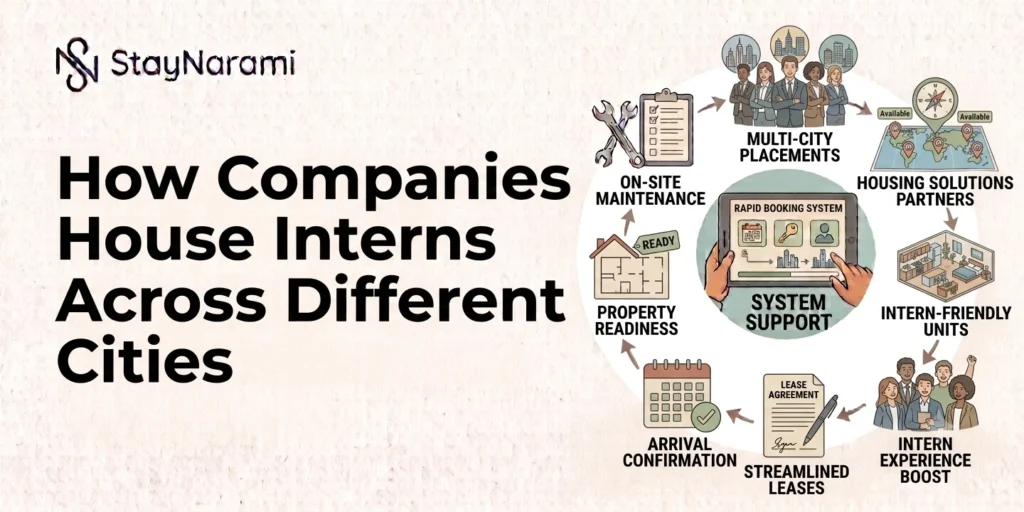
How Companies House Interns Across Different Cities

One Program. Multiple Cities. Less Housing Chaos.
StayNarami helps you coordinate furnished intern housing across markets without managing every city separately.
Housing one group of interns in one city is manageable. Housing interns in New York, Austin, Chicago, Atlanta, and Seattle at the same time is a different problem.
Securing enough apartments is just one of the challenges the HR and early-talent teams must negotiate․ The teams also have to manage rental prices‚ lease lengths‚ neighborhoods‚ commutes‚ arrival dates‚ roommates‚ security deposits‚ utilities‚ and standards for the apartment in each market․ One city may have plentiful furnished inventory while another becomes difficult to book just weeks before the program starts․
Housing also affects who can realistically accept an internship. According to the National Association of Colleges and Employers’ 2026 Internship & Co-op Survey, about half of participating employers provide financial relocation assistance to interns. Among employers assisting, the average lump-sum support was $3,310 for housing and $1,417 for travel. Employers may consider the cost of living‚ distance to the job site‚ and the overall duration of the program in determining financial assistance․
That is why multi-city intern housing needs to be planned as one program rather than a collection of unrelated bookings. Companies need to determine how and where internships will be housed‚ what housing standards should be‚ how much to budget for local housing markets‚ who to contact if problems arise‚ and how to make changes in dates and headcount․
TL;DR (Too Long; Didn’t Read)
- Designed originally for HR teams‚ early-talent leaders‚ and companies running multiple distinct intern programs in multiple cities․
- The multi-city intern housing program is best set up when standard aspects are handled at a general level across companies (such as budget‚ type of housing‚ acceptable commute times‚ acceptable roommate arrangements‚ and move-in processes), but cases are handled independently at the city level․
- The goal is not identical apartments everywhere. It is a consistent housing experience without forcing HR to manage dozens of unrelated landlords, leases, invoices, and support contacts.
- This guide explains how to control costs across markets, coordinate arrivals, maintain housing standards, support interns, and run one nationwide housing process.
What Is Multi-City Intern Housing and Why Do Companies Need It?
Multi-city intern housing means arranging temporary housing for interns who will be working in two (or more) different cities during one internship program․ For example‚ a company might hire:
- 20 interns for its New York office
- 12 interns in Dallas
- 8 interns in Chicago
- 6 interns in Atlanta
Though all interns may begin during the same two weeks‚ their housing needs are not necessarily identical․
A two-bedroom apartment in Dallas may be too expensive in New York․ One city may have effective public transport while the other requires a car or a parking space․ In certain markets‚ furnished apartments are available for a 10-week stay; in others‚ stays are typically longer․
The company therefore needs two things at once: local flexibility and program-wide consistency.
NACE’s earlier internship research also found that more than three-quarters of surveyed employers offering relocation assistance believed it helped produce a better applicant pool. Housing support can therefore affect more than logistics; it may widen the number of students who can reasonably consider an internship away from home.
“Take care of associates, and they’ll take care of your customers.” — J. Willard Marriott.
That principle applies well to internship programs. An intern who arrives in a new city without worrying about furniture, utilities, unsafe listings, or a surprise two-hour commute can start the program in a much better position.
What Challenges Do Companies Face When Housing Interns Across Multiple Cities?

The cardinal sin is to think that what works well here will work everywhere․
1. Different Rental Markets
Housing prices and availability can change sharply between cities. That makes one national per-intern housing allowance difficult to use fairly.
A $3,000 budget may cover a very different type of property depending on the market.
2. Different Commute Needs
Being five miles from the office does not mean the same thing everywhere.
An apartment five miles away may be an easy train ride in one city but a long rush hour car commute in another․
Companies should therefore measure location using expected commute time, not distance alone.
3. Different Intern Arrival Dates
One university may finish classes in early May while another finishes in June. International interns may also arrive earlier because of travel arrangements.
Housing dates should be based on actual arrival and departure windows rather than one program-wide move-in date.
4. Changing Headcounts
Interns decline offers. Teams add late hires. Start dates move.
If every unit is booked around the maximum possible headcount months in advance, the company may pay for empty beds. If it waits too long, the remaining housing may be expensive or poorly located.
Good multi-city intern housing planning leaves room for both outcomes.
What Types of Housing Options Work Best for Multi-City Intern Programs?
No one housing type will be the best in every city․
Housing Type |
Best Fit |
Main Advantage |
Main Limitation |
| Furnished apartments | 30+ day programs | Kitchen, living space, move-in readiness | Availability varies by city |
| Corporate housing | Larger organized programs | Easier central coordination | Rates vary by market |
| University summer housing | Summer programs near campuses | Often designed around student schedules | Limited dates and locations |
| Extended-stay hotels | Small groups or uncertain dates | Flexible booking | Less living space for longer stays |
| Traditional leases | Longer assignments | May provide more housing choices | Furniture, deposits, utilities, and lease setup |
| Shared furnished homes | Groups comfortable living together | Can reduce per-person cost | Roommate and occupancy planning required |
Interns‚ in internships of eight‚ ten‚ or twelve weeks‚ often receive furnished housing‚ so they do not have to buy beds‚ desks‚ cookware‚ and other things needed to furnish an apartment․
Even if the initial apartment prices are lower‚ the company charges additional fees for renting furniture‚ internet access‚ utilities‚ deposits‚ and household goods setup time․ These amounts should be compared to the total cost of housing‚ not rent․
How Do Companies Standardize Housing Quality Across Different Cities?
Consistency does not mean that all interns share the same floor plan or even the same furniture․ It means defining a minimum standard that applies everywhere.
A multi-city intern housing checklist might require:
- A clean and functional furnished unit
- A real bed for each assigned intern
- Working Wi-Fi
- Kitchen or suitable cooking facilities
- Laundry access
- Working heating and cooling
- Safe locks and building access
- Reasonable access to the work location
- Clear parking information where cars are needed
- A defined maintenance contact
- Utilities active before arrival
- No hidden sleeping arrangements such as sofa beds unless agreed in advance
The company can then allow each city to solve those requirements differently. For example‚ the Manhattan intern might live in a small apartment near public transit‚ while the Dallas intern might live in a larger apartment with a parking spot but further away from downtown․ Though the properties are different‚ both apartments satisfy the same basic program․
How Do We Coordinate Move-Ins and Move-Outs Across Multiple Locations?
Most move-in issues have to do with missing information rather than with the property․ Create one housing roster that includes:
- Intern name
- Work city
- Office address
- Property address
- Move-in date
- Move-out date
- Flight or arrival time when relevant
- Roommate assignment
- Parking requirement
- Key or access instructions
- Housing contact
- Emergency contact
Do not send this information through scattered email chains if dozens of interns are involved. A central housing tracker makes it easier to spot problems. If 18 interns arrive in three cities on the same Sunday, the team can see where after-hours access needs to be arranged before anyone reaches the door.
1. Example
Imagine a company has 42 interns arriving across Austin, Chicago, and Boston. Instead of treating each booking separately, the housing coordinator creates three city groups and then assigns every intern an exact property, roommate, arrival window, and access method.
Three days before arrival, the coordinator confirms that utilities are active and access instructions have been sent.
That simple process can prevent dozens of individual “Where do I go?” messages on move-in day.
Give Interns a Better Place to Start
StayNarami provides furnished 30+ day housing for students and interns, with options matched to each city, commute, dates, and program needs.
How Do Companies Manage Housing Costs Across Cities With Different Price Ranges?
Trying to force every city into the same dollar limit is usually the wrong starting point.
NACE reports that cost-of-living analysis is one of the factors employers already use when setting intern relocation assistance.
The same principle works when companies arrange the housing directly. Create city-specific budget ranges instead. For each market, calculate:
Monthly property cost + utilities + parking + taxes + cleaning + deposits or fees + transportation impact = total housing cost
Then divide that figure by the number of interns housed. This produces a much more useful cost per intern.
Suppose Apartment A costs $7,000 per month and houses four interns, while Apartment B costs $5,800 but houses only two. Apartment B looks cheaper at the property level but is much more expensive per intern.
Companies should also track empty-bed cost. If four apartments are booked for interns who later withdraw, the unused space can erase savings gained elsewhere.
How Does a Single Housing Partner Simplify Multi-City Intern Placements?
Managing every city independently can create a long list of contacts.
The HR team may end up communicating with apartment managers in Boston, leasing agents in Dallas, property owners in Atlanta, and hotels in another market. Each one may have different invoices, contracts, payment dates, maintenance processes, and cancellation terms.
A nationwide housing partner can reduce the number of moving parts. Instead of asking:
“Who manages the Denver apartment?”
The team has one primary housing contact. That can simplify:
- Housing searches
- Property comparisons
- Furnished-unit requirements
- Move-in coordination
- Billing
- Extensions
- Maintenance communication
- Headcount changes
- Property replacements when needed
StayNarami’s current housing model is built around nationwide furnished placements for corporate teams and other temporary assignments lasting 30 days or more, with housing sourced according to team size, location, and timeline.
For multi-city intern housing, that structure can be especially useful when the same HR or early-talent team is responsible for several offices.
How Do We Support Interns Relocating to a New City for the First Time?
Not every intern has signed their lease‚ roomed with a stranger‚ used a city subway system‚ or traveled hundreds of miles from family․ Sometimes‚ giving them an address is not enough․
Before arrival, send a short housing guide covering:
- Exact property address
- Move-in process
- What is already provided
- What interns should bring
- Roommate names
- Laundry access
- Nearest grocery options
- Office commute
- Public transportation
- Parking rules
- Building rules
- Maintenance contact
- Emergency procedure
- Move-out expectations
The company should also be clear on what will not be covered․ If the interns must pay for parking‚ extra cleaning‚ broken items‚ or upgrades, it should be communicated before arrival․ Clear information is preferred over long welcome packets that no one reads․
How Do We Help Companies Manage Multi-City Intern Housing Nationwide?
A strong multi-city intern housing plan starts before individual properties are selected.
Companies should first provide:
- Every internship city
- Office or worksite addresses
- Expected intern headcount by city
- Desired move-in and move-out dates
- Budget range for each market
- Preferred roommate arrangement
- Vehicle and parking needs
- Maximum acceptable commute
- Required amenities
- Expected changes in headcount or dates
From there, housing can be sourced around the actual program rather than filling one request at a time.
StayNarami is a temporary, fully furnished housing service throughout the US‚ with a minimum stay period of 30 days․ The service includes an initial consultation regarding the housing location‚ number of people‚ time period, and budget‚ followed by a housing search and moving-in process.
For the nationwide intern program‚ though‚ the company gets an advantage‚ since it can standardize its housing process with the ability to pick which locations work well․
Keep Every City Under One Housing Plan
StayNarami helps you manage locations, headcounts, dates, and housing needs through one clear process.
Conclusion
Companies housing interns across different cities do not need identical apartments everywhere. They need identical standards and a repeatable process.
The most effective multi-city intern housing programs usually establish the budget, minimum housing standards, commute limits, roommate rules, move-in process, and communication structure before the first property is booked.
Then each city can be handled according to its actual rental market.
That balance matters. They would also like centralized policies and procedures‚ where possible‚ but with the flexibility to deal with the needs of each site․
When companies get that right‚ interns spend less of their first week trying to solve housing problems‚ and HR teams spend less of their summer managing dozens of disconnected leases and property contacts․
Frequently Asked Questions
1. How do large companies house interns in different cities?
Many use a combination of furnished apartments‚ corporate housing‚ university housing‚ extended-stay hotels, and housing allowances․ Large programs may cluster them so that the human resources department can apply the same basic housing requirements to multiple locations without requiring a reservation at each location․
2. Is it cheaper to use one housing provider for multiple cities?
It can reduce administrative work and make costs easier to track, but using one provider does not automatically guarantee lower rents. The bigger advantage is having fewer contracts, contacts, invoices, and booking processes to manage. Companies should still compare the total cost per intern in each market.
3. Do intern housing costs vary a lot by city?
Yes. Rent, short-term housing supply, parking, neighborhood, season, apartment size, and distance from major employment areas can create large differences between cities. Market-specific budgets usually work better than one fixed national amount.
4. Can one platform manage intern housing for a nationwide internship program?
A nationwide temporary housing partner can coordinate placements in multiple locations as long as suitable housing is available in the required markets. Before choosing a provider, employers should check geographic coverage, minimum stays, furnishing standards, billing, and support procedures.
5. How do companies ensure consistent housing quality across locations?
Create minimum standards before the housing search starts. These might include proper beds, furniture, utilities, internet, kitchen access, laundry, cleanliness, security, acceptable commute times, and a clear maintenance process. The buildings do not need to look alike to provide a consistent experience.
6. What cities have the highest demand for intern housing?
Large employment and university markets tend to see strong summer demand. New York, Boston, Washington, D.C., Chicago, Austin, Seattle, and the San Francisco Bay Area are examples of markets where summer temporary housing can become competitive.
However, employers should focus more on inventory near their actual office than on a national city ranking. A city may have plenty of housing overall but very little that fits a specific budget and commute.
7. How far in advance should companies plan multi-city intern housing?
Planning should begin once approximate intern counts and locations are known, even if every offer has not yet been accepted. Larger programs benefit from starting several months before summer so teams can establish budgets, property standards, and likely demand before the best-fitting options become limited.
Need housing for your team?
Tell us what you need and we'll take care of the rest — anywhere in the U.S., 30+ days.
Request Housing →Related Articles