The Complete Guide to Corporate Housing for Construction Crews & Out-of-State Project Teams (2026)

Every out-of-state construction project runs into the same problem: where is the crew going to sleep? It sounds like a minor logistics detail, but it holds a very important aspect.
According to the Bureau of Labor Statistics, construction remains one of the most mobile workforces in the country, with crews regularly relocating for projects that stretch anywhere from a few weeks to over a year. That kind of movement means housing isn’t a side expense, but it is an important part that cannot be ignored.
In fact, the U.S. construction industry employs over 8 million workers, and according to industry surveys, companies spend an average of $150-$250 per worker per night on hotel accommodations – costs that can be cut by 30-40% by switching to corporate housing.
This is where corporate housing for construction crews plays a major role instead of organizing workers into crowded hotel rooms or going for short-term rentals on listing sites that weren’t built for crews of ten or more.
Whereas corporate housing offers furnished, lease-ready apartments designed for groups working away from home, understanding how this model works can mean the difference between a smooth deployment and a logistics hassle.
TL;DR (Too Long; Didn’t Read)
- Built for construction company owners, project managers, and HR/ops teams who need to house out-of-state crews without relying on hotels or unreliable short-term rentals.
- Answers the questions crews and managers ask most: How to cut lodging costs?, How to simplify group billing?, How to keep workers close to job sites?, and How to scale housing up or down as headcount changes?
- The solution: Corporate housing fully furnished, lease-ready apartments designed specifically for construction teams, with one invoice, one point of contact, and flat predictable rates.
- Over 8 million U.S. construction workers, and companies switching from hotels to corporate housing report 30-40% savings on accommodation costs.
- In this guide you will get the full cost comparison, a checklist for vetting housing providers, a step-by-step planning process for out-of-state projects, and answers to common FAQ’s related to corporate housing for construction crews.
Why Hotels Don’t Work for Construction Crews
This management is ineffective for large projects because hotels are designed for visitors staying two or three nights, not for crews working twelve-hour shifts for months at a time.
Most hotel rooms don’t have a real kitchen, which means you have to arrange every meal. This will add daily housekeeping interruptions, and a compact space will give you more stress.
A few specific pain points come up again and again:
- No separation between workdays, since there’s nowhere to unwind outside a single small room
- Laundry costs add up fast when crews are paying per load at hotel machines or sending clothes out
- Group billing through hotels requires managers to manually reconcile dozens of bills, which is often labor-intensive and error-prone.
- Parking for trucks, trailers, or work vehicles is rarely designed into hotel lots
- Long stays at hotel rates quietly become one of the most expensive parts of the entire project.
What Is Corporate Housing for Construction Teams?
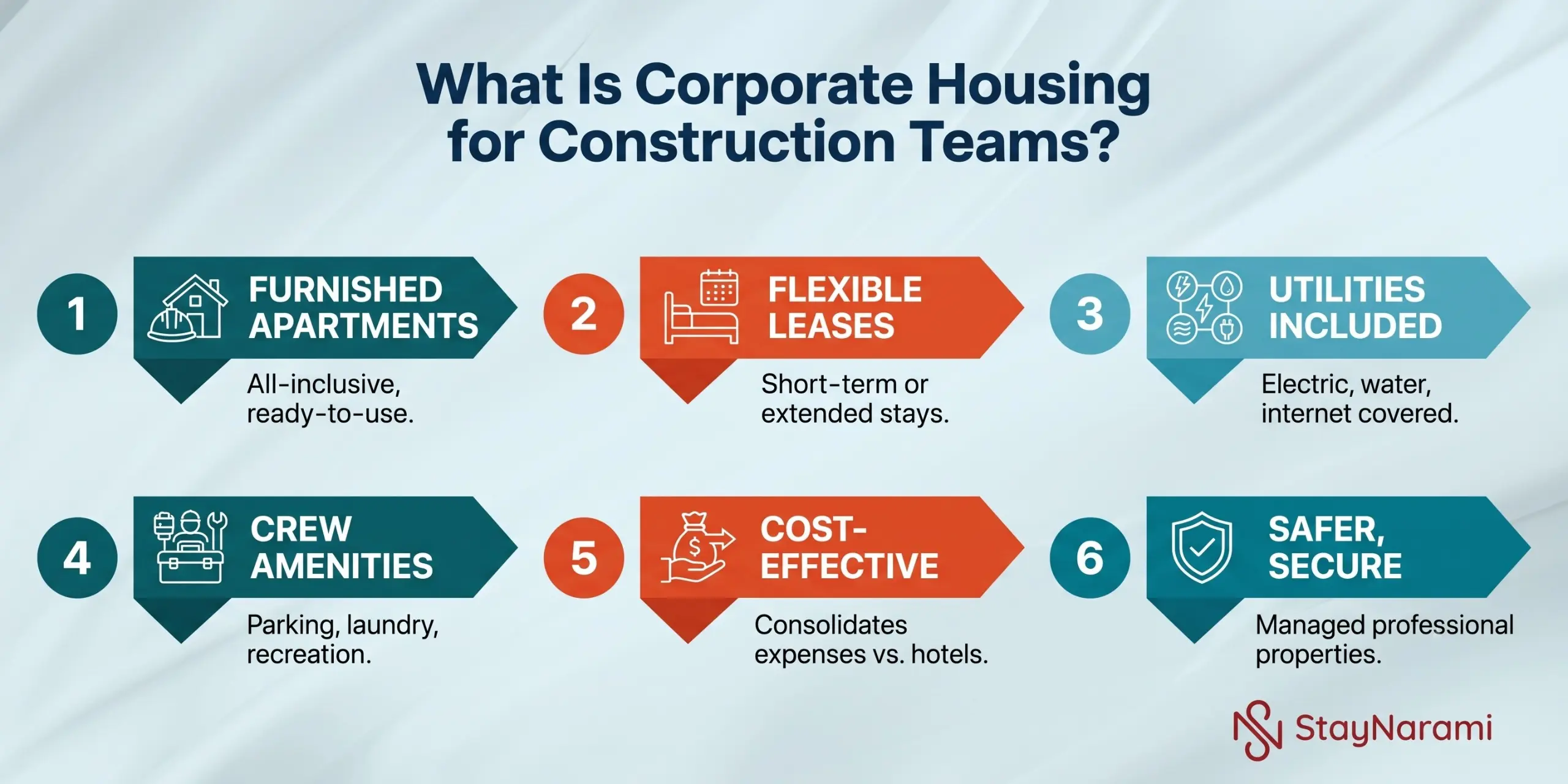
Corporate housing for construction crews is fully furnished housing, usually apartments or small homes, leased out for weeks or months at a time specifically for project teams working away from their home base.
In order for a crew to move in and begin living like they would at home, each unit usually comes with furniture, kitchen appliances, Wi-Fi, and basic utilities already set up. This is what separates it from furnished housing for construction workers booked through general listing sites, where availability, quality, and group capacity vary wildly from one booking to the next.
For project teams, this model solves a few problems at once, like crews getting private bedrooms with shared common spaces, which keeps costs reasonable while still giving people room to breathe after a long shift.
Instead of managing big reservations across various platforms, managers will have a single point of contact for billing, maintenance, and lease terms. Because these properties are selected with crews in mind, they are often closer to job sites, have better parking, and are easier to scale up or down as project headcount shifts.
Key Benefits of Corporate Housing for Project Teams
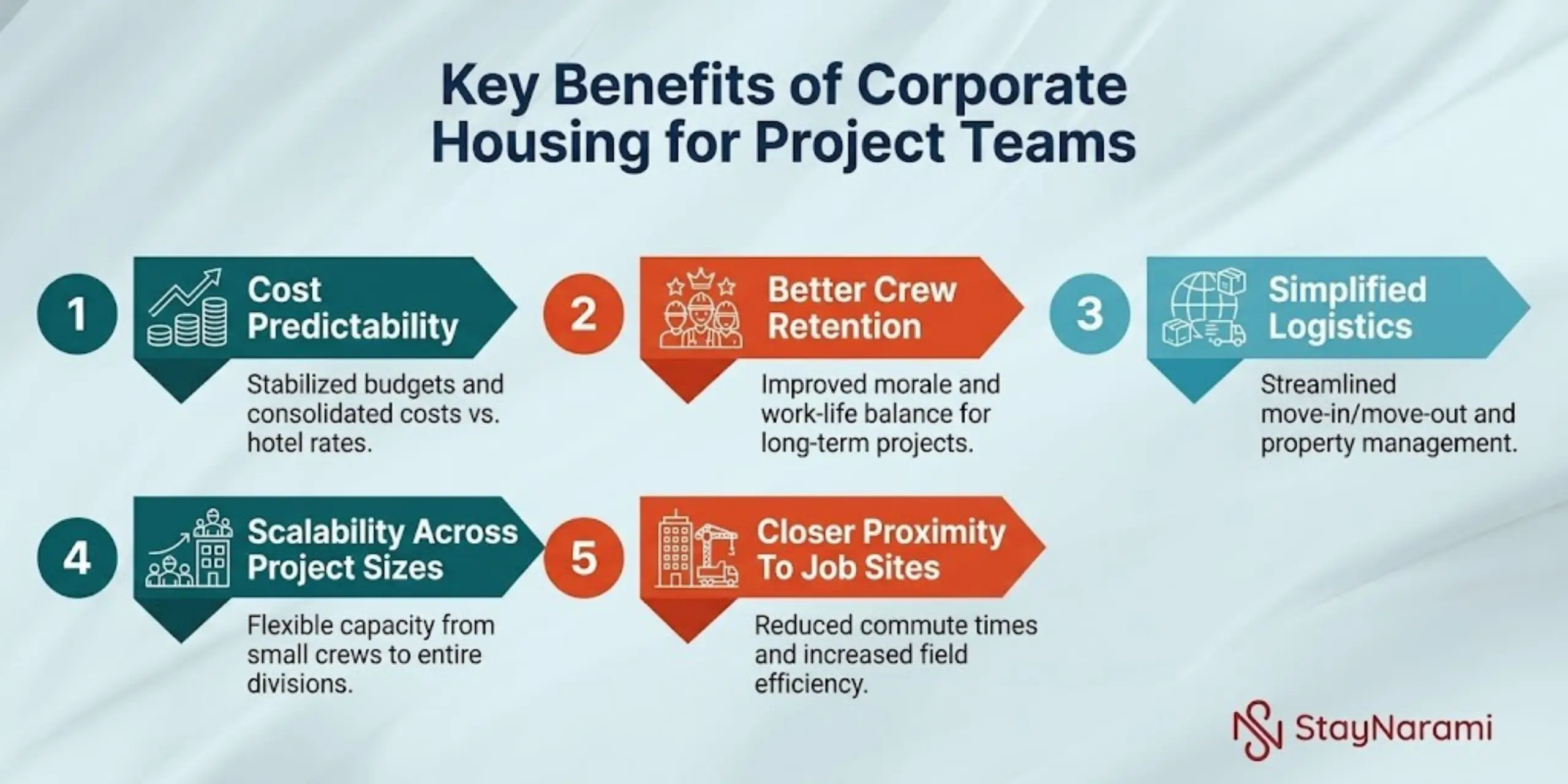
1. Cost Predictability
Hotel rates will fluctuate with demand and season, which makes budgeting a little tough, and corporate housing is typically offered as a flat monthly or weekly rate, so finance teams can guess accurately months ahead of a project even starting.
2. Better Crew Retention
Workers who get a real kitchen, a simple bedroom, and a living room to relax in tend to stick around longer on out-of-state assignments. So, this simply means fewer people quitting mid-project, which means less searching for replacement hires and less disruption to the schedule.
3. Simplified Logistics
This simply means one lease, one invoice, and one provider managing maintenance requests across the whole crew. That’s a significant reduction in administrative load compared to managing a dozen separate hotel reservations or rental listings.
4. Scalability Across Project Sizes
Corporate housing providers can usually adjust their unit counts up or down as headcount changes, whether they are a five-person specialty crew or a fifty-person team managing a multi-phase build. This is something that hotels and individual rentals find difficult to match.
5. Closer Proximity To Job Sites
Providers who specialize in workforce housing solutions often have existing relationships with property managers near industrial and project hubs, thus reducing commute time for crews who’d otherwise be driving 40 minutes each way from a hotel near the airport.
Ready to simplify housing for your next out-of-state project? Talk to our team about furnished crew housing options near your job site, available for crews of any size on flexible lease terms.
Workforce housing is no longer a fringe benefit – it’s a competitive advantage. Companies that get crew housing right spend less time on logistics and more time on production.” — Gregg Logan, Managing Director, RCLCO Real Estate Consulting
What to Look for in a Corporate Housing Provider?
Not every corporate housing provider operates the same way, and the difference matters once you are actually relying on them for a live project. A few things worth checking before signing anything:
1. Flexible Lease Terms
Project schedules change frequently, and a provider bound by strict 12-month minimums isn’t designed for construction projects, where early wrap-ups and extensions are the rule rather than the exception.
2. Group Billing And Centralized Invoicing
One consolidated invoice per billing cycle saves enormous time compared to reconciling individual worker expenses.
3. Proximity To Job Sites
Ask specifically how close available units are to the project location, not just to the nearest city center.
4. Furnishing Quality And Consistency
Photos can be deceiving. So ask for recent unit walkthroughs or video tours before committing a crew of twenty to a property.
5. Maintenance Responsiveness
Ask about average maintenance turnaround times upfront.
6. Experience With Construction Crews Specifically
A provider that mainly handles corporate relocations for office employees may not understand crew schedules, parking needs for work trucks, or the wear and tear that comes with twelve-hour shift living.
This is also where the difference between corporate housing and hotels for crews becomes clearest. Hotels rarely offer any of the above as standard, since their entire booking model is built around short individual stays, not group logistics over months.
How to Plan Crew Housing for an Out-of-State Project
- Start with the project timeline, including likely extensions. Crews rarely finish exactly on schedule, so build in a buffer room when negotiating lease length so an extension doesn’t mean starting the housing search over from scratch mid-project.
- Map out crew size and any expected fluctuations. A project that starts with eight workers might scale to twenty-five during a peak phase, so letting your provider know this upfront helps them plan unit availability rather than scrambling for last-minute capacity.
- Confirm proximity and commute realities. A unit that looks close on a map can still mean a 35-minute drive during local traffic patterns. Ask locals or the provider directly about realistic commute times during work hours.
- Book earlier than feels necessary. Good crew housing inventory near active job sites tends to move quickly, especially in markets with multiple concurrent projects. Booking four to six weeks ahead of mobilization gives far more flexibility than scrambling two weeks out.
- Keep the crew informed about expectations. When people move in, a brief explanation of what is and isn’t included, as well as house rules regarding common areas, helps to avoid conflict.
Labor availability and worker retention are among the top challenges facing construction firms today – and housing stability for traveling crews directly affects both.
Corporate Housing vs. Other Options: Full Comparison
| Factor | Hotels | Airbnb / Short-Term Rentals | Corporate Housing |
| Kitchen access | Rarely, or mini-fridge only | Usually yes | Yes, fully equipped |
| Group billing | Manual, per-room | Per-listing, inconsistent | Centralized, single invoice |
| Lease flexibility | Nightly only | Host-dependent, often rigid | Built for weeks or months |
| Scalability for crew size | Limited by room count | Limited by individual listings | Designed to scale up or down |
| Proximity to job sites | Often near highways/airports | Varies widely | Frequently near industrial zones |
| Maintenance support | Hotel staff, limited scope | Host-dependent, can be slow | Dedicated property management |
| Cost predictability | Fluctuates with demand | Varies by season/host | Flat, predictable rate |
| Privacy and space | One small room | Often good, no consistency | Private rooms, shared common areas |
This comparison makes the gap fairly obvious once you set it out. Hotels work fine for a two-night stay. Short-term rentals can work in a hurry, but availability and consistency aren’t guaranteed at scale. Corporate housing is the only option actually built around the realities of project-based crew deployment.
How Corporate Housing Makes a Difference In Real Life
- A 12-person electrical crew on a six-month commercial build. Initially booked into two hotels split across town due to room availability, the crew lost nearly an hour each day just coordinating pickup and drop-off between locations. So, moving into a single corporate housing property near the site consolidated everyone under one roof and cut that daily time loss entirely.
- A specialty crew was brought in for a three-week emergency repair job. With such a short window, the company almost defaulted to hotels by default, since most providers assume short stays only suit hotel-style bookings. A short-term housing arrangement for contractors instead gave the six-person team a shared house with a full kitchen, which kept food costs down and let the crew cook proper meals after long days instead of living on gas station food.
Conclusion
For out-of-state crews, housing decisions are typically handled as an extra factor until they become a daily challenge. Hotels weren’t built for long stays and large groups, and individual short-term rentals don’t scale cleanly once a project grows. With furnished, adaptable, and predictable housing designed around how project teams actually work and live during an assignment, corporate housing for construction crews fills that exact gap.
If you are planning for a five-person crew on a short repair job or a fifty-person team on a year-long build, then getting housing sorted early, with a provider who understands construction timelines, saves money, reduces turnover, and keeps the focus where it belongs: on the project itself.
Frequently Asked Questions
1. Is corporate housing for construction crews tax-deductible for the company?
In most cases, housing provided for employees working away from their tax home qualifies as a deductible business expense. However, specifics depend on how the arrangement is structured and on current guidelines. It’s worth reviewing details with a tax professional familiar with construction-specific deductions.
2. How far in advance should I book corporate housing for my crew?
Four to six weeks before mobilization is a safe window in most markets, though high-demand areas with multiple active projects may require even earlier booking to secure the right unit count near the job site.
3. What happens to the housing arrangement if a project timeline changes or gets extended?
Most corporate housing providers offer flexible lease extensions, unlike rigid hotel contracts or individual rental agreements. It’s still worth confirming extension terms and notice periods before signing the original lease.
4. Can corporate housing accommodate crews of different sizes – from 5 workers to 50 plus?
In contrast to hotels’ short-term rentals, workforce housing solution providers usually manage several units within the same complex or adjacent properties, making it much easier to scale headcount up or down.
5. Who typically pays for crew housing – the company or the individual worker?
This varies by company policy, but in most construction settings, the employer covers housing directly as a project cost, often structured alongside per-stipend allowances rather than paid out separately after the fact.
Need housing for your team?
Tell us what you need and we'll take care of the rest — anywhere in the U.S., 30+ days.
Request Housing →