Housing Logistics for Large Construction Projects (10+ Workers)

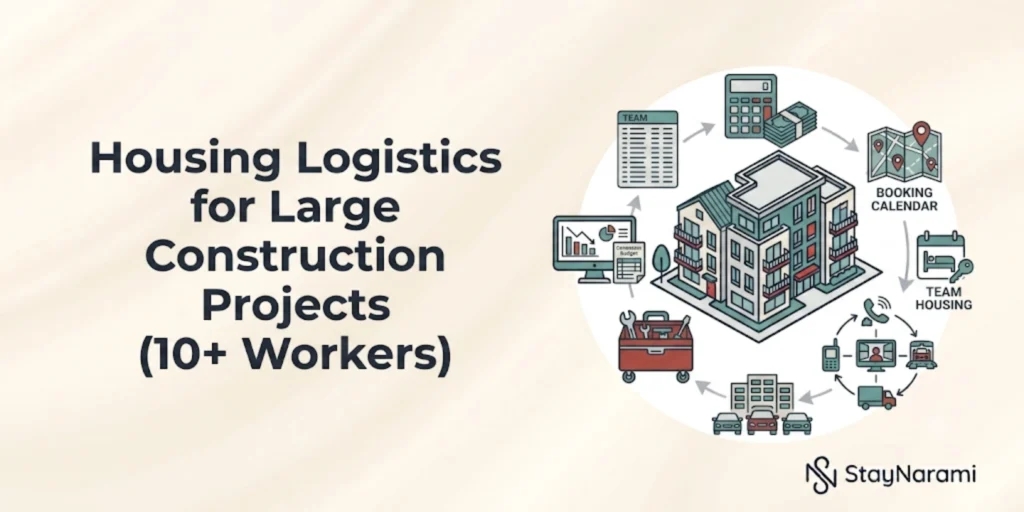
Housing 10+ Workers Requires More Than Rooms
StayNarami finds flexible crew housing near the job site, even as your team size and schedule change.
In 2011, western North Dakota faced a problem that can happen whenever a major project brings workers into a small or already crowded market. Jobs were available, drilling activity was growing, and thousands of temporary workers were needed. However, the local housing supply could not keep up.
A 2011 state-funded report cited an estimate from the North Dakota Housing Finance Agency that about 6,200 temporary workers would be needed to drill new wells. With too little temporary housing available, finding places for those workers became a major challenge. One portable housing complex with 158 bedrooms was moved into the region, but local officials described it as only a temporary answer to a much larger shortage.
The report raised one simple question:
“We can get people a job almost any day they show up, but where are they going to stay?”
Source: North Dakota Rural EMS Improvement Project report.
This historical example shows why housing logistics for large construction crews should begin before workers arrive. Rooms may be sold out. Parking may be full. Workers may be placed too far from the job site. Reservations may also be difficult to change. That is why crew housing should be planned before workers arrive.
TL;DR (Too Long; Didn’t Read)
- Built for construction company owners, project managers, workforce coordinators, and operations teams arranging temporary housing for crews of 10 or more workers.
- Answers the key questions: How many beds should you reserve during each project phase? How can you avoid paying for empty rooms? How close should housing be to the job site? And what should every large-crew housing agreement include?
- The solution is a centralized housing plan built around weekly headcount forecasts, usable bednights, shift schedules, vehicle requirements, commute limits, and flexible terms for extensions or early departures.
- Large crews can lose significant time through poor housing placement. For example, if 20 workers spend an additional 30 minutes commuting each day for 60 workdays, the crew loses approximately 600 hours to extra travel.
- In this guide, you will learn how to forecast housing demand, calculate cost per occupied bed-night, choose suitable properties, confirm work-truck and trailer parking, protect worker rest, manage booking changes, and prepare backup housing for unexpected disruptions.
Why Does Crew Housing Become Harder After 10 Workers?
There is no exact point at which crew housing becomes difficult. However, once a company is housing 10, 20, or 50 workers, informal booking methods are usually no longer enough.
Different trades may arrive at different times. Some workers leave early, replacements arrive midweek, and night-shift employees need quieter rooms. Trucks and trailers may require secure parking. Choosing the right accommodation strategy can help reduce housing costs for construction projects while ensuring worker comfort. One property may lack enough rooms, but spreading the crew too widely makes transportation and communication harder.
The goal is not only to find beds. It is to keep the correct number of usable beds available during every project phase.
How To Plan Housing For Construction Crews Of 10+ Workers
1. Build A Weekly Demand Forecast
Create a housing schedule with each worker’s trade, arrival date, departure date, shift, vehicle needs, room type, and supervisor contact.
Forecast by week as crew size varies in mobilization, peak work, inspection, and closeout. Have a little give or take for emergency replacements, but don’t pay for that extra throughout the project.
2. Calculate Bed-Nights Before Comparing Rates
Use this formula:
Workers × nights = total bed-nights
As per the above formula, a 15-worker crew requires 900 bed-nights for its 60-night stay. Compare properties based on the actual cost per bed per night, including rent, taxes, cleaning, deposits, parking, utilities, internet, and transportation.
Rates can change by destination and season. Federal lodging benchmarks also use location-specific and sometimes month-specific rates, showing why one flat estimate may not fit a long project.
3. Define A Realistic Range Of Travel
The lowest-priced house can be expensive if the commute is too far.
If 20 workers spend an extra 15 minutes traveling each way for 60 workdays, the crew loses 600 hours to additional travel. Make a comparison of housing and transport costs; fuel, paid travel time, car wear & maintenance, and risk of late shift starts.
Match The Housing Type To The Project Length
Extended-stay hotels and properties are suitable for short assignments, changing dates, and staggered check-in times for traveling construction teams. Stable crews may prefer furnished apartments or houses if they are going to be there for several weeks or months, as kitchens, laundry, and other communal appliances are often provided.
A hybrid plan can also work. Supervisors and long-term workers can use furnished housing, while rotating trades use flexible rooms nearby. Keep properties within the same small area whenever possible.
How To Choose The Right Property
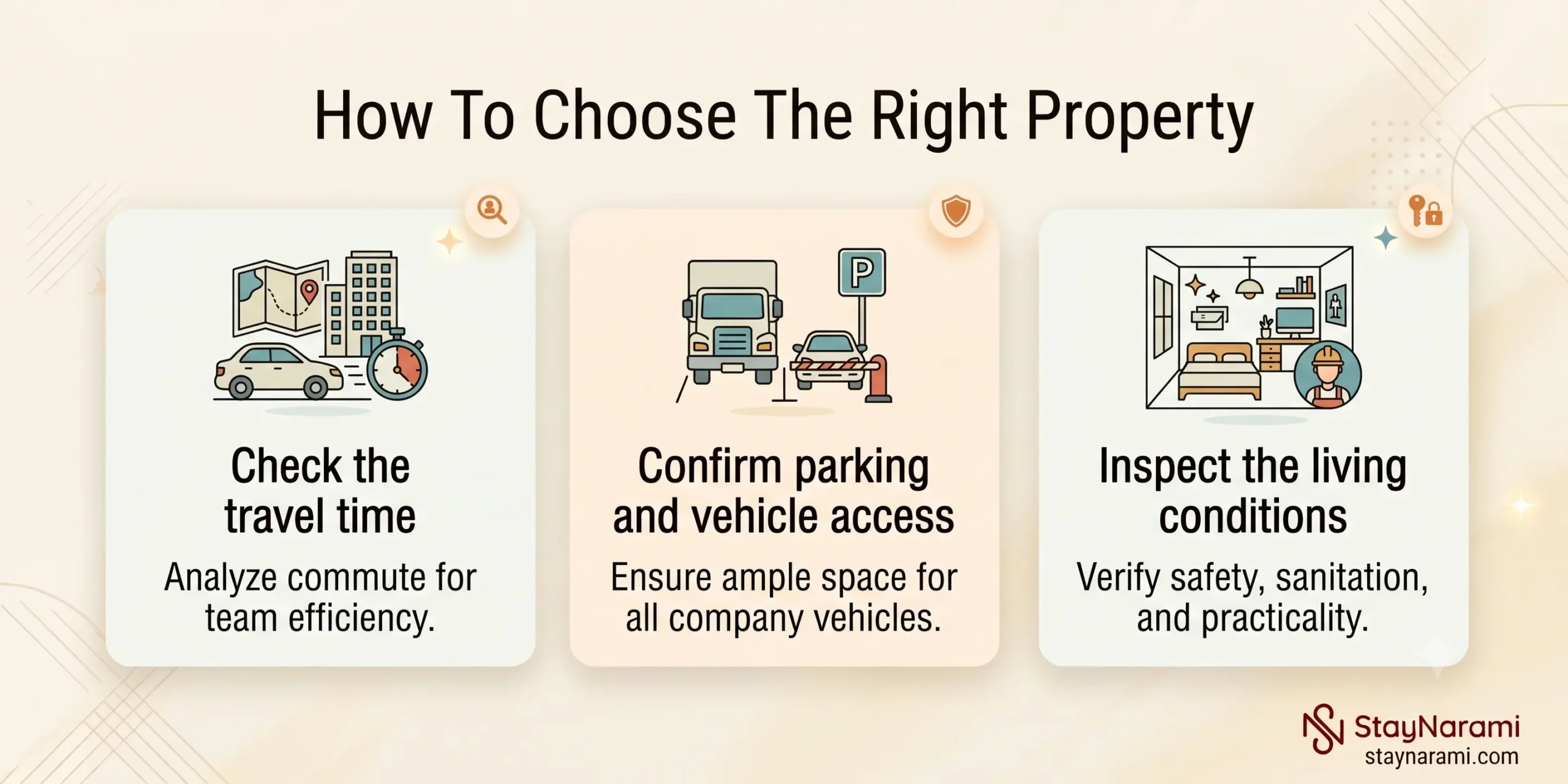
1. Check the Travel Time
A lower-cost house might be more expensive if it is a distance away from the jobsite. Before choosing a property, compare:
- The travel time during actual shift hours.
- The estimated fuel cost.
- Vehicle wear and maintenance.
- Paid travel time, when applicable.
- The risk of workers arriving late.
2. Confirm Parking and Vehicle Access
Do not assume that a property can accommodate construction vehicles. Ask the property manager clear questions:
- How many vehicles can the crew park?
- Are pickup trucks and work vans allowed?
- Can equipment trailers remain overnight?
- Is parking included in the rate?
- Are there height, length, or access limits?
- Can workers leave early in the morning?
The answers should be confirmed in writing.
3. Inspect the Living Conditions
Housing should give workers a clean and practical place to rest after physically demanding work.
The National Institute for Occupational Safety and Health states:
“Fatigue can slow down reaction times.”
Poor sleep does more than make workers tired. It can affect focus, memory, and decision-making. For crews working long hours or night shifts, a proper place to sleep is a safety need, not a comfort extra.
Check the following before booking:
- The property has working heating and air conditioning.
- Each worker has a proper bed.
- Night-shift workers can sleep in quiet rooms.
- The bathrooms are suitable for the crew size.
- The kitchen has enough storage and cooking space.
- The property has enough washing machines and dryers.
- The internet connection is reliable.
- Grocery stores and basic services are nearby.
Issues may not be evident on listing photos, but a video tour or actual inspection can show them.
Keep Your Entire Crew Housed and Organized
Explore furnished housing for 10+ workers, long-term projects, and changing crew sizes.
What Should Every Housing Agreement Cover?
A low nightly rate has little value if the booking cannot be adjusted when the project schedule changes. Before confirming housing logistics for large construction crews, document:
- Room, bed, and occupancy limits
- Extension and early-departure terms
- Dates for releasing unused rooms
- Worker replacement procedures
- Deposit, damage, and cleaning rules
- Parking for work vehicles
- Billing and maintenance contacts
- After-hours check-in instructions
Have all agreements, property information, room lists, and emergency contacts in one shared file. Avoid taking things on word alone.
Make Rest a Priority
Construction work is hard on the body. Workers need enough sleep to recover and stay alert. Most adults need at least seven hours of sleep. Without it, workers may struggle to focus, make decisions, and work safely. Providing comfortable construction crew housing helps ensure workers have a proper place to rest and recover after long shifts.
Check for noise levels, heating/cooling systems, blackout curtains for night shift workers, bathroom facilities, laundry facilities, kitchen facilities, internet, parking, and local grocery stores. Safe living space, potable water, sanitary facilities, cooking facilities, laundry facilities, air exchange, and proximity to the job are also key worker-accommodation considerations.
If possible, conduct an inspection prior to move-in. Photos listed on the website may not show road access, parking configuration, layout of space, or neighborhood noise.
Create One Control Point For Changes And Costs
Assign one housing coordinator and one backup. Workers should not create separate bookings except during an emergency.
Track five numbers each week:
- Beds booked
- Beds occupied
- Empty paid beds
- Cost per occupied bed-night
- Average commute time
Review these figures during project meetings. If paid occupancy stays low, release rooms, combine properties, or change the booking structure.
The U.S. General Services Administration provides location-based federal lodging rates that can be used as a general budgeting reference. For fiscal year 2026, the standard federal lodging rate is $110 per night in locations without a separate local rate. However, this is a federal reimbursement limit, not a guaranteed market price.
Keep A Backup Plan Ready
Maintain one backup property, a small emergency-room allowance, and a process for adding workers after hours. Plan for vehicle problems, property repairs, bad weather, unexpected project extensions, and arrange temporary housing for construction crew to ensure uninterrupted project operations.
A backup arrangement may require a fee or deposit, so confirm the terms in advance. Even so, having a backup can prevent the entire crew from missing work when the original housing becomes unavailable.
Plan the Beds Before the Crew Arrives
Share your project dates, workforce schedule, bed requirements, vehicle count, and preferred commute to find suitable options before availability tightens.
Final Takeaway
Successful housing logistics for large construction crews begin with a clear worker schedule and an accurate bed-night calculation. The property should also provide reasonable travel time, suitable parking, clean living conditions, and flexible booking terms.
Before arranging housing for construction crews of 10+ workers, calculate the full cost, inspect the property, confirm every important condition in writing, and appoint one person to manage all changes. These simple steps can prevent unnecessary costs and last-minute housing problems.
Frequently Asked Questions
1. When should housing be booked?
Begin once the project location, estimated dates, and crew range are known. Final counts can be adjusted later when the agreement includes release and extension terms.
2. Is a hotel or a furnished rental better?
Hotels will typically facilitate easier changes. Furnished rentals can provide additional space, a kitchen, and laundry facilities for extended periods of time. Review total costs, flexibility, parking, commute, and stability of crew.
3. How can empty-room costs be reduced?
Forecast demand weekly, negotiate room-release dates, avoid booking peak headcount for the whole project, and track paid occupancy.
4. Who should manage crew housing?
One coordinator should control bookings, assignments, invoices, changes, and property communication. A backup should have access to the same records.
Need housing for your team?
Tell us what you need and we'll take care of the rest — anywhere in the U.S., 30+ days.
Request Housing →Related Articles