How to Find Housing for Construction Crews Working Out of State

Housing Your Crew Out of State?
Get furnished housing matched to your job-site location, crew size, vehicle needs, project dates, and preferred commute time.
A contractor wins a six-month project in another state. Six electricians arrive first. Eight more join during the installation stage, and a smaller crew stays to finish the job.
Since the crew size changes throughout the ongoing project, the manager needs flexible housing. The stay must have enough beds, kitchens, laundry facilities, and truck parking, and be close to the construction site. The booking should also allow extensions if the project runs late.
This is why finding out-of-state crew housing takes more planning than booking a few hotel rooms. The housing must align with each stage of the project, workers’ schedules, vehicle needs, budget, and potential date changes.
Apart from this, finding good housing for construction becomes even more important when skilled workers are already difficult to find. You will be surprised to know, but poor living conditions or long drives can leave workers tired, creating further challenges for an already limited crew.
TL;DR (Too Long; Didn’t Read)
- Built for construction company owners, project managers, and operations teams arranging temporary housing for crews working on out-of-state projects.
- Answers the most important questions: How early should you book crew housing? How do you keep workers close to the job site? How can you accommodate changing headcounts? And how do you compare the true cost of hotels, rentals, and furnished housing?
- The best solution is flexible, fully furnished construction crew housing with separate beds, kitchens, laundry facilities, reliable Wi-Fi, work-vehicle parking, and written extension terms.
- A poor housing location can create major productivity losses. For example, a 16-person crew commuting 90 minutes each day spends approximately 120 working hours on the road every week.
- In this guide, you will learn how to plan housing around each project phase, compare costs per worker-night, verify beds and parking, assess housing providers, prepare for schedule changes, and avoid unsuitable or fraudulent rentals.
Why Reliable Crew Housing Matters
According to a 2025 Associated General Contractors of America (AGC) survey of the workforce, the following traits would be most beneficial to the industry:
- 92% of construction companies that hired workers had difficulty finding qualified workers.
- 45% reported project delays caused by shortages involving their own employees or subcontractors.
- 78% had experienced at least one delayed project during the previous 12 months.
AGC chief economist Ken Simonson explained the problem clearly:
“Construction projects of all types are being delayed because there aren’t enough qualified workers available for firms to hire.”
When skilled employees agree to travel, poor housing should not become another reason a project falls behind. In this blog, we’ll help you find the perfect housing for your hardworking construction crews.
Why Out-of-State Construction Crew Housing Requires Planning
Housing, workforce, equipment, and site access should be planned alongside labor, equipment, transportation, and site access. Plan housing before the crew is ready to travel. If you delay the booking, it will directly increase your expenses and can also contribute to delayed work.
Picture this: a crew of 16 living 45 minutes from the job site spends 90 minutes on the road each day.
Over five workdays, the crew spends:
16 workers × 1.5 hours × 5 days = 120 travel hours
That equals five full days spent on the road.
A long commute also raises fuel costs and adds wear to company vehicles. Workers often arrive tired. And after all of this, they are left with less time to eat, rest, and sleep before the next shift. To avoid all of this, check the following before searching for housing:
- The starting and peak crew sizes
- Arrival and departure dates
- Room-sharing rules
- Number and type of work vehicles
- Acceptable commute time
- Required kitchens, bathrooms, and laundry
- Possible extension period
- Early-completion terms
- Total housing budget
1. Search From the Actual Job Site
Use the exact gate or entrance that workers will use each day. Do not search from the project owner’s office, the city center, or a ZIP code alone. A property 12 miles away may require workers to cross a congested bridge. Another property 18 miles away may offer a faster and more reliable route. Measure the commute during shift hours. A route that looks short at 2:00 p.m. may be much slower before an early shift or during evening traffic. For rural or remote projects, check:
- Road and winter conditions
- Toll roads and weight restrictions
- Nearby gas stations
- Mobile phone coverage
- Access for trucks and trailers
- Street lighting and security
- Flooding or seasonal road closures
Give housing providers a commute-time limit rather than only a mileage limit. “Within 25 minutes during the morning shift” is more useful than “within 10 miles.”
2. Build a Crew Housing Plan
Do not begin by asking for a certain number of houses or hotel rooms. Start with the number of workers and the bed arrangement. Create a roster showing each worker’s:
- Arrival and departure date
- Shift
- Supervisor
- Bedroom assignment
- Vehicle
- Room-sharing status
Separate the starting headcount from the peak headcount. Share the complete staffing schedule with the housing provider from the beginning.
3. Confirm Beds, Not Just Bedrooms
A four-bedroom property might have:
- One king bed
- Two queen beds
- One room with bunk beds
That arrangement may not meet a company policy requiring separate beds or private rooms for supervisors. Bathrooms also matter. A house advertised for 10 guests may have only one bathroom. That can cause delays when everyone starts the same shift. Ask for a written list of:
- Bedrooms
- Bed sizes
- Bathrooms
- Maximum occupancy
- Parking spaces
- Property access rules
4. Plan for Delays and Crew Changes
Schedules during the construction process are dynamic. Changes due to weather conditions, inspections, delays, change orders, and subcontractors’ schedules may delay the completion date. To ensure smooth planning for temporary housing for construction crew, it is essential to break the project down into three phases. This approach helps align housing arrangements with changing project timelines while minimizing disruptions and ensuring the crew has suitable accommodations throughout the project.
Confirmed period: The dates covered by the current project schedule.
Possible extension: Extra time that may be required if the project runs late.
Closeout period: The time needed for inspections, testing, punch-list work, and demobilization. Ask the provider:
- How much notice is required to extend the stay?
- Can only one unit be extended?
- Will the monthly rate change?
- Is another tenant scheduled after the original departure date?
- Can the crew size be reduced?
- What happens if the project finishes early?
A verbal promise is not enough. Extension and cancellation terms should appear in the housing agreement.
5. Compare the Full Cost
The advertised nightly or monthly rate does not show the complete housing cost. A quote may also include:
- Occupancy taxes
- Security deposits
- Cleaning charges
- Utilities
- Wi-Fi
- Furniture
- Parking
- Pet fees
- Housekeeping
- Administration fees
- Early-departure penalties
For fiscal year 2026, the General Services Administration standard travel rate includes up to $110 per night for lodging before taxes. It also includes $68 per day for meals and small travel expenses. Some cities and counties have higher rates. Check the rate for your project location before setting your housing budget. These are federal reimbursement limits. They are not required prices for private construction companies and do not guarantee that housing will be available at those rates.
Calculate Cost Per Worker-Night
A 12-person crew needs housing for 90 nights.
| Option | Base calculation | Added fees | Total cost | Cost per worker-night |
| Hotel | 6 rooms × $125 × 90 nights | Not included | $67,500 | $62.50 |
| Furnished housing | 3 furnished units | $5,000 | $47,000 | $43.52 |
Total worker-nights:
12 workers × 90 nights = 1,080 worker-nights
Hotel:
$67,500 ÷ 1,080 = $62.50 per worker-night
Furnished housing:
$47,000 ÷ 1,080 = $43.52 per worker-night
This is an example and not an estimate for the entire country. Rates may vary and are dependent on location, season, occupancy, parking, and length of stay.
Housing Options for Construction Crews
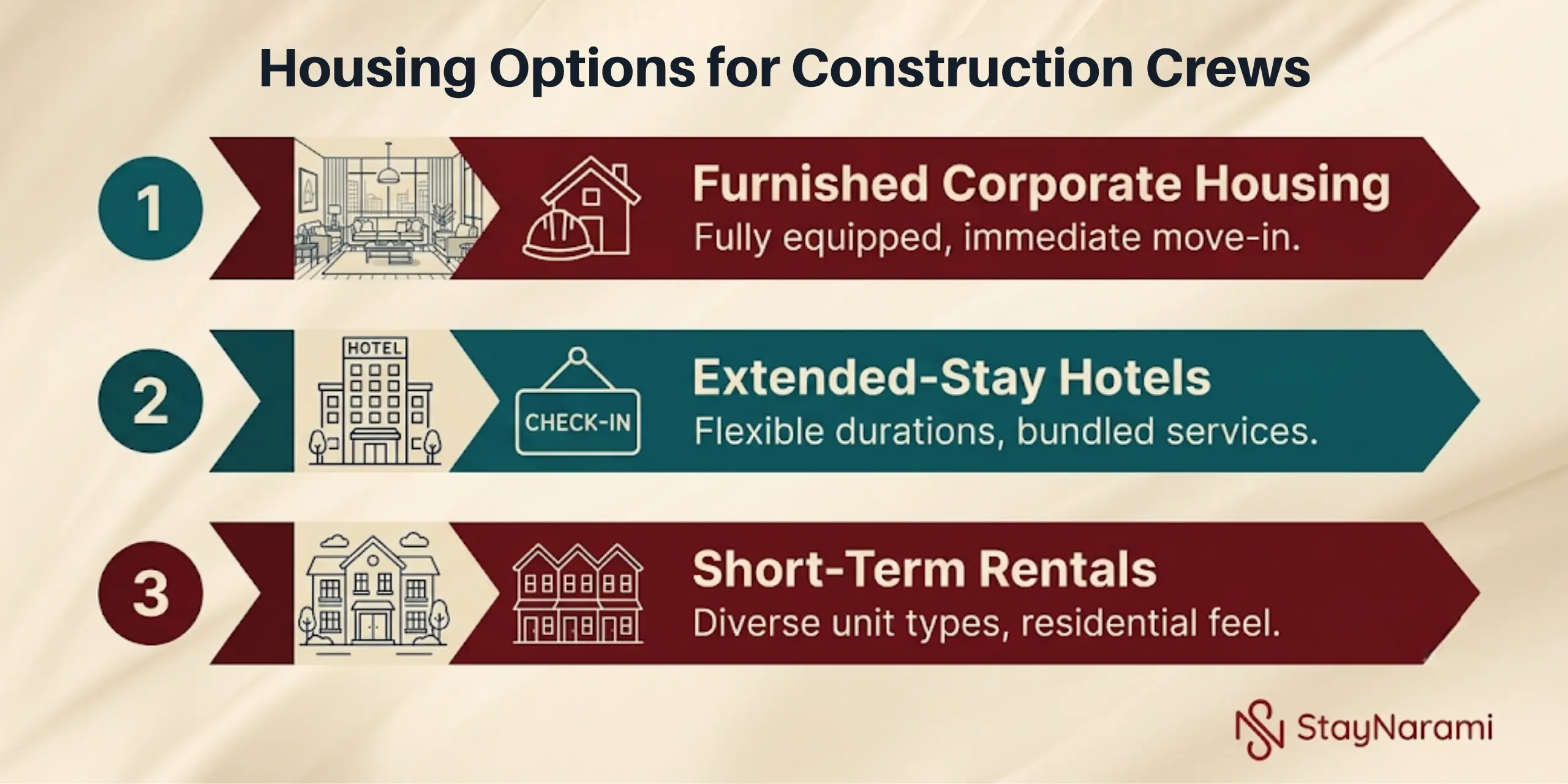
1. Furnished Corporate Housing
Corporate housing provides furnished homes for temporary business stays. The monthly cost may include:
- Furniture
- Utilities
- Wi Fi
- Kitchen supplies
- Laundry
- Parking
Corporate housing works well for projects that last 30 days or longer. It can also lower the cost when several workers share one property. Ask the housing provider for a full list of included items. A property listed as fully furnished does not always include everything your crew needs. Check for:
- Beds and bedding
- Cooking tools
- Dishes and utensils
- Washer and dryer access
- Internet service
- Utility limits
- Parking spaces
- Cleaning fees
2. Extended-Stay Hotels
In the case of small crews, critical schedules, and the beginning stage of an ongoing job, extended-stay hotels can be helpful. Accommodations may include a fridge, microwave, stove, desk, and access to guest laundry. It should be noted that some kitchen appliances, housekeeping services, and laundry costs may vary across hotels.
3. Short-Term Rentals
Short-term rentals often provide kitchens, laundry rooms, driveways, and shared living areas. They can help when corporate housing options are limited. However, each property has different rules. Owners set their own parking limits, cancellation terms, occupancy limits, fees, and maintenance policies.
Rental fraud is another concern. According to the Federal Trade Commission, consumers reported nearly 65,000 rental scams and approximately $65 million in losses between 2020 and December 2025.
Before sending money:
- Search the property address online.
- Compare the listing across several websites.
- Verify the owner or management company.
- Request a live video walkthrough.
- Ensure payment is made to the right person.
- Don’t wire money; use gift cards or cryptocurrency.
- Don’t pay without a signed contract.
Modular Housing and Workforce Camps
Modular housing or temporary workforce camps can be required for remote infrastructure projects and industrial and energy projects. While these can be a solution for a large team being placed near the project, they do need to be planned out with water, drainage, sewage, sanitation, laundry, waste collection, fire protection, food service, permits, and security taken into consideration.
The OSHA temporary labor camp standard includes requirements covering water, shelter, toilets, bathing, laundry, waste disposal, lighting, and sanitary conditions. Employer-operated housing is a decision that companies should make with legal, safety, and local permitting advice before establishing a camp.
Built for Construction Workers
Explore flexible furnished housing for projects lasting 30 days or longer, with kitchens, laundry, parking, and options for changing schedules.
See What Crew-Ready Housing Actually Looks Like
Private rooms, real kitchens – browse housing built specifically for construction teams, not tourists.
Where to Find Crew Housing
Work With a Workforce Housing Provider
A housing provider can search furnished apartments, homes, and other units based on the project’s requirements. Send a complete request:
“We need housing for 14 electricians from September 8 to February 28. The project may run eight weeks longer. Each worker needs a separate bed. We also need kitchens, laundry, Wi Fi, and parking for five pickup trucks and two cargo vans. Our shift starts at 6:00 a.m., so we want housing within 25 minutes of the job site.”
Clear information helps the provider find suitable housing faster.
Stay Narami helps companies find crew housing based on the number of workers, project dates, location, parking needs, and required amenities. Clear details help the team find suitable options faster. Connect with us to know more!
Contact Local Property Managers
Local apartment communities and property management companies may offer furnished units, company leases, or shorter rental terms. Ask about:
- Minimum lease periods
- Furniture packages
- Utilities
- Company billing
- Multiple units in one community
- Commercial vehicle parking
- Security deposits
- Early move-out charges
- Lease extension rules
Booking directly may save money in some cases. However, the contractor may then need to manage every lease, deposit, utility account, invoice, move-in, and repair request. That workload can become difficult when a crew is spread across several properties.
How to Check a Housing Provider
Before signing, request:
- Legal business name
- Business address
- Tax documentation
- Written rental agreement
- Billing contact
- Property manager’s contact details
- Maintenance process
- Deposit and refund terms
Read reviews carefully. Focus on comments about long stays, billing accuracy, property condition, maintenance response, extensions, parking, and deposit returns. Terms such as “flexible lease” or “crew-friendly” have little value unless the exact conditions appear in writing.
Managing Housing After Move-In
Assign one person to coordinate all crew housing. The coordinator should maintain:
- Worker and rooming rosters
- Arrival and departure dates
- Unit assignments
- Vehicle and license plate details
- Keys and access codes
- Move-in photographs
- Maintenance records
- Property rules
- Invoices and deposits
Notify the provider before moving workers between units or adding another person. A vacant bed does not automatically reduce the rent, and an unapproved worker could exceed the property’s occupancy limit.
How StayNarami Helps
StayNarami helps construction crews and project teams find fully furnished housing across the United States for stays of 30 days or longer.
Companies provide the job-site location, crew size, project dates, vehicle details, and housing requirements. StayNarami then searches for suitable furnished properties and helps coordinate the process through move-in.
We mostly provide all types of amenities, and our cost depends on their availability, and extension terms depend on the project and location. These details should be confirmed before booking.
Construction companies can request crew housing from StayNarami by submitting the job-site location, dates, team size, vehicle details, and accommodation requirements.
Secure Housing Before the Crew Arrives
Share your job-site address, staffing schedule, required amenities, and vehicle details to begin finding suitable crew accommodations.
Final Takeaway
The best construction crew housing is not always the property with the lowest nightly rate. It is the housing that:
- Keeps workers close to the job
- Accommodates the full crew safely
- Provides suitable parking
- Fits the project schedule
- Allows reasonable changes
- Reduces management work
- Stays within the complete project budget
Start with a clear housing request. Confirm the job site address, crew schedule, room sharing plan, number of vehicles, maximum commute time, required amenities, possible extension period, and total cost before you book. Good planning helps you avoid long drives, last-minute hotel stays, parking problems, unsuitable housing, and other issues that distract your team from the project.
Frequently Asked Questions
1. How early should a company arrange construction crew housing?
Begin once the project location, approximate dates, and expected crew size are known. Larger crews, remote sites, peak travel seasons, and projects requiring truck or trailer parking generally need more lead time.
2. What is the average cost of construction crew housing?
The national average is not available. The cost will vary depending on the city, season, number of workers, bedroom layout, parking, taxes, length of stay, and what’s included. Use the total cost per worker-night for comparisons of properties.
3. What amenities matter most for a long-term crew?
Most long-term crews need:
- A separate bed for each worker
- Enough bathrooms
- A full kitchen
- Laundry facilities
- Reliable Wi-Fi
- Heating and air conditioning
- Parking for work vehicles
- Safe access to the property
- Reasonable travel time to the job site
The right amenities depend on the crew, project length, shift schedule, and vehicle needs.
4. What happens if the construction project is extended?
The housing provider must confirm that the property remains available. An extension may require a different rate, a new deposit, updated dates, or a revised agreement. Always obtain the extension in writing.
5. Can construction crew housing expenses be deducted?
IRS considers some travel expenses to be tax deductible when a person is working away from his/her tax home temporarily.
If the assignment lasts for a period greater than one year, the IRS considers it to be an indefinite assignment and not a temporary one.
Consult your tax adviser for further information before claiming your crew housing and travel expenses as business expenses.
Need housing for your team?
Tell us what you need and we'll take care of the rest — anywhere in the U.S., 30+ days.
Request Housing →Related Articles