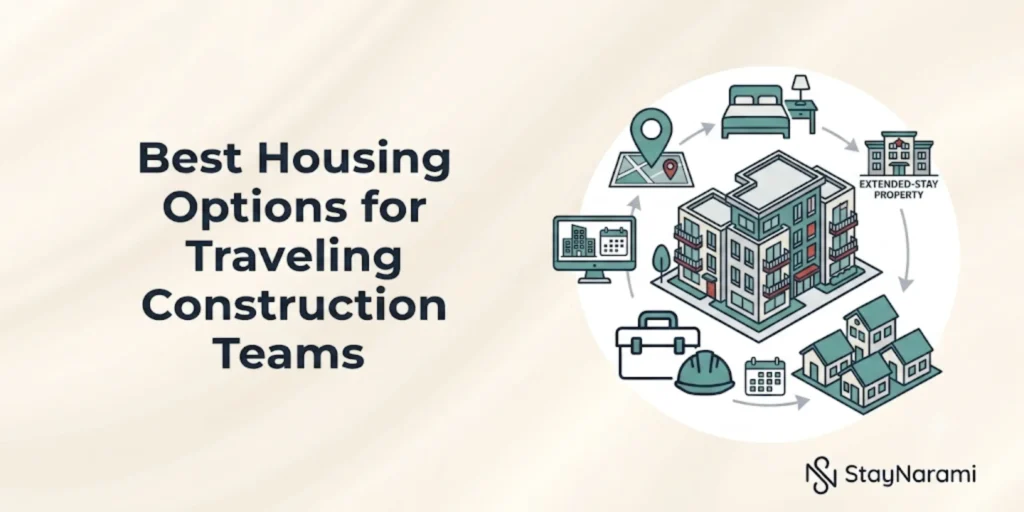
Best Housing Options for Traveling Construction Teams

The Cheapest Room May Cost You More
Find furnished accommodations that match your crew size, project timeline, vehicle needs, and preferred distance from the job site.
In June 2026, U.S. construction payroll employment reached about 8.33 million workers. Many of them moved between cities as construction jobs began, peaked, and ended.
A 2025 industry survey also revealed that 92% of construction companies that were hiring were struggling to find qualified employees. When skilled workers are difficult to replace, poor housing can create avoidable problems for both the crew and the project.
Choosing housing options for traveling construction teams takes more than comparing nightly rates.
A Construction Crew Housing option may look affordable at first, but the final cost can increase after adding taxes, parking for work trucks, laundry, meals, deposits, utilities, and fuel for a long daily commute. You need to consider the total cost before booking. In this blog, we explain the best Construction Crew Housing options and show you how to compare the true cost of each one, helping you choose the most cost-effective solution for your project.
TL;DR (Too Long; Didn’t Read)
- Built for construction company owners, project managers, and operations teams comparing housing options for traveling crews working on temporary or out-of-state projects.
- Answers the key questions: Which housing option works best for each project length? Are hotels or furnished rentals more cost-effective? How should companies calculate the true housing cost? And when do RVs or modular camps make sense?
- The best option depends on the crew size, project duration, location, vehicle needs, shift schedules, and the likelihood of delays. Hotels offer flexibility for short stays, while furnished homes and apartments often provide better value for stable projects lasting 30 days or longer.
- In June 2026, U.S. construction employment reached approximately 8.33 million workers. A 2025 industry survey also found that 92% of hiring construction companies struggled to find qualified employees, making comfortable and reliable housing even more important for retaining traveling crews.
- In this guide, you will compare hotels, extended-stay properties, furnished apartments, rental homes, traditional leases, RVs, and modular housing. You will also learn how to calculate cost per usable bed-night, account for commute expenses, evaluate flexibility, and avoid common booking mistakes.
Why Crew Housing Needs Careful Planning
Crew housing affects more than your budget. It also affects sleep, arrival times, vehicle use, food costs, and worker morale.
Long shifts and changing schedules can leave workers tired and stressed. Federal guidance says long or irregular work hours can reduce concentration and increase fatigue.
Apart from this, the Occupational Safety and Health Administration (OSHA) reports that working for 12+ consecutive hours can increase the risk of injury by 37%. Good housing gives workers more time to rest, eat, and prepare for the next shift. It also helps your crew arrive on time and ready to work.
Henry Ford once said, “Every man needs more than one day a week for rest and recreation.” For a traveling crew, a quiet room and a reasonable commute are basic needs after a physically demanding shift.
Quick Comparison Of Housing Options For Traveling Construction Teams
Housing type |
Best project length |
Best for |
Main advantage |
Main drawback |
| Standard hotel | 1 night to 2 weeks | Small teams and uncertain dates | Fast booking and easy cancellation | High long-stay cost |
| Extended-stay hotel | 2 to 8 weeks | Rotating crews | Kitchenette, laundry, and flexible terms | Limited space |
| Furnished apartment | 30 days to 6 months | Supervisors and small teams | More privacy and living space | Deposits and notice rules |
| Furnished rental home | 1 to 6 months | Stable crews of four or more | Lower cost per worker when full | Parking and occupancy limits |
| Traditional lease | 6 months or longer | Large, stable teams | Potentially lower monthly rent | Setup work and a long commitment |
| RV or campground | Several weeks to months | Mobile rural crews | Can be close to remote sites | Weather and hookup needs |
| On-site modular housing | Long remote projects | Large teams | Little or no daily commute | Setup cost and permits |
There is no single best housing for construction workers in every market. Hotels usually win on flexibility. Furnished homes often win on cost per person. Extended-stay properties sit between the two, while on-site housing helps where normal rentals are scarce.
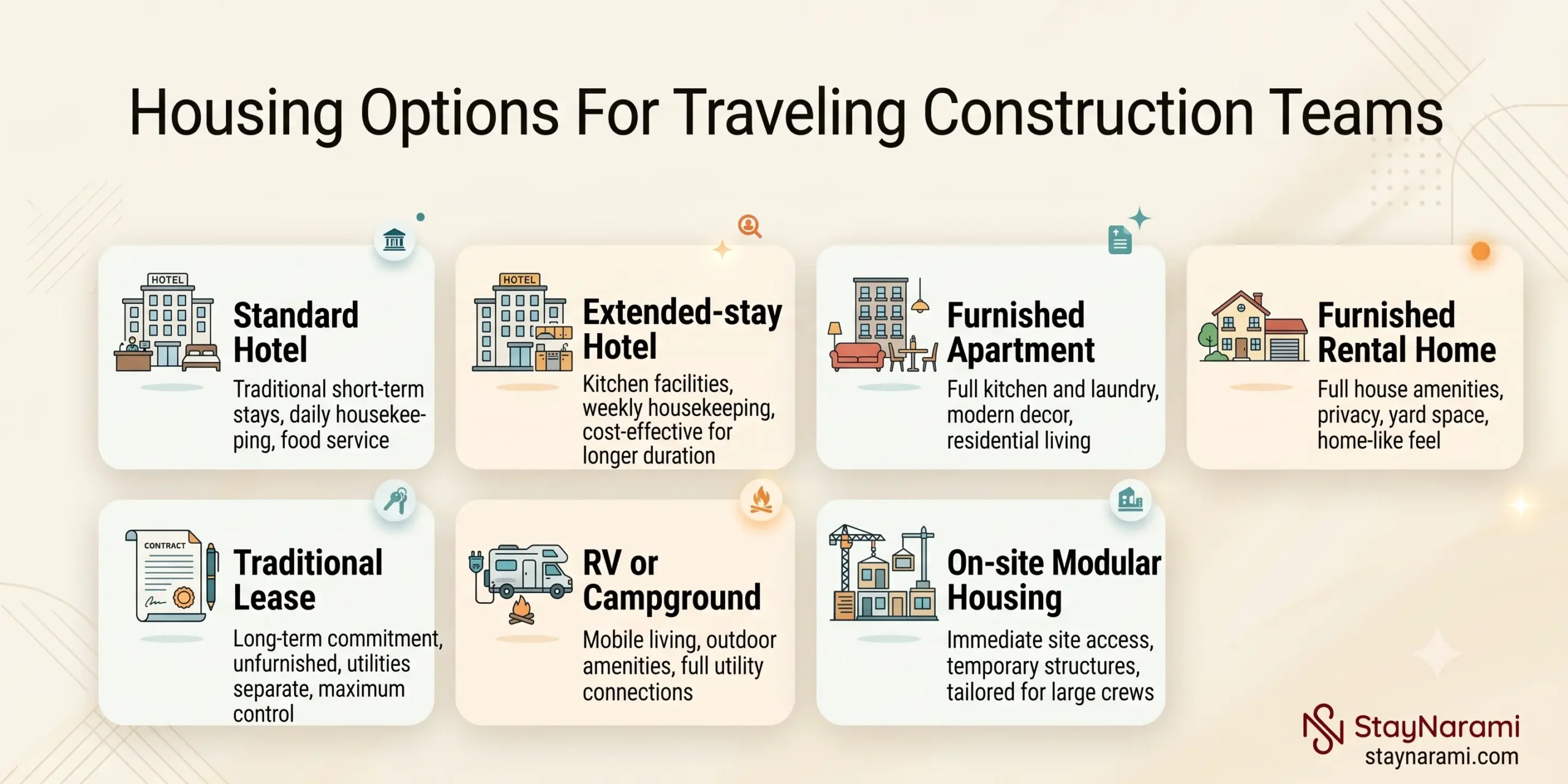
Which Housing Option Fits Each Project?
1. Standard hotels for short and uncertain assignments
A regular hotel is often the safest option for temporary housing for construction crew when the stay will last only a few days, the start date may change, or the final headcount is unclear. Rooms can usually be adjusted without arranging utilities, furniture, or a lease, making hotels a flexible solution for short-term construction projects.
The weakness is the long-stay cost. The federal standard lodging allowance for many U.S. locations is $110 per night for fiscal year 2026, although many cities have higher rates. This is a reimbursement benchmark, not a national hotel average.
At that rate, six rooms for 30 nights would cost:
6 rooms × $110 × 30 nights = $19,800
This is not an amount including hotel taxes, parking, meals, or other charges.
Go for standard hotels if you want housing emergencies, inspections, last-minute repairs, and many other projects that require short-duration visits.
2. Extended-stay hotels for longer stays
Well, as the name suggests, extended stay is generally considered for longer stays. In this, there is usually a small kitchen along with a fridge, work area, and laundry facilities. This type offers weekly or monthly rates, which provide more flexibility compared to apartment rentals.
This type of accommodation is good when electricians, installers, welders, and commissioning groups arrive in different phases of a construction project. One can start with several rooms and then, when the team gets bigger, arrange more rooms for additional employees.
One should make sure of the kitchen equipment in advance. Well, a microwave does not equal a stove. In addition, make sure to also check:
- Cookware and dishes
- Laundry costs
- Housekeeping
- Breakfast
- Parking for pickup trucks and work vans
- Extra fees and deposits
3. Furnished Apartments
Furnished apartments are quite comfortable for small crews when they stay 30 days or longer. There is a bedroom, living area, full kitchen, and laundry facilities in most of these apartments. The workers will have more room to live than in a hotel room.
It is important to determine the number of bedrooms, bathrooms, parking spots, and utilities before booking the facility. Moreover, check the conditions of your lease just in case your project finishes earlier or later than initially estimated. The key point here is flexibility. When signing the contract, inquire about:
- Minimum stay requirements
- Security deposits
- Cleaning charges
- Early departure fees
- Extension rates
- Utility limits
- Notice periods
A lower monthly price may not save money if the company must pay for an apartment after the project ends.
4. Furnished rental homes for stable crews
A rental home might be one of the most affordable housing options for traveling construction teams, where several workers will stay at this place for the same period. It can be cheaper than booking several rooms in hotels, but it has a kitchen, driveway, laundry, and living area.
Do not count bedrooms. Count beds. A four-bedroom house may still have only three usable beds. One room may have a king bed for a couple, another may have a queen bed, and one room may be set up for children. That will not work for four employees who each need their own bed.
Check the following before making a booking:
- Legal occupancy limit
- Number and type of beds
- Number of bathrooms
- Driveway and street parking
- Trailer restrictions
- Commercial vehicle rules
- Neighborhood noise rules
- Internet reliability
- Cleaning responsibilities
A low-cost house is not useful if two pickups, a trailer, and a service van cannot park there.
5. Traditional leases for long projects
If the project is more than six months, a standard apartment/house lease may suffice. Monthly rent may be less expensive than a short-term furnished rental, particularly in smaller cities.
The company may still need to arrange the following:
- Beds and furniture
- Electricity and water
- Internet service
- Kitchen supplies
- Utility deposits
- Regular cleaning
- Repairs and maintenance
- Final move-out cleaning
A traditional lease only saves money when the project is long and stable enough to use the full lease period.
6. RVs and campgrounds for rural work
In case the construction site is far from hotels, apartments, and rental properties, then the use of RVs will be useful. It is even best suited for jobs requiring constant movement between different rural areas.
The full budget needs to exceed the cost of the RV. Consider expenses for camping, electricity, water, sewer, propane, gasoline, maintenance, insurance, and weather conditions.
Furthermore, zoning regulations of the area and duration of stay in the camping grounds must be considered. While an RV performs well in mild climates, it may not perform well in extremely high or low temperatures.
6. On-site modular housing for remote projects
The temporary cabin, dormitory facilities, and modular camps can accommodate many big projects related to infrastructure, energy, and industry that need space far from local residential facilities.
Units on-site can minimize commuting, and sleeping quarters, kitchens, dining rooms, showers, and laundry rooms can be located near the work.
However, this option requires early planning for:
- Land use approval
- Water and wastewater
- Electricity
- Heating and cooling
- Fire safety
- Security
- Cleaning
- Food service
- Waste collection
It is rarely practical for a small crew, but it can solve a serious housing shortage during a large, long-term project.
Give Your Crew More Than a Place to Sleep
Get a free housing quote for your next project — fully furnished, move-in ready, and delivered before your crew even lands.
How To Compare The True Housing Cost
1. Calculate the cost per usable bed-night
A bed-night means one usable bed for one night. It provides a fair way to compare a hotel, rental home, apartment, or workforce lodge.
Formula:
Total housing cost ÷ total usable bed-nights = cost per bed-night
For example, 12 workers staying for 60 nights require:
12 workers × 60 nights = 720 bed-nights
If the complete housing cost is $72,000:
$72,000 ÷ 720 bed-nights = $100 per bed-night
Include taxes, booking fees, nonrefundable deposits, utilities, parking, furniture, and cleaning.
Only count beds workers will actually use. A sofa should not be treated as a permanent bed, and two workers on opposite shifts should not automatically share the same room.
2. Add the commute penalty
A cheaper property can become expensive when it is far from the job site. Since July 1, 2026, the federal business mileage rate has been 76 cents per mile. This rate is not the exact operating cost of every truck, but it can serve as a useful planning reference.
Suppose cheaper housing adds 20 miles each way. Two trucks would travel an extra 1,760 miles over 22 workdays:
40 extra miles × 2 trucks × 22 days = 1,760 miles
At 76 cents per mile:
1,760 miles × $0.76 = $1,337.60
The company may save $1,000 on rent but add about $1,338 in estimated vehicle costs.
There is also a time cost. If 10 workers spend an extra 48 minutes traveling each day, the team gives up about 176 hours of rest or usable time during that month.
3. Price schedule flexibility
Construction dates vary due to weather, inspections, delays in materials, changes in labor, and additional work. When considering the signing of an agreement, ask:
- Can unused rooms be released?
- How much notice is required?
- Can worker names be changed?
- Can the booking continue month to month?
- Is the extension rate protected?
- Is there an early departure charge?
- Which deposits are refundable?
The cheapest fixed contract may become the most expensive option when a crew leaves early, but the company must continue paying.
What Every Crew Property Should Provide
The best housing for construction workers should match how the team lives and works. Confirm that the property offers:
- Safe parking for pickups, vans, trailers, and tools
- Enough real beds and bathrooms
- A kitchen suitable for regular meals
- Laundry access for the full crew
- Reliable heating, cooling, water, and internet
- Quiet sleeping areas for different shifts
- Reasonable travel time to the job site
- Clear smoking, guest, pet, and shared-space rules
- Fast maintenance support
- Flexible departure and extension terms
Request a short video walkthrough before paying a deposit. Ask the property contact to show the driveway, bedrooms, bathrooms, kitchen, laundry area, entrance, and exterior lighting. Staged listing photos rarely answer practical crew questions.
Common Mistakes To Avoid
Do not select housing by nightly price alone. Other common mistakes include booking beds before the workforce schedule is final, assuming work trucks will fit, mixing opposite shifts in noisy shared housing, and signing a long lease without an exit plan.
A better approach is to reserve stable, lower-cost units for the core crew. Use flexible hotel or extended-stay rooms for temporary workers, inspectors, and closeout teams.
Review occupancy every week. If three workers leave earlier than expected, release their rooms instead of paying for empty beds until the original checkout date.
Choose the Right Housing Before Costs Add Up
Share your job-site location, project dates, crew size, bed requirements, and vehicle details to find housing that supports your budget and workforce.
Final Takeaway
The right choice depends on crew size, project length, vehicles, shifts, location, and schedule risk. Hotels suit short stays. Extended-stay rooms support rotating teams. Furnished homes and apartments often provide better value for stable assignments, while RVs and modular camps can solve remote-site problems.
Before approving the next booking, compare every quote by usable bed-night and add the commute penalty. That one step gives a clearer picture of the real cost and helps teams choose housing options for traveling construction teams that support both the budget and the workers.
If you need furnished housing for an upcoming out-of-state project, contact StayNarami. Share your project address, dates, crew size, bed requirements, vehicle count, and preferred commute to discuss suitable housing options.
StayNarami provides fully furnished housing for construction teams working on out-of-state projects across the U.S. Its housing is intended for stays of 30 days or longer. It can be arranged around the project’s location, crew size, dates, and unit requirements.
Corporate housing is a good fit when you need:
- Multiple furnished properties
- One point of contact
- Housing near a particular jobsite
- Flexible terms for a temporary assignment
- Move-in-ready units
- Support during the crew’s stay
You still need to give the provider accurate information. If you request housing for 14 workers and later send 20, the units may exceed their approved occupancy. Inform the provider about possible crew growth and rotation before signing.
Frequently Asked Questions
1. What is the best housing for a traveling construction crew?
If you’re staying for less than 14 days, it is typically easiest to stay in a hotel. Furnished apartments or rooms in extended stays could be a better option for longer-term assignments, such as those that last for 30 days or more. RV sites and/or modular housing may be necessary for large remote projects.
2. Are hotels or rental homes cheaper for construction workers?
Rental homes can be cheaper per person when the crew is stable, and every bedroom is used. Hotels may be cheaper when dates change often because individual rooms can usually be canceled without paying for a long lease.
3. How close should crew housing be to the jobsite?
There is no single distance that works for every project. Compare travel time, road conditions, shift hours, fuel use, and vehicle wear. A higher-priced property near the site may cost less overall than cheaper lodging with a long daily drive.
4. Should construction workers share rooms?
Room sharing may help cut costs but should be based on company policy, taking privacy, shift schedules, and sleep requirements into consideration. Due to differential working hours and shifts, workers may require a separate room.
5. How early should crew housing be booked?
Begin searching when the project location, likely headcount, and start window are known. For large teams, seasonal markets, and rural locations, start several weeks or months ahead. Keep a portion of the booking flexible until the workforce schedule is firm.
Need housing for your team?
Tell us what you need and we'll take care of the rest — anywhere in the U.S., 30+ days.
Request Housing →Related Articles