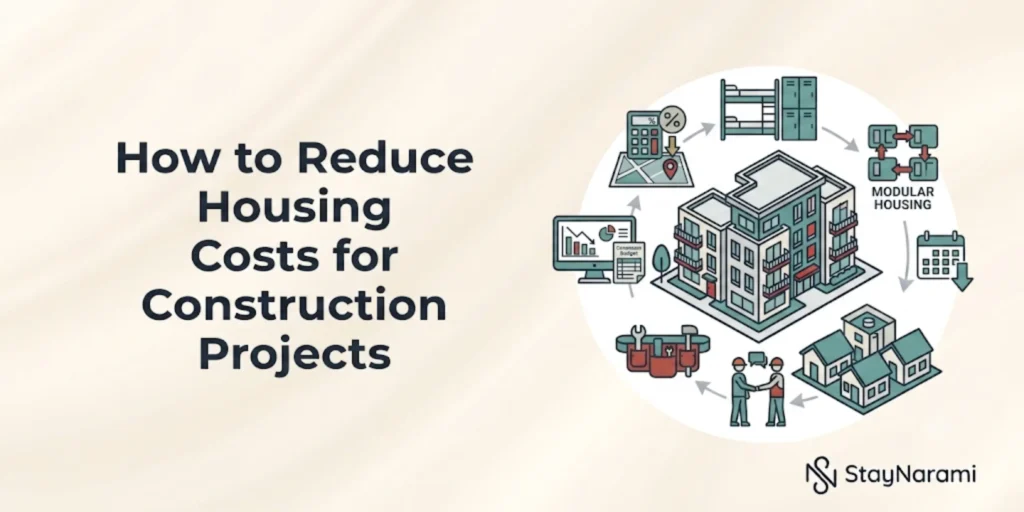
How to Reduce Housing Costs for Construction Projects

Need to Reduce Crew Housing Costs?
Find furnished housing that fits your project timeline, crew size, job-site location, parking needs, and overall budget.
Housing can make or break the budget on an out-of-town construction project.
At first, it may look simple: book rooms, move the crew in, and get the job done. However, with taxes, parking, transportation, meals, deposits, cleaning fees, extended hours, and changes of plans adding up, crew housing can be one of the quickest project cost eaters.
The easiest way to reduce Construction Crew Housing costs for a construction project is not to choose the cheapest room. Instead, it is to plan the entire housing strategy before the crew arrives. A well-organized Construction Crew Housing plan helps control expenses, improves logistics, and ensures workers have comfortable accommodations throughout the project.
TL;DR (Too Long; Didn’t Read)
- Built for construction company owners, project managers, estimators, and operations teams trying to control housing expenses for traveling crews.
- Answers the key questions: How can contractors reduce crew housing costs? Which housing option works best for each project length? How do kitchens, commute times, parking, and flexible booking terms affect the final price?
- The most effective approach is to plan housing before mobilization, compare the total cost per worker, keep crews close to the job site, negotiate using the full booking volume, and choose agreements that allow dates or room counts to change.
- Hotels may work for short or uncertain assignments, while extended-stay properties, furnished apartments, and shared homes often provide better value for projects lasting several weeks or months. Access to kitchens can also reduce meal spending, while shorter commutes can lower fuel costs, vehicle mileage, and lost travel time.
- In this guide, you will learn how to match housing to the project length, calculate the full cost beyond the nightly rate, negotiate better group terms, reduce meal and transportation expenses, avoid scattered bookings, and build flexibility into every housing agreement.
Why Construction Crew Housing Costs Rise So Quickly
The U.S. Bureau of Labor Statistics (BLS) construction industry employment statistics report that there were approximately 8.33 million construction workers employed in June 2026
Meanwhile, there is still a shortage of skilled and experienced workers. According to the 2025 AGC and NCCER Workforce Survey, 88% of companies that directly employ craft workers had positions for crafts in 2025; 83% said the positions were harder to fill than a year earlier.
This is why many contractors bring crews from outside the project area. Once that happens, housing becomes a real project cost, not just a travel detail.
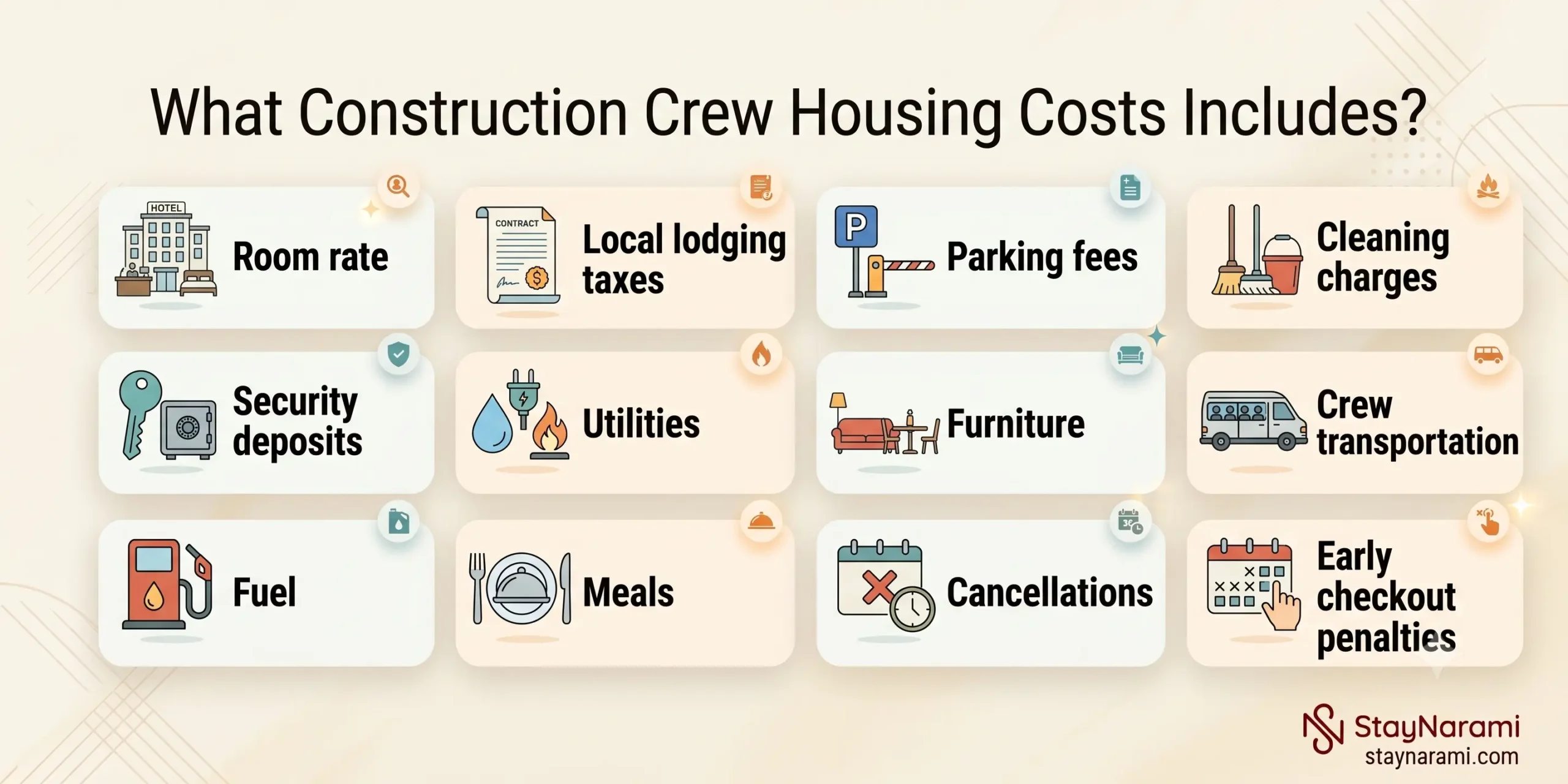
The problem is that many teams only look at the nightly rate. But the real cost includes the following:
- Room rate
- Local lodging taxes
- Parking fees
- Cleaning charges
- Security deposits
- Utilities
- Furniture
- Crew transportation
- Fuel
- Meals
- Cancellations
- Early checkout penalties
A room that looks affordable on paper can become expensive once all these extra costs are added.
Start Planning Housing Before Mobilization
The easiest way to lower construction crew housing costs is to plan early.
When booking lodging one week in advance before the crew’s arrival, the prime choices might be sold out. Hotels might be filled up, rents might be high, and employees might find themselves in various places.
Before booking anything, create a simple housing plan:
- How many workers need housing?
- When does each crew arrive?
- How long will each group stay?
- Will the crew size increase or decrease?
- Does the crew need private rooms or shared rooms?
- How far can workers commute to the construction site?
- How many work trucks, vans, or trailers can be parked easily?
- Will the crew need kitchens, laundry, or storage?
Quick Overview Of Construction Crew Housing Options Based On Project Length
Housing option |
Usually works best for |
Main cost advantage |
Common risk |
| Standard hotel | Short stays and emergency mobilization | Easy to book and cancel | High nightly cost, meals and parking |
| Extended-stay hotel | Crews staying several weeks | Weekly rates, kitchens and laundry | Limited room layouts or truck parking |
| Furnished apartment | Small crews on stable assignments | Utilities and furniture may be included | Deposits and fixed lease dates |
| Furnished house | Larger crews needing private bedrooms | Lower cost per worker | Cleaning, occupancy and neighbor restrictions |
| RV park or crew camp | Remote or industrial projects | Can place workers near the site | Setup, utilities, permits and maintenance |
| Housing stipend | Small crews that prefer self-booking | Less work for the company | Poor cost control and scattered locations |
Hotels often make sense as temporary housing for construction crew during the first few nights when the crew size is uncertain. Once the schedule becomes stable, moving long-term workers into furnished housing or an extended-stay property can lower the cost per person and provide a more comfortable, cost-effective solution.
Booking the whole crew together can also make shared houses and larger units financially practical. Booking workers one at a time usually leads to scattered rooms, mixed rates, and weaker negotiating power.
Choose Housing Based On Project Length
Not every project needs the same housing setup. A hotel may be fine for a three-day job, but it may be too expensive for a 90-day project.
1. For short stays: hotels
Hotels work well for short projects because they are flexible and easy to manage. They are also useful when the crew size is still uncertain.
The main problem with hotels is the cost. According to CoStar’s January 2026 report, the average hotel room in the United States costs $152.09 per night.
If 10 workers are to be accommodated for 30 nights in separate rooms, the costs will be approximately:
$152.09 × 10 workers × 30 nights = $45,627
This price is not tax inclusive, nor does it cover other hotel charges such as laundry and parking fees.
2. For medium stays: extended-stay hotels
For projects of one to four weeks, extended-stay hotels may be a good option. These hotels might include:
- A small kitchen
- Laundry access
- Weekly rates
- Larger room than a traditional hotel room.
Additionally, a kitchen can also save employees money by enabling them to prepare their own meals as opposed to going out every day to eat in a restaurant.
3. For longer stays: furnished rentals or workforce housing
For longer projects, furnished apartments, rental homes, corporate housing, and/or workforce housing may be less expensive. These homes could have:
- Kitchens
- Laundry
- Common space
- More parking
- Lower monthly pricing
- Better comfort for longer stays
At first, the nightly rate might not sound as affordable. The total cost of the month, however, might be less than staying at a hotel.
Look At The Full Cost
Don’t go for a property just because of the rent or nightly fee.
For example, a rental located 45 minutes from the job site may save $20 per night, but the longer commute can increase fuel costs, vehicle mileage, and travel time. But it will only make the trip more expensive and longer. Employees can also come in late and/or fatigued before work.
A closer home to the job site will be more expensive per night, but in other ways it might be worth the cost.
A better way to compare housing is:
Housing cost + transportation cost + parking + meal impact + commute time
If a slightly more expensive property saves each worker 30 to 40 minutes of travel per day, it may be the better choice.
This matters even more for crews working long shifts, early starts, or night work.
Negotiate With The Full Crew Volume
Large crew housing gives contractors buying power.
If you have 15 workers staying 60 nights, that is 900 room nights if each worker has a separate room. Hotels and housing providers want that business.
Instead of asking only for a lower nightly rate, negotiate the full package:
- Weekly or monthly pricing
- Free or reduced parking
- Flexible check-in and checkout
- No early departure penalty
- Lower deposit requirements
- Weekly housekeeping
- Included utilities
- One consolidated invoice
- Ability to add or remove rooms
If the property charges high parking and cleaning fees or has a no-cancel policy, the lower nightly rate will be of no use.
Use Kitchens To Reduce Meal Spending
One of the easiest expenses to forget while finding a place to live is meals.
Crews who are staying in standard hotel rooms, with no kitchens, depend on restaurants, takeout, gas stations, and convenience food. That adds up fast.
For fiscal year 2026, the U.S. General Services Administration M&IE expense rate is $68 per day for federal travel to locations without a separate locality rate. Some cities have higher rates. Although private companies are not required to use this figure, it serves as a useful planning benchmark for Traveling Construction Teams when estimating daily meal and incidental expenses for out-of-town projects.
Let’s take an example:
With the kitchen access saving $12 per worker per day, the 20-person crew saves the following:
$12 × 20 workers × 30 days = $7,200
That saving may be greater than the difference between the two home choices.
Keep The Crew Close To The Jobsite
Location affects cost more than many teams realize.
Housing that is far from the jobsite can create daily problems:
- More fuel use
- Longer drive times
- Higher transportation costs
- More late arrivals
- More worker fatigue
- More scheduling issues
- Lower crew morale
A slightly more expensive rental closer to the jobsite may cost less overall once fuel, mileage, and travel time are included.
Reduced travel time can also contribute to the safety and productivity of crews who work early morning shifts, overnight shifts, or extended hours.
Avoid Scattered Housing
When workers are placed in different hotels or rentals across town, management becomes harder.
Scattered housing can create problems like:
- Different commute times
- Missed rides
- Confusing check-ins
- Uneven living conditions
- More supervisor follow-up
- More invoices to reconcile
- Lower crew morale
Keeping the crew in one property, or at least in one area, usually makes daily operations smoother.
In larger crews, it’s not simply convenient to be consistent. It enables supervisors to understand where people are, when they are going to leave, and if transportation is on schedule.
Build Flexibility Into Every Booking
Construction schedules change. Weather, material delays, inspections, labor shortages, and change orders can all affect how long a crew needs housing.
The AGC and NCCER Workforce Survey also reported that 45% of firms experienced project delays due to shortages of their own workers or subcontractors’ workers.
Because delays are common, rigid housing terms can become expensive.
Before booking, ask:
- Can the stay be extended?
- Can rooms be reduced if the crew size drops?
- What is the cancellation window?
- Are unused nights refundable?
- Is there an early checkout penalty?
- Can workers move between units if needed?
- Are rate changes possible after the first month?
You can invest a bit more initially with a flexible housing agreement, but it can save thousands of dollars if the timeline shifts.
Is Corporate Housing More Cost-Effective?
See how furnished corporate housing can reduce hotel, meal, transportation, utility, and long-stay accommodation expenses.
Watch Taxes And Long-Stay Rules
Short-term lodging taxes can add a major cost to hotel stays. In some locations, longer stays may qualify for reduced or exempt lodging taxes after a certain number of consecutive days.
Rules vary by city and state, so this should be checked before booking. A 28-night stay and a 31-night stay may be treated differently in some markets.
This is one reason crew housing should be reviewed by location, not booked the same way everywhere.
Centralize Housing Decisions
Letting each supervisor or crew member book their own housing may feel easy, but it usually creates waste.
Centralized housing gives the company better control over:
- Rates
- Invoices
- Taxes
- Cancellations
- Parking
- Deposits
- Move-in and move-out dates
- Worker assignments
- Project-level cost reporting
It also makes it easier to compare housing costs across projects.
A good rule is simple: if housing is part of the project budget, it should be managed like a project cost.
When a housing partner makes sense
For a small crew and short project, internal booking may be fine. But for larger projects, out-of-state jobs, or crews of 10+ workers, a housing partner can save time and prevent costly mistakes.
A housing partner can help with:
- Finding properties near the jobsite
- Comparing hotels, rentals, and workforce housing
- Negotiating group rates
- Managing move-ins and move-outs
- Handling changes in crew size
- Coordinating furniture and utilities
- Consolidating invoices
- Solving housing problems during the project
This is especially useful when the project team is already busy managing labor, schedules, materials, subcontractors, safety, and inspections.
Quick checklist to reduce housing costs
Before finalizing construction crew housing, check these points:
- The crew schedule is mapped by phase
- The housing type matches the project length
- The total cost includes fees, taxes, parking, and deposits
- Commute time has been calculated
- Kitchen and laundry access are considered
- Weekly or monthly rates have been negotiated
- Cancellation and extension terms are clear
- Housing is centralized under one process
- Invoices are easy to track
- Workers have safe and practical living conditions
Plan Early and Spend Less on Housing
Share your crew size, project dates, location, and accommodation needs to find a practical option before prices rise.
Plan Early and Spend Less on Housing
Share your crew size, project dates, location, and accommodation needs to find a practical option before prices rise.
Final thoughts
For construction projects, try to save money on housing by beginning before the crew arrives. The most significant savings are typically planned, rather than last-minute discounts.
Consider the type of housing. Hire crews in the vicinity of the job site; Negotiate on volume; monitor meal and transportation expenses. Make sure the agreement is flexible enough to allow for changes to the timetable.
It’s not merely about low-cost housing. The idea is to provide shelter that helps the project budget and crew and keeps the project going. StayNarami helps companies find flexible housing for construction crews based on project dates, crew size, location, parking, and other needs. Contact us to discuss your requirements; we’ll help you with the best option.
Frequently Asked Questions
1. What is the cheapest housing option for a construction crew?
If you only require a few nights’ stay, an economy hotel may be practical because it does not require a long-term lease. For projects of weeks or months in duration, extended-stay hotels, furnished apartments, or shared homes might be more affordable. The last thing to take into account is the total cost per worker.
2. How far should crew housing be from the construction site?
There isn’t a universal set distance that will be suitable for every project. To reserve, calculate the daily price of the vehicle and limit the number of minutes your commute is allowed to take. An extra-cost home located close to this location may actually be a more affordable option if fuel, mileage, and travel time are taken into account.
3. How early should construction crew housing be booked?
Start looking as soon as the project dates and approximate headcount are known. For regular markets, requesting group options three to four weeks before arrival can provide more choice. Remote areas, seasonal markets, and cities hosting major events may require earlier booking.
4. Should construction workers share hotel rooms?
That depends on company policy, worker expectations, room size, shift schedules, and the length of the assignment. Shared rooms can reduce costs, but forcing workers on opposite shifts to share a room may affect rest and create conflict. Many companies reduce costs by sharing a house while still giving each worker a private bedroom.
5. How should crew housing be included in a construction bid?
Housing is generally estimated using worker-nights, bed-nights, or room-nights, not simply labor hours. It also includes housing, taxes, car parking, food expenses, travel costs, deposits, and allowances for changes in schedule. Where possible, use the costs of similar jobs that have been finished in the past and, during the week, record how much is actually spent compared to the estimate.
Need housing for your team?
Tell us what you need and we'll take care of the rest — anywhere in the U.S., 30+ days.
Request Housing →Related Articles