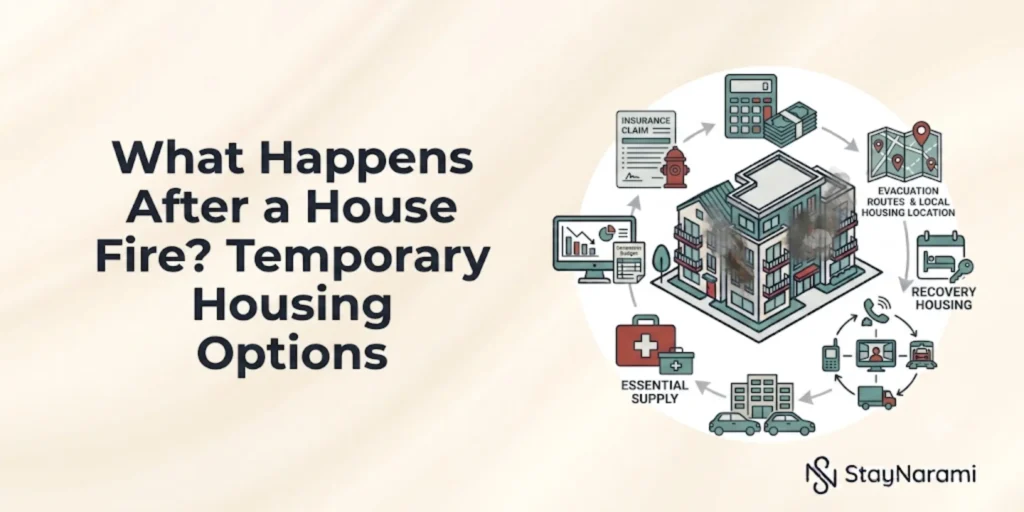
What Happens After a House Fire? Temporary Housing Options

Need a Safe Place After a House Fire?
Find temporary furnished housing based on your family size, pets, location, budget, insurance requirements, and expected repair timeline.
Fire hazards are very unpredictable. In fact, in the USA, a fire incident is reported every 96 seconds. This makes it a serious concern. As per the report published by the National Fire Protection Association (NFPA), there were 329,500 home structure fire incidents nationwide. This collectively created approximately $11.4 billion of property damage.
After the family manages to escape a fire, they find themselves standing on the road and have no place to stay after the fire.
Sometimes, even if just one room is burned down by the fire hazard, the house is declared uninhabitable by the fire officials. The reason behind this is that smoke, water, heat, or electrical problems can make a home unsafe, especially when you have toddlers.
Now the only choice left is to look for temporary housing. They have to choose different housing options, which include the following:
- A shelter for immediate help
- A hotel for a short stay
- An extended-stay hotel for a longer visit
- A furnished apartment
- A short-term rental home
The best option depends on how long the family must stay away from home and what their insurance will cover.
TL;DR (Too Long; Didn’t Read)
- Built for homeowners, renters, families, insurance claimants, and anyone who needs a safe place to stay after a house fire makes their home temporarily unlivable.
- Answers the most urgent questions: Where can a family stay immediately after a fire? Will insurance cover temporary housing? Which housing option works best for a stay lasting days, weeks, or months? And what expenses and documents should be tracked for an insurance claim?
- The solution depends on the expected repair timeline. Hotels and emergency shelters can help during the first few nights, while extended-stay hotels, furnished apartments, and temporary rental homes are usually more practical for longer displacement periods.
- U.S. fire departments responded to approximately 329,500 home structure fires, causing around $11.4 billion in property damage. Even when a fire affects only part of a home, smoke, water, electrical damage, or structural concerns may make the entire property unsafe to occupy.
- In this guide, you will learn how temporary housing after a house fire works, how Additional Living Expenses coverage may help, how to compare housing options, what to ask an insurance adjuster, which receipts to keep, and how to choose a temporary home that supports your family, pets, work, and school needs.
Where To Go After The Fire Incident?
The first thing to do is to find a place where the family and pets can be safe. Later, things like getting an insurance claim and paperwork can be done afterward when you know your loved ones are in safe hands.
1. Do not enter the home without permission
Stay out of the home until told that it’s safe after the fire. Ask fire officials to get your clothing, papers, medicine, and valuable things. They will help you. Do not go inside by yourself. It is mandatory and safe to be away from the fire incident scene.
The American Red Cross recommends that residents:
“Stay out of fire-damaged homes until local fire authorities say it is safe to re-enter.”
2. Complete the most urgent tasks
On the first day:
- Make sure everyone is safe.
- Get medical help for burns or breathing problems.
- Take hurt pets to a veterinarian.
- Tell family and friends where you are.
- Contact your homeowners’ or renters’ insurance provider for help
- Request the fire department to let you know where you can get the fire report.
- Get relative help or official help, at least for the first night.
- Keep all important things like clothing, medication, and groceries for survival.
- Be sure to retain all receipts connected with the fire.
The decision about where to live is a long-term one and doesn’t need to be made right away. Stay at a hotel, emergency shelter, or home of a family member to allow time to contact your insurance company and understand how long you might be displaced. Insurance housing for displaced families can help cover suitable temporary accommodation while you determine the repair timeline and next steps.
How Temporary Housing After A House Fire Usually Works
As more information becomes available, housing needs frequently change. Consideration of accommodation can be broken down into three stages.
1. Emergency housing for the first few nights
The first place you stay does not need to solve every long-term problem. Its purpose is to provide immediate safety while the property is inspected. Possible choices include:
- Booking a hotel or motel
- Staying with friends and relatives
- Using an emergency shelter
- Receiving short-term assistance from a local relief organization
2. Short-term housing for several days or weeks
A hotel may be the right choice until an official makes a decision on whether your property can be repaired or cleaned. But it is worth considering a cost-effective option because staying in a hotel for a long time can be expensive for you. An extended-stay hotel may offer the following:
- A small kitchen
- A refrigerator
- On-site laundry
- Weekly pricing
- Flexible checkout terms
- Basic furniture and utilities
3. Longer-term housing for several months
If repairs will take months, a furnished apartment, condominium, or house might be the more practical choice. A home may have separate rooms, a kitchen, laundry, and storage, and allow for a more normal lifestyle.
The longer the rental is, however, the more planning is required. Before signing, review the terms of the lease, the down payment, utility fees, pet policies, furniture, internet, parking, and exit fees.
Comparing Temporary Housing Options
Housing option |
Best for |
Main advantages |
What to check |
| Friends or relatives | The first few days | Little or no housing cost and immediate support | Privacy, pets, travel time, household space, and length of stay |
| Emergency shelter | Immediate accommodation | Safe shelter when no other option is available | Location, accessibility, meals, family sleeping arrangements, and pets |
| Hotel or motel | A few nights | Fast booking, flexible checkout, and regular cleaning | Taxes, parking, meals, laundry, room size, and extension rates |
| Extended-stay hotel | Several weeks | Kitchen, laundry, furniture, and weekly rates | Kitchen area, storage room, pet fees, internet, and cancellation terms |
| Furnished apartment | One to several months | More privacy, full kitchen, and normal living space | Deposits, utilities, lease terms, parking, and furniture |
| Furnished house | Larger families or longer stays | More bedrooms, storage, privacy, and possible yard space | Overall cost, maintenance, school distance, and early departure |
| Disaster housing assistance | Eligible declared-disaster survivors | May provide lodging or rental support | Eligibility, application deadlines, documents, and local availability |
Find Housing While Your Home Is Repaired
Explore temporary housing options for families displaced by fires and other disasters, with furnished spaces designed for stays lasting several weeks or months.
Will Insurance Pay For Temporary Housing?
Some of the homeowners’ and renters’ insurance policies come with Additional Living Expenses (ALE) or loss-of-use coverage.
ALE may help pay for the reasonable extra costs of living somewhere else when a covered fire makes your home unlivable. It may cover a hotel, temporary rental, increased meal costs, laundry, storage, transportation, and other necessary expenses, depending on the policy.
The National Association of Insurance Commissioners explains that ALE covers temporary housing and other additional costs while a covered home is being repaired or rebuilt. Read more about this in the guide to additional living expenses.
ALE usually covers the additional amount
Insurance does not normally pay every living expense after a fire. It usually pays a reasonable increase above what the household normally spends.
For example:
Expense |
Normal monthly cost |
Cost after the fire |
Possible additional expense |
| Housing | $2,000 mortgage | $2,000 mortgage plus $3,200 rental | $3,200 |
| Food | $900 groceries | $1,400 meals and groceries | $500 |
| Transportation | $350 | $500 because of a longer commute | $150 |
| Laundry | $40 | $120 | $80 |
In this example, the household’s additional monthly expenses total $3,930. The actual amount paid by insurance would depend on the policy limit, approved expenses, and claim terms.
Questions to ask the insurance adjuster: Before booking a longer stay, ask:
- Does my policy include ALE or loss-of-use coverage?
- What is the total dollar limit?
- Is there a separate time limit?
- Does the insurance company require the building to be approved first?
- Do pet fees or boarding charges count?
- What receipts and documents must I provide? Ask for important approvals in writing.
- A phone conversation may be difficult to prove later.
How Much Can Temporary Housing Cost?
The price varies according to the location, household size, property type, and stay duration. The cost of these small charges adds up quickly to big monthly bills. A hotel costs the following:
- Room rate: $175 per night
- Lodging taxes and fees: $25 per night
- Parking: $20 per night
- Pet fee: $150 per month
The room with taxes and parking would be $220 per night. Without meals, laundry, or pet fees, it would cost more than $6,600 over 30 nights.
Although $6,600 per month is expensive, a room with a kitchen may reduce restaurant costs during a longer stay.
Also, the pet fee would bring the example to $6,750, not $6,600, if included.
Look at the full fee, not the advertised price per room.
How To Choose The Right Temporary Home
The lowest bid doesn’t always have the best functionality. A poor location or unsuitable layout can make an already stressful period more difficult.
1. Estimate How Long You May Be Displaced.
Ask the insurance adjuster, restoration company, and repair contractor for their current estimates. These estimates may be different because each person is responsible for a different part of the process.
Choose flexible housing when the timeline remains uncertain. A property that allows monthly extensions and early departure may be safer than a cheaper rental with a fixed six-month lease.
2. Keep Work And School Travel Manageable
Check the travel time to:
- Workplaces
- Schools and daycare
- Medical appointments
- The damaged home
- Family support
- Grocery stores and pharmacies
A distant property may cost less in terms of rent but increase fuel costs, travel time, missed school, and daily stress.
3. Check The Needs Of The Whole Household
Before confirming temporary housing after a house fire, make sure the property has:
- Enough beds and bedrooms
- A usable kitchen
- Suitable bathrooms
- Laundry access
- Reliable heating and air conditioning
- Internet for work or school
- Safe parking
- Space for essential belongings
- Written permission for pets
- Accessibility when required
Keep Clear Records Of Every Expense
This point is very important; insurance claims always require proof that an expense was necessary and related to the fire. One or a few missing details lead to a delay in the process.
To avoid this, create separate folders for
1. Housing documents
Keep:
- Hotel invoices
- Rental agreements
- Security-deposit receipts
- Utility bills
- Parking charges
- Cleaning fees
- Furniture-rental bills
2. Daily living expenses
Keep receipts for:
- Meals
- Groceries
- Laundry
- Transportation
- Medicine
- Essential clothing
- Pet care
- Storage
3. Property and claim documents
Save:
- The fire report
- Damage photographs
- Contractor estimates
- Emails from the insurer
- Repair schedules
- Lists of damaged belongings
- Claim-payment records
When Can FEMA Provide Housing Help?
FEMA housing assistance is generally connected to a presidentially declared disaster and may include hotel reimbursement, rental assistance, or other temporary housing support for eligible survivors. It normally does not apply to an isolated house fire that is outside a declared disaster.
Lodging reimbursement, rental aid, or other temporary housing support may be provided to eligible household members in a declared disaster area. Program eligibility and availability are dependent on disaster-specific requirements. Check out FEMA housing assistance programs.
If there is a single-house fire that falls outside the scope of a declared disaster, you should notify the insurance company, local emergency management agency, local Red Cross branch, housing agency, landlord, or local disaster relief organizations.
Comfortable Temporary Housing for Your Family
Share your preferred location, household size, pet needs, insurance details, and expected stay to begin finding suitable temporary housing.
Final Takeaway
When you have the right information about responding to a fire incident, the circumstances can be controlled. It is advised not to live at the fire incident site until it has been declared safe.
Take into account the following when selecting a place of temporary housing after a house fire:
- The total cost
- How long will repairs take
- Distance from work and school
- Number of bedrooms
- Kitchen and laundry needs
- Pet rules
- Parking
- Flexible lease terms
Retain all hotel, food, travel, and lodging receipts. These may be requested by your insurance company. Also, don’t sign a long lease or make a big payment without first talking with your insurance company.
The most economical offer isn’t necessarily the most effective. The right temporary house will help keep your family protected, comfortable, and nearby to all the necessary things while your house is under repair.
Need Help Finding the Best Temporary Housing?
If due to fire, one household is not part of a federally declared disaster, you should contact your insurance provider first. You can also try calling the local emergency management agency, American Red Cross branch, housing agency, landlord, or local disaster relief organization.
You can also contact StayNarami for help finding temporary housing that fits your family’s needs, budget, pets, location, and expected repair time.
Frequently Asked Questions
1. Does renter’s insurance cover temporary housing?
Many renters’ policies include loss-of-use or ALE coverage for covered fires. The landlord’s insurance normally covers the building, not the tenant’s personal belongings or additional living expenses.
2. Can insurance pay for a furnished house?
It may cover a furnished house when the cost is reasonable for the household size and expected repair period. Get written approval before signing an agreement.
3. Are restaurant meals covered?
ALE may cover the reasonable increase above your normal food spending, especially when the temporary property has no kitchen. Keep a record of all your meal receipts.
4. What happens if the temporary lease ends before repairs are finished?
Contact your insurer before the booking expires. Request an updated repair timeline and approval for an extension or another property.
5. Can insurance cover pet-friendly housing?
Pet fees, pet-friendly accommodation, or boarding costs may qualify when they are necessary because of the fire. Coverage differs by policy.
Need housing for your team?
Tell us what you need and we'll take care of the rest — anywhere in the U.S., 30+ days.
Request Housing →Related Articles