Modular Housing vs Traditional Housing for Crews: Which Is Right for Your Workforce?

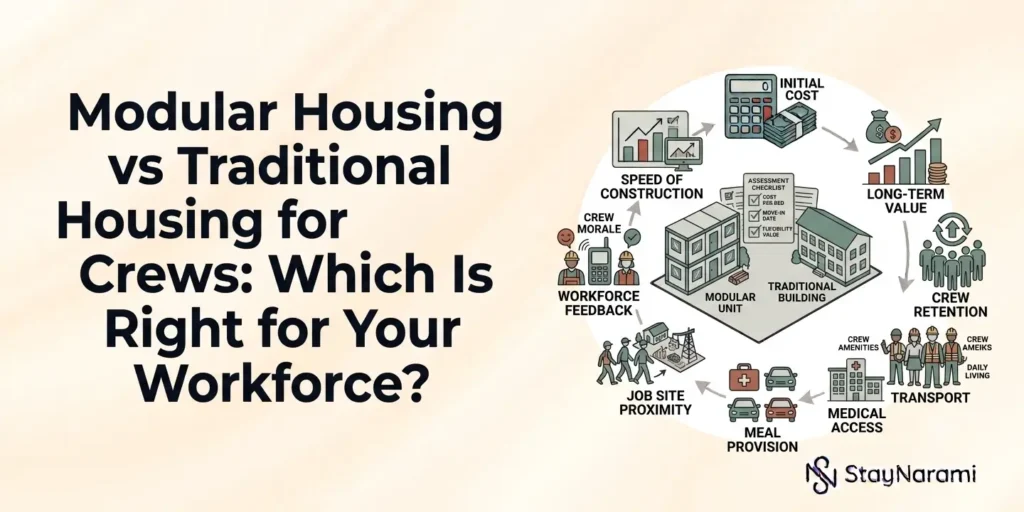
Find the Housing Model That Fits Your Project
StayNarami helps you compare temporary housing options based on crew size, project duration, job-site access, available inventory, and changing workforce needs.
The cost of housing can easily become one of the highest costs on a remote or out-of-state project, but nobody ever talks about it.
A few hotel rooms for two weeks are easy to manage. Housing 50 workers for six months is a different job. Room availability changes, hotel rates rise, leases expire, workers are moved between properties, and long commutes begin to eat into the workday.
The size of the construction workforce shows how common this challenge can be. The U.S. construction industry employed about 8.33 million people in June 2026, and construction companies often move workers between multiple project sites.
Meanwhile, labor is hard to replace. 92% of companies responding to the survey by Associated General Contractors (AGC) that had jobs available for craftsmen reported a lack of skilled workers. Safeboxbd’s unfavorable crew accommodation can exacerbate an already challenging retention issue.
When comparing modular housing vs traditional housing for crews, the real question is not simply, “Which room is cheaper?”
It is:
Which option gives the project enough beds, in the right location, for the full schedule, at the lowest total cost?
TL;DR (Too Long; Didn’t Read)
- Written for construction companies, project managers, and work crews who are looking to compare modular housing with hotels, rentals, and other traditional ways of providing crew housing.
- The conventional sort of accommodations is quicker to set up, and it is appropriate for more compact crews, brief work, and also uncertain project timetables. Modular construction provides greater bed capacity, site options, building layouts, levels of amenities and security, and is more suitable for large projects, remote and long-term projects.
- It depends on crew size, project duration, available local housing options, setup costs, permits, access to utilities, and total cost per bed-night occupied. There may be an advantage in a ‘hybrid plan’ which combines hotel accommodation during the mobilization and modular housing during the main workforce for some projects.
- To help project teams select a housing solution that fits the budget while also keeping workers available and close to the site, this guide outlines the costs, setup requirements, flexibility, comfort, and long-term value of both options.
Modular Crew Housing vs. Traditional Housing
The main difference between modular crew housing and traditional housing is where the accommodation comes from and how much control the company has over it.
What Is Modular Crew Housing?
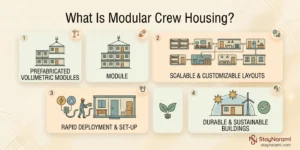
Modular crew housing is built off-site, delivered to the project site by sections, and set up close to the job site. It is engineered to meet the needs of the workers so the layout, size, and facility features can be tailored to the needs of the crew.
Depending on the project, modular housing may include the following:
- Dormitory-style sleeping areas
- Private bedrooms with shared bathrooms
- Two-bedroom units with a connecting bathroom
- Apartment-style units with kitchens and living spaces
- Laundry facilities, offices, and recreation rooms
- Full workforce camps with dining halls and commercial kitchens
This option is often used for large, long-term, or remote projects where the local housing supply cannot support the number of workers arriving.
What Is Traditional Crew Housing?
Traditional crew housing relies on properties that already exist in the surrounding area. Companies may place workers in:
- Hotels and motels
- Extended-stay properties
- Furnished apartments
- Rental homes
- Bunkhouses
- Existing workforce camps
This is normally more rapid to organize as the homes are currently being built and available. But the company can’t control where they’re located, how they’re laid out, parking, the amenities, the rates, or whether they will be available in the future.
The Key Difference Is Control
With traditional housing, the company must work with whatever the local market can provide. Workers may be spread across several properties, room availability may change, and prices may increase during busy periods.
The modular crew housing approach by the company offers a separate housing solution for its workers. It can determine the number of beds, unit layouts, location of the site, shared facilities, security, parking, and length of use.
Traditional housing has convenience and flexibility; modular housing has control and consistency. The choice depends on the size of the crew, the required time of the project, location, and available housing in the area.
Factor |
Modular Housing |
Hotels and Rentals |
| Initial cost | Higher | Usually lower |
| Long-term cost | Can fall as occupancy increases | Continues every night |
| Deployment | Requires delivery, site work and permits | Can be booked quickly |
| Availability | Adds new beds near the project | Depends on the local market |
| Mobility | Some units can be moved and reused | Cannot move with the crew |
| Layout control | High | Limited |
| Daily management | Usually handled by the employer or camp operator | Mostly handled by the property |
| Best use | Large, remote or long-term crews | Small, short or changing crews |
Cost and Deployment Speed
Hotels normally win on speed. When rooms are open, a crew may be able to move in within a day. There is no foundation to build, utility line to install, or occupancy inspection to arrange.
The problem is the continuing room cost.
CoStar reported that the average U.S. hotel room rate reached $168.51 per night in May 2026. Occupancy stood at 65.7%, but local markets can be much tighter than the national average, particularly near disaster zones, major construction projects, festivals, or seasonal work areas.
Consider a crew of 40 workers sharing 20 rooms for 90 nights:
20 rooms × 90 nights × $168.51 = $303,318
That figure does not include taxes, parking, laundry, meals, pet charges, room damage, or price increases.
The same hotel stay extended to six months would cost more than $600,000, even before additional expenses.
Long-term rentals may reduce the nightly cost, but they create other problems. A four-bedroom home does not always provide four suitable beds. The property may also lack truck parking, laundry capacity, or permission for several unrelated workers to stay there.
Modular housing has a larger setup bill. Costs can include:
- Unit purchase or lease
- Transportation
- Cranes and installation
- Foundations or supports
- Grading and drainage
- Water, sewer, and electrical connections
- Furniture and appliances
- Permits and inspections
- Cleaning, maintenance, and security
- Removal and site restoration
However, modular units can be built while the site is being prepared. The Modular Building Institute says this overlap can make modular projects 30% to 50% faster than conventional construction.
“Projects can be completed 30% to 50% sooner than traditional construction.”
— Modular Building Institute
That does not mean every workforce camp will be ready in a few weeks. Delivery still depends on unit availability, road access, land preparation, utility connections, and local approval.
A prepared site with existing utility connections may move quickly. A remote site needing a well, septic system, access road, and custom units will take longer.
Compare Cost Per Occupied Bednight
The easiest way to compare different crew accommodation options is to calculate the cost per occupied bed-night.
Total housing cost ÷ total nights that workers actually occupy the beds
For hotels, include:
- Room charges
- Taxes
- Parking
- Meal allowances
- Laundry
- Transportation
- Cancellation fees
- Empty rooms held for future workers
For modular housing, include:
- Units
- Delivery
- Installation
- Site preparation
- Utilities
- Furniture
- Camp management
- Maintenance
- Removal
- Storage
- Expected resale or reuse value
Occupancy matters.
A 50-bed camp that remains nearly full for 12 months may be economical. The same camp may be expensive if only 20 workers use it after the first month.
Modular housing will, however, not necessarily be cheaper after a specific number of weeks. The break-even point will vary with the size of the crew, hotel rates in the area, on-site expenses, as well as the duration of the units’ occupancy.
Comfort, Location, and Crew Retention
Sometimes the room with the lowest price could end up being the most expensive.
Staying 50 miles from the location can generate fuel costs, shuttles, and a few extra hours of travel per day for a hotel. Living in the same area as the project may be more expensive, but this decreases travel expenses and time.
The sleeping environment is also important.
The CDC states that adults between 18 and 60 should generally get seven or more hours of sleep each night. It also explains that quality sleep should be uninterrupted and refreshing.
“Quality sleep means you are getting uninterrupted and refreshing sleep.”
— Centers for Disease Control and Prevention
It may be challenging if the workers are in the same confined space or have overlapping shifts or work near a busy highway.
Before choosing any temporary crew housing, check:
- How many workers will share each bedroom?
- Does every worker have an individual bed?
- Can night-shift workers sleep during the day?
- Is heating and cooling reliable?
- How many people share each bathroom?
- Are laundry machines available?
- Is there enough space for meals and food storage?
- Can work trucks and trailers park safely?
- How long is the drive to the job site?
- Is internet service strong enough for personal and work use?
Modular housing allows for more control over the layout. A company may make a request for private rooms, blackout drapes, extra washing machines, or to divide the work area into workday and night shifts.
Hotels may lack control, but typically they have housekeeping, front desk, and already-in-place maintenance.
If that’s the convenience you’re looking for, it might be worth paying more for at night.
For some crews, that convenience may be worth the higher nightly rate.
Mobility, Permits, and Code Requirements
Mobility is one of the biggest advantages of modular housing, but only when the units are designed to move.
A permanent modular building is manufactured in sections but normally remains on one site.
A relocatable modular building is designed to be taken apart, transported, and used again.
Companies with a steady pipeline of projects may move the same units from one job site to another. This can spread the purchase cost over several years and improve long-term value.
Before buying relocatable units, ask:
- How many moves can the units handle?
- Who pays for dismantling and transportation?
- Where will they be stored between projects?
- Will they meet the code in another state?
- Does relocation affect the warranty?
- Will the next site need a different foundation?
- Can damaged panels, roofs, or utility connections be replaced?
Local approval is still required.
Modular housing does not avoid zoning, fire, electrical, plumbing, occupancy, or health rules. Requirements can change by state, county, and city.
Some employer-provided camps may also fall under OSHA’s temporary labor camp rules. For sleeping rooms covered by the standard, OSHA requires at least 50 square feet of floor space per occupant and a ceiling of at least seven feet.
“Each room used for sleeping purposes shall contain at least 50 square feet of floor space for each occupant.”
— OSHA
OSHA’s rules also address drainage, water supply, toilets, showers, waste collection, and protection from the weather. A Department of Labor checklist states that covered sites must not be overcrowded and should not be subject to periodic flooding.
Before signing an agreement, confirm requirements with:
- The local planning or zoning department
- The building department
- The fire marshal
- The health department
- The state modular building program
- The utility provider
- A qualified housing or labor compliance adviser
A modular provider may deliver code-compliant units, but the land, foundation, utility system, and intended occupancy may require separate approval.
Explore Housing Designed for Your Crew
StayNarami provides furnished crew housing with kitchens, laundry, parking, real beds, and flexible terms for temporary and long-term projects.
Which Crew Housing Option Fits the Project?
Hotels or rentals usually make more sense when:
- The crew is small.
- The assignment will last only a few weeks.
- Worker numbers may change without warning.
- Suitable rooms are already close to the job site.
- The company does not want to operate a camp.
- The project may be canceled or delayed.
Modular housing is worth considering when:
- Dozens or hundreds of beds are required.
- The project will last several months or years.
- Nearby hotels are full or expensive.
- The site is far from towns.
- The company needs controlled access or security.
- Workers need purpose-built kitchens, laundry, or recreation areas.
- Long hotel commutes would add cost.
- Units can be reused on future projects.
A mixed plan may work better than choosing only one.
For example, the first 10 workers may stay in a hotel while the site is prepared. The main crew can move into modular housing later. Supervisors may use private apartments while the wider workforce stays in shared or private modular rooms.
This reduces the risk of delaying the project while waiting for the complete housing site.
A Simple Decision Check
Project Situation |
Better Starting Option |
| 10 workers for three weeks | Hotel or extended stay |
| 20 workers for four months in a city | Compare extended stay and rentals |
| 60 workers for nine months in a remote area | Modular housing |
| Crew size changes every week | Hotels or flexible rentals |
| Several future projects are confirmed | Relocatable modular housing |
| Site has no water, sewer, or electricity | Traditional housing may be faster |
| Local rooms are sold out | Modular or managed workforce camp |
| Immediate start followed by a long project | Hybrid approach |
Request Complete Quotes, Not Room Rates
Ask each provider for a full price covering the same dates, crew size, and services.
A useful housing request should include:
- Job-site address
- Move-in and move-out dates
- Minimum and maximum crew size
- Number of beds required
- Private or shared room preference
- Shift schedules
- Parking requirements
- Kitchen and meal needs
- Laundry needs
- Cleaning frequency
- Internet requirements
- Security needs
- Expected project extensions
- Future sites where units may be reused
Then compare the full cost, not just the advertised rate.
A cheap hotel 45 minutes away may cost more after fuel and transportation are added. Modular housing may look expensive until its cost is divided across a full year or several projects. 0The right workforce housing solution should keep workers close to the site, provide enough rest, and remain flexible when the schedule changes.
Compare Your Options Before Costs Begin to Rise
Share your project location, workforce size, expected timeline, bed requirements, and housing budget with StayNarami to identify suitable accommodations.
Conclusion
Planning housing before the crew arrives gives you more options and more bargaining power.
Share your project location, dates, workforce size, bed requirements, and budget with StayNarami. We can help you compare suitable temporary crew housing and request pricing based on the actual needs of your project. Request a crew housing quote before local rooms fill up.
Frequently Asked Questions
1. Is modular housing cheaper than hotels for long-term crews?
It can be cheaper when many beds stay occupied for several months. However, delivery, site work, utilities, permits, management, and removal must be included. Compare both options using total cost per occupied bed-night.
2. How long does modular crew housing take to set up?
Setup can take several weeks or a few months. Existing units on a prepared site can move quickly. Custom buildings, new utility systems, and complex permits will increase the schedule.
3. Can modular housing be moved between job sites?
Relocatable modular units can be dismantled and moved. Permanent modular buildings are normally intended to stay in one location. Confirm transport limits, code requirements, and warranty terms before purchasing.
4. What industries use modular crew housing?
Construction, oil and gas, utilities, mining, renewable energy, agriculture, infrastructure, and disaster recovery projects commonly use modular workforce housing.
5. Does modular crew housing meet local building codes?
It can be designed to meet the required codes, but approval is location-specific. Employers should confirm zoning, building, fire, health, utility, and occupancy requirements before workers move in.
Need housing for your team?
Tell us what you need and we'll take care of the rest — anywhere in the U.S., 30+ days.
Request Housing →Related Articles