How to House Workers in Rural Areas

Bring the Crew Closer
StayNarami helps you find furnished housing based on your rural job-site location, crew size, work vehicles, project dates, and preferred commute.
Finding housing for an oilfield man camp is usually easier when the job site is close to a nearby town. The U.S. contains approximately 97% of the nation’s land area in rural communities, and approximately 20% of the population. This means facilities such as housing, stores, roads, medical facilities, and other essential services are much more widely distributed — making it harder for companies to set up an oilfield man camp or find suitable worker housing near remote job sites.
This can be a significant planning issue for construction firms, contractors, energy projects, disaster recovery crews, and other employers in rural areas about how to house workers in rural areas. A small town may have only one motel, a few rental homes, and an RV park that is already full during hunting, harvest, or tourist season.
Distance also affects safety. Federal workplace guidance reports that accident and injury rates are 18% higher during evening shifts and 30% higher during night shifts than during day shifts. Asking tired workers to drive another hour after a long shift can increase safety risks.
As federal rural housing guidance puts it:
“Well-built, affordable housing is essential to the vitality of communities in rural America.”
A good housing plan should, therefore, address more than the rent. Employers must consider the following: bed, travel time, utilities, permits, parking, meals, safety, privacy, and what to do in case of a change in crew size.
TL;DR (Too Long; Didn’t Read)
- Built for contractors, farms, utility companies, energy projects, and operations teams arranging housing for workers in rural areas.
- Rural housing requires more than finding available beds. Commute safety, parking for work vehicles, utilities, internet, occupancy guidelines, and changing crew sizes are other factors employers need to take into account.
- For smaller projects, a hotel is a possibility; other housing models, such as furnished rentals, RVs, modular units, worker camps, or a blended housing option, may be more appropriate for longer projects.
- This blog covers the key rural workforce housing programs and helps you with what to consider when selecting housing for a remote project.
Why Rural Worker Housing Is a Challenge
1. Limited Hotel and Rental Inventory
Rural housing markets usually have fewer properties than cities and suburbs. There may be available homes in the county, but that does not mean they are suitable for a work crew.
Some properties can have the required number of bedrooms but insufficient beds. Another might prohibit the use of work trucks, trailers, pets, or two or more unrelated tenants. Some homes may not be available year-round or be seasonal rentals. Others might be far from supermarkets, gas stations, or the project site.
Local families or other project crews can also pose a problem for employers. Nationally, affordability of housing is already an issue. 49.7% of all renter households in the U.S. had housing costs exceed 30% of their income in 2023. If the outside crew is big, this could put a strain on a small rental market.
Check for the job site, not the nearby town. On a clear highway, a house 30 miles away might be easier to commute from than a house 15 miles away on a narrow mountain road.
2. Long Commute Times and Turnover Risk
A low nightly rate can become expensive when workers must travel long distances every day. Extra driving increases fuel use, vehicle wear, transportation hours, and the risk of late arrivals.
The path needs to be trialed under actual operating conditions. Roads that are fine in the daylight can be dark, icy, flooded, or filled with lots of heavy trucks during a shift change.
Before approving a property, check:
- The normal drive time during shift hours
- Road conditions in rain, snow, or high heat
- Access for vans, pickups, and work trailers
- Fuel stations and repair services
- Mobile phone coverage along the route
- The nearest urgent care center or hospital
- Safe parking at the property
A practical housing target is not always the shortest distance. It is the safest and most reliable daily route.
Start With the Crew’s Actual Housing Needs
Employers often search for properties before confirming what the crew needs. This leads to paying for the wrong number of rooms or discovering that several workers must share beds.
Write down all the housing requests before contacting a landlord or housing provider. It should include:
- Number of workers
- Number of separate beds required
- Arrival and departure dates
- Expected crew changes
- Day and night shift schedules
- Maximum acceptable commute
- Number and size of vehicles
- Trailer or equipment parking needs
- Kitchen and laundry requirements
- Internet and phone service needs
- Accessibility needs
- Cleaning frequency
- Rules for visitors, pets, smoking, and alcohol
Count beds, not bedrooms. A four-bedroom home may contain only three usable beds if one room is used as an office or if two rooms are set up for couples.
Decide whether each worker needs a private room. It costs more but may suit supervisors, different shifts, or longer projects.
Go Beyond Limited Local Rentals
StayNarami connects remote project teams with practical housing options when nearby hotels, apartments, and rental homes cannot accommodate the crew.
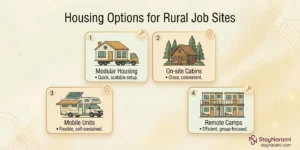
Housing Options for Rural Job Sites
Housing option |
Usually best for |
Main advantage |
Common limitation |
| Local rental homes | Small crews staying several weeks or months | Kitchens, laundry, and a home-style setting | Limited supply and occupancy restrictions |
| Motels or small hotels | Short projects and changing crew sizes | Fast move-in and simple billing | High nightly cost and limited cooking space |
| Modular housing | Medium or large crews on longer projects | Can be placed near the job site | Requires land, permits, utilities, and setup |
| RVs and travel trailers | Small or mobile crews | Flexible placement and private sleeping space | Campground rules, utility needs, and weather limits |
| Managed worker camps | Large crews in very remote areas | Housing, meals, laundry, and services in one place | High setup cost and more permit requirements |
| Mixed housing plan | Projects with changing needs | Reduces dependence on one property type | Requires stronger booking and tracking systems |
1. Modular and Mobile Housing Units
If the local hotels and rentals can’t house the whole crew when working in remote locations, modular units or factory-built units can be utilized for temporary housing. Rooms may be bedroom rooms, bathroom rooms, kitchen rooms, dining rooms, offices, or laundry rooms.
They can work well when:
- The project will last several months or longer
- The crew is too large for local rentals
- Suitable land is available near the site
- Utility connections can be installed
- The project has enough lead time for permits and delivery
The unit price is only part of the cost. Employers may also need to pay for land preparation, transportation, foundations, stairs, fire access, electrical service, water tanks, wastewater treatment, propane, generators, internet, cleaning, and removal.
Before an order, a site assessment should be completed. The delivery truck must be able to get to the site, and the ground must be accessible with wet or frozen ground.
2. Leased Local Rentals and Furnished Housing
Renting houses, apartments, cabins, or furnished rentals is the most convenient option for small or medium crews. Employees have access to a work kitchen, bathroom, and laundry and have more space than a typical hotel.
If you are going to be staying for an extended period, a monthly lease could be more affordable than nightly rentals. But a full employer comparison with all costs, such as deposits, furniture, utilities, cleaning, transportation, and potential early cancellation, should be done.
Don’t presume that a landlord will permit crew housing. Request in writing permission to
- Number of people in the vehicle
- Company paid rent
- Work vehicles and trailers
- Crew changes during the lease
- Night shift arrivals
- Parking arrangements
- Cleaning and maintenance access
- The person responsible for damage
It may be easier to lease several smaller homes than one large house. This can reduce crowding and allow day and night shift workers to stay in separate properties.
3. RV and Worker Camp Setups
RVs can be useful for mobile crews, short seasonal jobs, and sites where normal rental housing is unavailable. They may be placed in an established campground or on approved private land.
An RV is not automatically a low-cost option. Look for the following when you’re comparing it with a rental home:
- RV rental or loan cost
- Campground or land fee
- Electricity, fuel, and propane
- Water and wastewater service
- Insurance and maintenance
- Internet service
- Winter preparation
- Laundry and shower access
- Cleaning and waste removal
Local rules may limit how long an RV can be occupied on private property. Permits and/or approved utility connections also are required in some areas.
Larger worker camps may use RVs, modular units, or bunkhouses with shared kitchens, showers, laundry, and recreation areas. They offer more control but require careful management.
What to Consider Before Choosing a Housing Solution
1. Crew Size and Project Duration
The project length often determines which housing option offers the best value. Hotels may work for a crew arriving for a few nights. Rental homes may be better for a six-week assignment. Modular units or a managed camp may become more practical when dozens of workers will remain in the same place for several months.
Also plan for changes. A project may begin with 12 workers, rise to 40 during peak work, and fall back to eight near completion. Avoid signing one fixed agreement without understanding how rooms can be added or released.
2. Budget and Per Diem Policies
The cheapest advertised room is not always the cheapest housing choice.
Use this calculation:
Total housing cost = rent or room charges + utilities + setup + furniture + cleaning + transportation + permits + management + cancellation costs
Then calculate:
Cost per occupied worker night = total housing cost ÷ total occupied worker nights
This provides a fair comparison between options. A rental home may have a higher monthly price but a lower worker-night cost when it includes six beds, a kitchen, laundry, and parking. Your housing policy should also explain:
- Whether the employer books and pays directly
- Whether workers receive a lodging allowance
- Which expenses are reimbursed
- Who pays deposits and utility charges
- How damages are handled
- Whether workers can choose their own housing
- What happens when a worker leaves early
Federal and state wage laws may apply when housing costs are deducted from pay or lodging is counted as wages. Employers should confirm the rules and keep clear records before making deductions.
3. Utilities and Site Infrastructure
Utilities are often a worker-night factor for remote housing. Before placing units on rural land, confirm the available capacity for:
- Drinking water
- Wastewater and septic service
- Electricity
- Heating and cooling
- Propane or natural gas
- Trash collection
- Internet and phone coverage
- Emergency vehicle access
Please don’t presume an existing domestic septic system will be able to cope with a large crew. A septic system designed to treat sewage from 20 or more people a day is a large-capacity septic system per federal environmental guidance. These systems could be subject to federal, state, tribal, or local regulation.
Evaluations of the water supply and wastewater capacity should be made before occupancy by qualified local professionals.
Working With Local Landlords and Housing Providers
While understanding the local relationships can help make rural housing easier, all agreements should be in writing.
Talk to property managers, real estate agents, campground owners, local governments, chambers of commerce, farm owners, and landlords. You won’t be able to find some of the properties on the big rental sites.
Make a full housing request to each contact. When a landlord is aware of employee numbers, dates, vehicles, payment, and anticipated use, they’ll be better able to respond.
Before signing, ask for:
- A video or in-person property tour
- A list of every bed and room
- Written occupancy approval
- Parking and trailer rules
- Utility details and limits
- Internet speed or coverage information
- Cleaning and maintenance terms
- Cancellation and extension rules
- Emergency contact details
- A move-in condition report with photos
Have one person per property. Employees should be aware of who to call for lockouts, repairs, issues with water lines, neighbors’ complaints, and scheduling changes.
Legal and Safety Requirements for Worker Housing
Rules vary according to location, industry, and housing and employment relationships. Before opening employer-controlled housing, make sure to see zoning, occupancy, building permitting, fire code, health, landlord laws, RV laws, and wastewater laws.
Federal temporary labor camp standards also may apply to agricultural and nonagricultural workplaces where employer-provided housing is a condition of employment.
Where relevant, inhalation combines aspects like drainage, shelter, sleeping area, toilets, water, waste disposal, cooking facilities, heating, and definitely hygiene. The standard specifies, for instance, that there should be, at least at the minimum, 50 square feet of sleeping room floor per person, and spacing must be followed for bunks and beds.
Additional inspections and requirements of housing may be imposed on agricultural employers, farm labor contractors, and agricultural employers using certain temporary worker programs. Federal checklists refer to water supply, drainage, toilet facilities, cooking space, waste removal, pest control, and recreation space.
At a minimum, every housing plan should provide:
- A safe bed for each worker
- Working smoke and carbon monoxide alarms
- Safe heating and electrical systems
- Clean drinking water
- Working toilets and showers
- Secure doors and windows
- Adequate lighting
- First aid supplies
- Fire extinguishers
- Emergency contact information
- A clear evacuation plan
- Regular cleaning and waste removal
Generators should be kept outside away from doors and windows and air intakes, as they can produce deadly carbon monoxide.
These conditions could differ significantly from one employer to another, so employers must verify conditions in advance with the local building office, fire marshal, health department, planning office, and labor authority before the workers move in.
Steps to Set Up Rural Worker Housing
Use this checklist to organize your worker housing solutions:
- Confirm the project schedule: Record arrival dates, departure dates, peak crew size, and possible extensions.
- Count workers and beds: Do not use bedroom count as a replacement for bed count.
- Map the search area. Compare every town and road within a safe driving time of the job site.
- Set a total budget: Include rent, utilities, transportation, cleaning, deposits, setup, and management.
- Compare several housing types: Review rentals, motels, RV parks, modular units, camps, and mixed plans.
- Check the commute in person: Test the route during actual shift hours and expected weather conditions.
- Review legal requirements: Confirm zoning, occupancy, fire, health, septic, and labor housing rules.
- Inspect the property: Check every bed, lock, alarm, appliance, bathroom, parking space, and utility.
- Create written worker rules: Cover guests, noise, vehicles, cleaning, smoking, damage, and emergency contacts.
- Keep backup housing available: Identify extra rooms or properties in case the crew grows or the main housing becomes unusable.
Plan the Stay Before Mobilization
Share your workforce schedule, required beds, parking needs, project duration, and essential amenities with StayNarami before local availability becomes limited.
Conclusion
Housing workers in rural areas requires more than finding available rooms. Employers must consider safe commute times, separate beds, work-vehicle parking, utilities, local occupancy rules, and possible changes in crew size. The best option may be a furnished rental, hotel, RV setup, modular unit, worker camp, or a mix of several housing types.
Planning early gives you more choices and helps prevent high costs, unsafe travel, and project delays. Compare the full cost per occupied worker-night, inspect each property, confirm all terms in writing, and keep a backup option available.
Frequently Asked Questions
1. What is the cheapest way to house workers in a rural area?
If you have a small team and have been around the area for more than a week, having an existing local rental might be the least expensive way to go. Modular units might be more cost-effective for a larger crew on a longer project. Compare the total cost per occupied worker night rather than looking only at the nightly or monthly rate.
2. Do employers have to provide housing for rural or remote job sites?
Employers are not always required to provide housing. However, many provide or help pay for housing when workers cannot reasonably find suitable accommodations near the job site. Extra rules may apply when housing is required as a condition of employment, when housing costs are deducted from wages, or when agricultural and temporary worker programs are involved.
3. How far in advance should rural worker housing be arranged?
Begin the search at least 60 to 90 days before workers arrive whenever possible. Larger modular or camp projects may require more time because of permits, site preparation, utility work, manufacturing, and delivery. Rural rentals may also be reserved months ahead during harvest, tourist, hunting, or major construction seasons.
4. Can modular housing be used without utility hookups?
Some modular units can operate with water tanks, generators, propane systems, and temporary wastewater equipment. However, this adds cost and maintenance needs. The site must still meet local rules for water, sewage, power, fire access, and occupancy.
5. How far should worker housing be from the job site?
There is no single distance that works for every project. Focus on travel time, road safety, weather, shift schedules, and access to fuel and medical care. Test the drive during the same hours workers will travel.
6. What should be included in rural crew accommodations?
Useful rural crew accommodations should include a separate bed for each worker, working bathrooms, safe drinking water, heating or cooling, secure storage, laundry access, reliable parking, cooking facilities or meal service, and a clear way to report maintenance problems.
Need housing for your team?
Tell us what you need and we'll take care of the rest — anywhere in the U.S., 30+ days.
Request Housing →Related Articles