Corporate Housing vs Extended Stay Hotels

Stop Paying Hotel Rates for a Long-Term Stay
StayNarami offers spacious, fully furnished housing with a kitchen, laundry, Wi-Fi, and one simple monthly cost.
While it is great to hear that you will be traveling to do some work, the pain is felt once the bill has come in for a hotel stay and you need to find a nice place to stay in a city your boss sent you to unless you are traveling under the guise of a vacation.
The easiest choice is to book a standard hotel room for the stay․ It takes about two minutes online. But man, that final bill adds up fast. Lodging costs can completely wreck a project budget before the work is even halfway done.
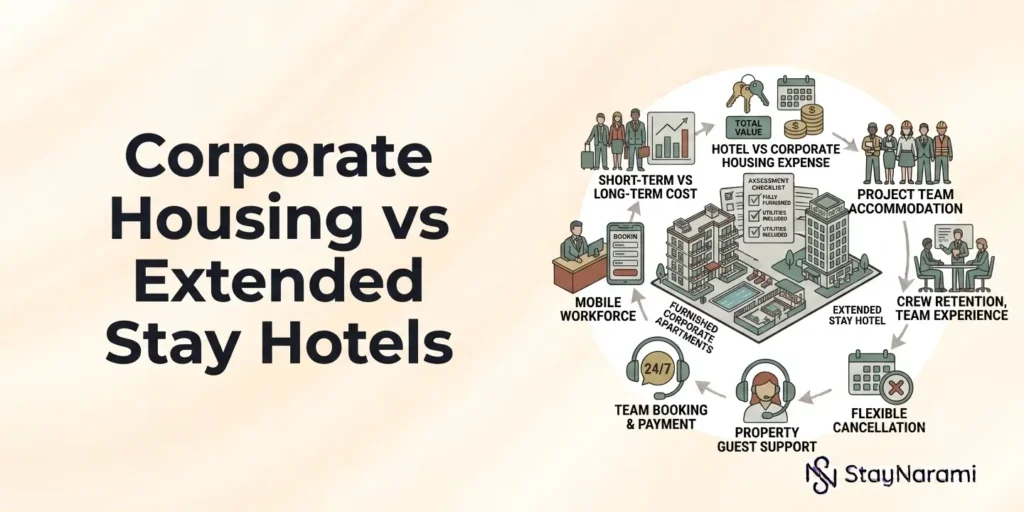
So, the big debate for any long trip always comes down to this: corporate housing vs extended stay hotels.
A recent 2026 report by the Highland Group shows that a mid-tier extended stay room runs about $115 a night. Upscale hotels can cost significantly more. And that base price does not even include sneaky local taxes. If you need a bed for a month or more, you have to look at the big picture.
TL;DR (Too Long; Didn’t Read)
- Designed specifically for the employer, project manager, relocation teams, and business travelers who need to compare corporate accommodation with extended-stay hotels.
- When you can’t be sure of your return date, or your trip won’t take long, extended-stay hotels are convenient for booking, housekeeping, and checking out. Typically, corporate housing offers greater space, a complete kitchen, laundry facilities in a unit, an Internet connection without having to share it with other people, and more value for the long haul, all for stays of thirty days or more.
- Room rates are only part of the cost. Hotel taxes, meals, laundry, parking, and limited space can make a 60- or 90-day stay expensive. Corporate housing taxes may also vary by location and length of stay.
- This guide gives you an honest temporary housing comparison. We will look at hidden fees, the tax traps that get everyone, and what it actually costs to live day-to-day. By the end, you will know exactly what fits your timeline best.
Overview: Two Ways to House Traveling Employees
Before putting down a company credit card, you should know how these two setups actually work. They are built for different situations.
Corporate housing is just a regular, fully furnished apartment. Sometimes it is a whole house. You rent it from a specialized company for a set block of time. Your rent covers everything. The couch, the water bill, the internet- it is all wrapped into one monthly price. You agree to stay for at least a month. Because of this, the housing company does not stress about finding new guests every three days. This helps keep your daily costs much lower.
An extended stay hotel is a big commercial building. You book it by the night or the week. You get a lobby and a front desk. People clean your room. You pay extra for the right to pack up and leave on a random Tuesday without breaking a lease. When folks start hunting for extended-stay hotel alternatives, they usually just want to stop paying the crazy daily rates that these hotels charge to keep their massive buildings running.
Space and Living Experience
Where you sleep changes how you feel after a ten-hour shift. Tiny rooms make people grumpy over time. Let us look at how the actual room size changes your daily routine.
1. Square Footage and Layout
The size difference here is wild. A standard extended stay hotel room gives you maybe 300 to 400 square feet. Your bed, a small desk, and the kitchen stuff all share one single room. When you sit on your bed, you stare at your work laptop. When you eat, you stare at your bed. With no separate rooms, the space can quickly feel cramped and uncomfortable. Cabin fever sets in fast.
Corporate apartments give you a real home layout. A standard one-bedroom gives you 700 to 900 square feet. You get a real living room with a sofa. You get a separate bedroom with a door that actually closes. If your partner or a dog comes along, you will not step on each other. When doing a strict furnished apartment vs hotel check, the apartment wins hands down. It feels like a normal home, not a holding cell.
2. Kitchen and Living Areas
Food is everything when you’re traveling․ Hotels have kitchenettes, and by kitchenettes I mean a mini-fridge‚ a little microwave‚ and maybe a hot plate built into a small counter․ A cramped kitchenette makes family meals difficult, and the tiny sink turns cleanup into a chore. Many guests end up relying on expensive takeout instead.
Corporate housing has a real, full-size kitchen. You get a normal oven and four burners. You get a big fridge that holds a week of real groceries. You have plenty of counter space to chop onions and prep meals. You can cook just like you do at home. Plus, you get a real living room to watch TV. You do not have to eat pizza while sitting on the edge of a hotel mattress.
Cost Comparison for 30, 60, and 90-Day Stays
If you want to know what actually saves money, you have to do the math. The nightly rate is just a starting point. Add in taxes and food, and the numbers flip completely.
Most states charge hotel taxes. Cities use this to make money off tourists. These taxes add 10% to 15% on top of your nightly rate. But here is the trick. If you sign an apartment lease for 30 days or more, the city usually sees you as a resident. That means corporate housing skips those massive taxes entirely.
Here is a real look at what one worker might pay over time.
Expense Factor |
Extended Stay Hotel |
Corporate Housing |
| Base Monthly Cost | $3,500 – $4,500 | $3,000 – $4,000 |
| Occupancy Taxes | 10% to 15% extra | 0% (Tax-free over 30 days) |
| Food (Monthly) | $900 (Eating out often) | $400 (Buying groceries) |
| Laundry (Monthly) | $60 (Paying for machines) | $0 (Free in your room) |
| Total 30-Day Cost | $4,810 – $6,135 | $3,400 – $4,400 |
| Total 60-Day Cost | $9,620 – $12,270 | $6,800 – $8,800 |
| Total 90-Day Cost | $14,430 – $18,405 | $10,200 – $13,200 |
Looking for a better way to house your traveling employees without breaking the budget?
See Where Your Lodging Budget Goes Further
StayNarami makes it easier to compare corporate housing costs, hotel expenses, meal savings, and long-term value before you book.
Amenities and Services
A lot of folks pick hotels because they think the extra services are nice. Sometimes they are. But you pay a steep price for them.
1. Housekeeping and Utilities
Hotels clean your room. Sounds great, right? Until the loud cleaning cart wakes you up at 8 AM on your only day off. Plus, lots of extended stay spots only clean your room once a week anyway. The hotel pays for water and power, which is nice. But you share the Wi-Fi with two hundred other people. Try doing a Zoom call when the internet keeps freezing up.
Corporate apartments include your utilities and internet in the monthly rent. You get your own private Wi-Fi router. The connection is fast and stable. You do have to clean the place yourself. But you get total privacy in return. Nobody walks into your room while you are resting.
2. On-Site Amenities
Hotels give you a lobby. Maybe you get a tiny gym with two treadmills. Sometimes you get free toast and coffee in the morning. If you need an extra towel, you can just walk down to the front desk.
Corporate apartments are located in normal apartment buildings. You get to use what the locals use. That might mean a massive community gym with heavy weights, a big swimming pool, and safe garage parking. Best of all? Corporate housing almost always puts a washer and dryer right inside your unit. No carrying dirty clothes to a creepy hotel basement. No digging in your pockets for quarters.
Flexibility and Lease Terms
Your travel schedule drives this choice more than anything else. Hotels offer crazy flexibility. If your boss says the project is done two weeks early, you pack up. You leave the keys at the desk, and you stop paying that exact day. Zero financial risk.
Corporate housing makes you commit. It is a real apartment, so the minimum stay is usually 30 days. You sign a paper saying you will pay for the whole month. If you leave on day 20, you still pay for all 30 days. You trade the freedom to leave early for a much lower daily price. This is why you must know your exact timeline before booking anything.
Location and Availability
Where you sleep changes your daily commute; extended stay hotels want to be seen by drivers. Because of zoning rules, they get built right next to loud highways or busy airports. You rarely find them in quiet neighborhoods with big trees. You usually have to drive your car just to grab a coffee or buy a snack.
Corporate apartments are everywhere normal people live. You can stay downtown near the cool spots. You can stay in a quiet suburb near good parks. You live exactly like a local. You can walk to cafes and big grocery stores. Living in a real neighborhood stops you from feeling lonely on a long work trip.
Which Is Better for Your Use Case?
Making the final call between the two options comes down to the calendar. Let us look at the two main ways this plays out for workers.
1. Short Stays (Under 2 Weeks)
Consider not having an apartment if you’re just in town for 10 days. You need a hotel. The flexibility ensures that you don’t lose any cash in case plans crash. No lease of space or security deposit is required. Yes, it’s a small room. For a brief stay, however, the mini-fridge and a hotel bed are just fine. The stay will be a few days, and the price will be higher per day, but as a result, the price becomes cheaper.
2. Long-Term Stays (30+ Days)
Once you hit the one-month mark, the math changes completely. The best option for long-term stays is corporate housing. You dodge those huge hotel taxes. You save tons of cash because you cook real food in a real kitchen. You sleep better in a quiet bedroom. You wash clothes for free. Signing a one-month lease is totally worth the thousands of dollars you keep in your pocket. Picking an apartment just makes basic financial sense for the long haul.
Give Your Team More Space Without Spending More
Share your location, dates, group size, and required amenities with StayNarami to find move-in-ready housing for stays of 30 days or longer.
Conclusion
Picking where to sleep for a long work trip does not have to be a guessing game. When you look at the real costs and how comfortable you actually want to be, the winner becomes obvious. Extended stay hotels make total sense for short trips where your plans might change at the last minute. They give you high flexibility. But they also charge you heavy taxes and give you barely any room to breathe.
Corporate housing is the smartest financial choice for any trip lasting a month or longer. It’s a real house with a large kitchen. This means that you have your own washing and drying machine for use. There’s plenty of room to really stretch out. More important still, you save money on restaurant and hotel charges and cook your own meals. When it’s time for a long trip, you’ll want to have your time frame checked. Don’t settle for that small hotel room, and make up your mind to try something that is truly a home rather than a hotel room if you’re planning to stay for over 30 days!
Frequently Asked Questions
1. Is corporate housing more affordable than an extended stay hotel?
Hotel stays for less than 2 weeks may become cost-effective; stays of 30 days or above, typically corporate housing options, are more affordable.
2. How much longer is the average corporate hotel stay than the average corporate housing stay?
Corporate housing generally lasts for a longer period of time, anywhere between 30 and 90+ days, while extended stay hotels are for week-long stays ranging anywhere from 1 to 4 weeks.
3. Are full kitchens, like in corporate housing, also available in extended stay hotels?
An extended stay hotel suite often offers kitchenettes, while corporate housing offers more living room space and full-size kitchens.
4. What is better for moving families?
Corporate housing is generally better for families due to more space, separate bedrooms, and a residential setting.
Need housing for your team?
Tell us what you need and we'll take care of the rest — anywhere in the U.S., 30+ days.
Request Housing →Related Articles