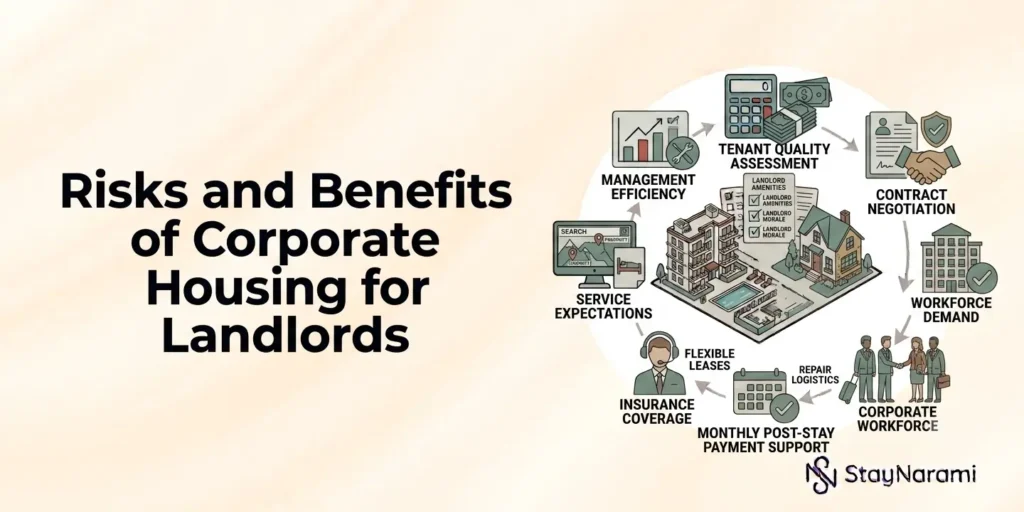
Risks and Benefits of Corporate Housing for Landlords

Earn More Without Managing Every Turnover
StayNarami helps property owners connect furnished homes with verified crews, corporate teams, relocating employees, and displaced families staying 30 days or longer.
Rental owners are in a tight spot right now. The U.S. Census Bureau put the national rental vacancy rate at 7.3% in the first quarter of 2026, and it took a median of 41 days in February 2026 to move a unit from listing to signed lease. Turnover is not cheap either. Most estimates land between $1,000 and $5,000 per move-out once you add lost rent, paint, cleaning, and marketing.
Collections are shakier too. Late payments in independently owned rentals climbed from 8.8% in mid-2024 to 11.7% by June 2025, and a December 2025 survey found 41% of rental investors were more worried about missed rent than the year before.
So when a company offers to lease your whole unit and pay every month, it sounds like the answer. Sometimes it is. Sometimes it hides a problem you will not see until month eight.
This guide lays out the real risks and benefits of corporate housing for landlords, with numbers instead of promises. You will get an honest look at both sides, a worked profit comparison, and a checklist for protecting yourself before you sign anything.
TL;DR (Too Long; Didn’t Read)
- Designed for landlords or property owners who are thinking about using a corporate master lease rather than a lease.
- Have steadier rent, fewer vacancy gaps, less tenant turnover, and perhaps even higher income with corporate housing. The potential dangers consist of enhanced wear and tear, single-supplier reliance, gaps in insurance, uncertain maintenance responsibilities, and expensive early termination clauses.
- A solid corporate lease can help enhance annual returns—especially since rent is vacant at 7.3% in early 2026 and can cost between $1,000 and $5,000 per turnover. It’s best to check on the provider, compare net profit, and have an agreement regarding occupancy, repairs, insurance, inspections, and payment requirements written out.
- This guide will cover the financial advantages, contract caveats, landlord checks, and lease safeguards landlords should consider before signing.
How Corporate Housing Works for a Landlord
In a standard rental, an individual or family signs the lease and occupies the property. In many corporate housing arrangements, a company or housing provider signs the lease and places employees, contractors, relocating workers, or other approved guests in the home. Corporate housing providers commonly operate through formal landlord-tenant lease agreements.
This arrangement is often called a corporate lease or master lease. The company is responsible for paying rent and following the lease, while the people staying in the property are usually listed as authorized occupants. Depending on the agreement and local law, the arrangement may also involve a sublease. Under a sublease, the original tenant generally remains responsible for its obligations to the landlord.
Not every corporate housing arrangement works this way. A landlord may lease directly to an employer, work with a provider under a management agreement, or operate the furnished rental independently. This article focuses on leasing the property to a corporate housing company.
The lease should clearly cover:
- Use (number of people) and the maximum number allowed in the room.
- Rent, deposit, utilities, furnishings
- Cleaning, repairs/property damage
- Insurance and liability
- Access by the landlord/inspection
- Renewals, extensions, and early termination
- Conforming to local rental and occupancy laws
These responsibilities should never be assumed. Put every important term in writing and have the agreement reviewed under the laws where the property is located.
Corporate Housing Landlord Pros and Cons at a Glance
Potential Benefits |
Possible Risks |
| Longer lease periods | Dependence on one company for rent |
| More predictable monthly income | More occupants may use the home |
| Fewer periods without rent | Furniture and utility costs |
| Less marketing between occupants | Insurance may need to change |
| One main business contact | Local rules may limit the use |
| Possible rent above standard market rates | Early termination could create sudden vacancy |
| Provider may manage guest communication | Poor management can lead to damage or complaints |
| Demand from several temporary housing needs | Profit depends heavily on lease terms |
Corporate housing is not automatically safer or more profitable than a standard lease. Results depend on the local market and the quality of the provider.
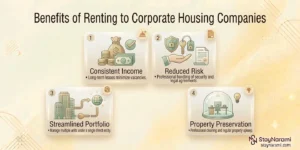
Benefits of Renting to Corporate Housing Companies
Let’s start with what actually works about this model.
1. Steady, Predictable Income
The biggest draw is simple. Your tenant is a business, and businesses pay from an operating budget instead of a paycheck.
Under most agreements, the provider owes you rent whether or not someone is living in the unit that week. Guests come and go. Your deposit stays the same. For an owner with a mortgage due on the first, that predictability is worth real money, and it is the main reason renting to corporate housing companies appeals to small landlords.
Compare that to a normal lease. One vacant month costs you roughly 8% of your annual rent. Two months cost closer to 17%. A lease that pays through slow seasons is not exciting, but it protects your return better than a higher headline rent ever will.
2. Less Hands-On Management
Turnover is where most small owners lose their evenings. Showings, screening, deposit arguments, and the call about the scratched floor.
Most of that is soaked up by the provider. They filter and redirect their own calls, scrub between calls, schedule calls over 11 pm, and give you one person to deal with. You are still the owner of the building – the roof is still yours, the furnace is still yours. The churn’s no more.
3. Higher Rent Potential
Furnished mid-term rentals generally command 20% to 50% more than the same unit rented bare. A place that gets $2,000 unfurnished often prices between $2,400 and $3,000 as corporate housing.
Be careful with that number, though. Under a master lease, a provider usually pays somewhere under the top furnished rate because they are the ones carrying vacancy risk and guest service. You are trading a slice of upside for stability. Whether that trade is smart depends on your market, and that is the honest answer to whether corporate housing is profitable for landlords in any specific case.
Corporate Leasing Risks to Consider
Now the part the sales pitch skips.
1. Wear and Tear from Frequent Turnover
Your unit will see more foot traffic than a single-family on a year lease. Different people, different habits, and more suitcases through the same doorframe.
That shows up in ways that are easy to underestimate:
- Floors, baseboards, and paint age faster
- Appliances get heavier use, especially the washer and dishwasher
- Locks, blinds, and cabinet hardware loosen sooner
- Furniture, if you own it, needs replacing every three to five years
None of this is catastrophic. It just means your maintenance reserve needs to be bigger than it was under a traditional lease, and the agreement has to say clearly who pays for what.
2. Dependence on a Single Tenant or Provider
This is the risk most owners never think about, and it is the serious one.
Under a master lease, your entire income from that property depends on one business staying solvent. If it fails, you do not have one late tenant. You have zero revenue and a legal problem.
That is not a theoretical worry in this market. Bankruptcy data reported in July 2026 showed 17,285 commercial filings in the first half of the year, up 13% from the same period in 2025. Commercial Chapter 11 filings rose 28%. Small business reorganizations jumped 50%.
Here is what happens if your master tenant files:
- An automatic stay blocks you from evicting or collecting right away
- If the lease is rejected, your claim is capped, often near one year of rent
- A cash security deposit can get pulled into the bankruptcy estate
- The people living in your unit may have their own rights to stay, which you might have to sort out in state court
One tenant paying reliably is a benefit. One tenant paying all of your rent is a concentration risk. They are the same arrangement viewed from different distances.
3. Contract and Liability Risks
A master lease is a normal lease with extra pages, and the extra pages are where owners get hurt. Common trouble spots:
- Vague vacancy language. If the lease does not clearly say rent is owed whether or not the unit is occupied, you may not be covered.
- Open-ended occupancy rights. Without a cap on headcount and a ban on nightly rentals, you can end up hosting something you never agreed to.
- Silent maintenance terms. No dollar threshold means every repair becomes a negotiation.
- Insurance gaps. Your standard landlord policy may not fit a business tenant or a furnished unit.
- Lender and HOA rules. Many mortgages and HOA documents restrict subleasing. Signing anyway can put you in default.
- Weak exit terms. If a project ends early and there is no notice period or fee, you are left with a sudden gap.
Here is the two-sided view in one place. This is the honest version of the corporate housing landlord pros and cons debate:
Benefit |
Matching Risk |
| Rent paid by a business, not an individual | If that business fails, all your income stops at once |
| No vacancy gaps between guests | You may give up some of the top furnished rate |
| Provider handles screening and cleaning | You lose direct control over who is in your unit |
| Longer stays than nightly rentals | Still more turnover than a single 12-month tenant |
| One point of contact | One point of failure |
| Higher rent than an unfurnished lease | Furnishing and faster wear can eat the premium |
| Lower marketing and listing costs | Contract complexity means legal review is not optional |
Lease With More Clarity and Less Guesswork
StayNarami’s Landlord Partner Program helps owners understand property requirements, leasing expectations, communication, and long-term corporate housing opportunities.
How to Minimize Risk as a Landlord
Most of what goes wrong here is preventable. It comes down to who you pick and what the paper says.
1. Vetting Providers and Contract Clauses
Treat this like lending money because, functionally, you are. You are extending a year of housing on credit.
Check the company first:
What to check |
What you want to see |
| Legal entity | Registered and in good standing with your Secretary of State |
| Track record | Several years operating, with named end clients |
| Landlord references | Two or three you can actually call |
| The key reference question | Did rent arrive on time even when the unit sat empty? |
| Financial backing | A parent company guarantee or an officer signature |
| Insurance | A current certificate with real coverage limits |
| Trade association membership | A signal of standards and staying power |
Then fix the contract. These clauses matter most:
- Rent is owed regardless of occupancy, stated plainly, with a fixed due date.
- A guarantee from a parent company or principal, so the lease is not resting on a thin entity.
- A letter of credit instead of a cash deposit, if you can get one, since cash deposits are weaker if the tenant files for bankruptcy.
- Occupancy limits in writing, including maximum headcount and no nightly rentals.
- A maintenance threshold, for example, the provider covers repairs under $300, and you cover systems and structure.
- Inspection rights, quarterly or twice a year, with reasonable notice.
- Early termination terms, meaning a notice period plus a fee.
- Furniture ownership and removal, spelled out for the end of the term.
1. Insurance and Documentation
Do not assume your current policy travels with you into this model. A 2026 furnished-rental insurance guide makes the point that homeowner’s coverage is not built for full-time rentals and that “contents” does not automatically include your couch, TV, or kitchen setup. It also notes insurers “may see nightly stays differently than 30+ day stays.”
Four steps that take an afternoon and save years of trouble:
- Tell your insurer a business will hold the lease, and ask what endorsement you need
- Require the provider to carry commercial liability and name you as an additional insured
- Photograph every room and sign a dated inventory at move-in and move-out
- Keep organized records of rent, repairs, inspections, and messages
Have a local real estate attorney read the draft before you sign. A few hundred dollars now beats a dispute you cannot win later.
Is Corporate Housing Right for Your Property?
The honest answer to whether corporate housing is profitable for landlords depends on your own numbers, not an industry average. Run them on your unit. Here is an illustrative comparison for a $2,000-a-month property over one year:
Comparison Point |
Traditional 12-Month Lease |
Master Lease to a Provider |
Furnished Rental You Run Yourself |
| Monthly rent | $2,000 | $2,200 | $2,700 when occupied |
| Gross for the year | $24,000 | $26,400 | ~$25,900 at 80% occupancy |
| Vacancy loss | -$1,200 | $0 | Built into the 80% |
| Turnover costs | -$1,500 | $0 | -$1,050 |
| Furnishing, spread over 4 years | $0 | $0 if provider furnishes | -$2,500 |
| Utilities and internet | $0 | $0 | -$2,400 |
| Comparison Point | Traditional 12-Month Lease | Master Lease to a Provider | Furnished Rental You Run Yourself |
| Monthly rent | $2,000 | $2,200 | $2,700 when occupied |
| Gross for the year | $24,000 | $26,400 | ~$25,900 at 80% occupancy |
So think of this as a worksheet, not a guarantee. Your rates, utilities, and occupancy will vary. However, most markets want to know your shape, and it tells of something people don’t assume: in most cases, a furnished rental made directly by the owner costs less, as the utilities, furniture, and cleaning absorb the overage.
This model tends to fit when:
- Your unit sits near hospitals, big employers, government sites, or active projects
- You want predictable income more than maximum income
- You can afford legal review and a proper insurance endorsement
- Your mortgage and HOA allow subleasing
It tends to be a poor fit when:
- There is no local demand from crews, agencies, or relocating staff
- This is your only property and losing a few months of rent would break you
- Your lender or HOA prohibits it
- You want zero involvement and no learning curve
See Whether Your Property Fits an Active Housing Need
Share your location, property type, availability, furnishings, amenities, and preferred lease terms with StayNarami to explore suitable placement opportunities
Final Takeaway
The risks and benefits of corporate housing for landlords are closely connected. A longer business lease could minimize dependency on vacancies as well as control daily administration. Still, it could likewise call for reliance on a single supplier and put even more emphasis on the business contract.
The best idea is to find out what’s in demand, work out the bottom line, do some research on the provider, check insurance, and negotiate for a lease that provides for subjects like occupants, repairs, damage, inspection, and early termination. The numbers and protections have to work for the owner, as corporate housing can be a useful leasing path when they do.
Frequently Asked Questions
1. Is it risky to rent my property to a corporate housing company?
There are risks, including higher turnover and relying on one company for rent. Check the provider’s record, insurance, references, and financial stability before signing.
2. How do I protect my property?
Use a detailed master lease, require liability insurance, collect a deposit, document the property’s condition, and retain regular inspection rights.
3. Can I cancel a corporate housing lease early?
Only if the lease allows it; clearly define notice periods, termination fees, and early-exit conditions before signing.
4. Is corporate housing more profitable than traditional renting?
It can be, mainly due to stable occupancy and fewer turnover costs. Compare the guaranteed annual rent with the expected income and expenses of a standard lease.
5. What happens if the provider stops paying rent?
Follow the lease’s default and enforcement terms. A parent company or personal guarantee may give you another party to pursue for unpaid rent.
6. Do I need to furnish the property?
Not always. Some providers supply the furniture, while others require a move-in-ready home. Confirm who owns, maintains, and removes the furniture.
Need housing for your team?
Tell us what you need and we'll take care of the rest — anywhere in the U.S., 30+ days.
Request Housing →Related Articles