What to Expect When Leasing Your Property to a Company

Lease to a Company Without Losing Control
StayNarami helps property owners connect with temporary company housing needs while keeping payment terms, occupancy rules, and property expectations clearly defined.
Leasing your property to a company can give you a steady business tenant, fewer vacant months, and less work between individual occupants. However, the process is different from approving a person or family for a standard residential lease.
The difference matters when rental demand becomes uncertain. The U.S. rental vacancy rate was 7.3% during the first quarter of 2026. A national figure cannot predict conditions in one neighborhood, but it shows why many owners are looking for leasing options that may reduce empty periods.
Under a corporate lease, a business usually signs the agreement and places approved employees, contractors, relocating families, or other temporary residents in the home. The company pays the rent, but the person sleeping in the property may change during the lease.
That setup can work well, but only when the landlord knows who is responsible for payment, damage, repairs, insurance, and occupant conduct. This guide explains the application process, important lease terms, payment practices, warning signs, and what landlords should confirm before giving a company the keys.
TL;DR (Too Long; Didn’t Read)
- Designed for landlords and property owners wanting to lease an apartment, home, or other property to a firm rather than an individual tenant.
- One business contact can be provided, and a corporate lease can help to reduce vacancies and provide more stable rent; however, the landlord must verify the company, set out who will be a survivor to the lease, and specify their liabilities for rent, damage, utilities, maintenance, insurance, etc.
- Recently, the rental vacancy rate in the U.S. eclipsed 7.3% in early 2026, and if suited well, hiring company rentals could help to minimize periods of vacancy.
- This guide discusses how corporate leases work, what documents to ask for, warning signs to be aware of, and what landlords can expect once you’ve moved in.
How Corporate Leases Differ From Individual Tenant Leases
A regular house lease typically specifies who will reside in the house. Those locals are screened, put in applications, show documentation of income, pay rent, and take responsibility for the property.
With a corporate lease, a business entity becomes the named tenant. It may use the property to house one employee for the entire term or rotate different approved occupants as assignments begin and end.
Corporate housing is described as professionally managed, furnished temporary accommodation. It is often used for stays of more than 30 days and operates through formal landlord-tenant agreements.
Corporate housing provides “fully furnished, temporary residential-style accommodations.”
The company may be an employer leasing directly, or it may be a housing provider that leases properties and places its clients in them.
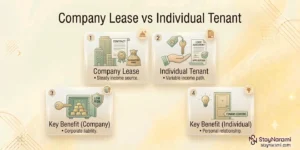
1. Company Lease vs Individual Tenant
Lease Area |
Company Lease |
Individual Tenant Lease |
| Named tenant | Business entity | Person or household |
| Occupants | Employees, clients, or approved guests | Named residents |
| Financial review | Business registration, credit, and payment history | Income, credit, and rental history |
| Rent payer | Company or housing provider | Resident |
| Occupant changes | May be allowed during the term | Usually require landlord approval |
| Main contact | Company representative | Resident |
| Furnishings | May be supplied by either party | Often supplied by tenant |
| Invoicing | May require W-9 and business records | Usually a standard rent receipt |
| Main risk | Company payment failure or weak lease terms | Individual payment failure |
Neither option is automatically safer. A well-established company may have more financial strength than one individual, but a new or poorly funded business may carry greater risk than a qualified long-term renter.
2. Who Signs the Lease?
The exact legal entity responsible for rent should sign the lease. Do not use only a brand name, website name, employee name, or informal business name.
The agreement should show:
- The company’s full legal name
- Its legal structure, such as an LLC or corporation
- Its state of registration
- Its business address
- Name of the authorized signer
- The signer’s authority to bind the company
- The company’s notice and billing contacts
An employee may sign on behalf of the company, but the employee should not become the tenant by accident unless that is the intended arrangement.
The Application and Approval Process
Renting to a business tenant still requires screening. The documents are different, but landlords should not skip the review because a company appears professional.
Start by requesting:
- The full legal business name
- State registration information
- A certificate of good standing, when available
- A completed W-9
- Proof of insurance
- Landlord or vendor references
- Financial statements or other proof of payment ability
- The intended use of the home
- Expected occupant count and stay length
- Renting, maintenance, emergencies, contact information
Businesses use the state authorities to register, and many states provide certificates that a company is up and running or is in good standing. Check with the appropriate state office to verify the record; do not depend solely upon a record supplied by the applicant.
Contact any two references about landlords. Inquire if the company was timely, notified of damages, adhered to occupancy limits, dealt with complaints, and returned the property in the proffered condition.
A company may also ask the landlord for Form W-9 before making rent payments. The form provides the taxpayer identification information needed when a payer must prepare an information return.
1. Questions to Ask During Screening
Ask direct questions instead of accepting broad promises:
- Why does the company need the property?
- Who will normally stay there?
- Will occupants be employees, contractors, clients, or unrelated guests?
- How often could occupants change?
- What is the expected length of each stay?
- Will the property appear on a public booking platform?
- Who screens the occupants?
- Who handles complaints and after-hours calls?
- Does the company have replacement housing if the home becomes unavailable?
- What happens when the project or client ends early?
The answers should match the written lease.
See How the Landlord-Partnership Works
StayNarami’s Landlord Partner Program outlines property requirements, lease expectations, communication processes, and opportunities for longer corporate stays.
Key Terms in a Corporate Lease Agreement for Landlords
A basic residential form may not be enough for a company arrangement. A corporate lease agreement for landlords must explain how the business will use the property and who carries each risk.
1. Length of Term and Renewal Options
Corporate leases may last several months, one year, or longer. Confirm the exact start and end dates rather than describing the term only as “month to month” or “long term.”
The agreement should address:
- Initial lease period
- Renewal options
- Required renewal notice
- Rent increases
- Holdover rent
- Early termination
- Project delays
- Extensions requested by occupants
- Move-out requirements
Watch for an agreement that promises a one-year term but lets the company cancel at any time with 15 or 30 days’ notice. That leaves much of the vacancy risk with the landlord.
Possible protections include a minimum paid term, a longer notice period, or an agreed early termination charge, where allowed by local law.
2. Subletting and Employee Occupancy Clauses
A company lease often needs to allow people other than the signing party to live in the home. A standard clause that bans all subletting could conflict with this purpose.
The lease should state:
- Which types of occupants are allowed
- Whether occupants must be employees
- Whether clients or contractors may stay
- The maximum number of occupants
- Whether names must be reported
- How often occupants may change
- Whether background screening is required
- Whether public listing sites are prohibited
- Whether the company may assign the lease
- Whether further subleasing is allowed
Do not provide unrestricted permission to place “any guest” in the property. Define the approved use as clearly as possible.
The company should remain responsible for rent, property care, rule violations, and damage even when an employee or client causes the problem.
3. Utilities, Furniture, and Services
Make sure to understand who is responsible for paying the electricity, gas, water, internet, trash, parking, lawn service, pest control, cleaning, etc.
Include an inventory of household items on the lease once the apartment is fully furnished. Add pictures, item descriptions, existing marks, and a replacement mark.
The agreement should also state who owns and removes the furniture at the end of the lease. A provider that brings its own furniture should not leave unwanted items behind without written approval.
Payment and Invoicing Practices
1. How Rent Payments Typically Work
Companies may pay by bank transfer, check, automated payment, or an accounts-payable system. Some require an invoice before releasing each payment.
Before move-in, confirm:
- Monthly rent amount
- Payment due date
- Payment method
- Billing address
- Invoice format
- Purchase-order requirements
- Security deposit
- Late fees
- Returned-payment fees
- Prorated first and final months
- Contact for missing payments
Find out whether the local housing contact can approve payments or whether invoices go through a separate accounting department. Obtain both contacts.
Do not let a company’s long payment cycle override the lease. If rent is due on the first day of the month, the business should arrange its internal process to meet that date.
Generally, any rent that is paid for the use or occupancy of property is rental income for the IRS. Records of rent, landlord expenses, landlord deposits, landlord repairs, and advance payments should be maintained by the landlord.
States & cities have varying security-deposit regulations. Ensure that deposits must go into a separate account, that interest needs to be paid, and that an itemized statement must be issued promptly after move-out.
Property Condition and Maintenance Expectations
Complete a detailed inspection before the company receives access.
Photograph:
- Walls and ceilings
- Flooring
- Doors and locks
- Windows and coverings
- Kitchen surfaces
- Bathrooms
- Appliances
- Furniture
- Outdoor areas
- Garage and parking
- Utility meters
Test plumbing, heating, cooling, smoke alarms, carbon monoxide alarms, appliances, and internet service. Both sides should sign the condition report.
The lease should divide repair duties into clear groups.
1. Landlord Duties
Typically, the owner is responsible for structural repairs, major plumbing, the electrical system, heating and cooling, habitability, and legal work.
2. Company Duties
The company may handle routine cleaning, occupant communication, minor consumables, lost keys, damage caused by occupants, and small repairs below an agreed limit.
Set a dollar amount for repairs the company may approve without contacting the landlord. Also explain what counts as an emergency and how quickly each party must respond.
Changing occupants can create more opportunities for small damage, but turnover frequency alone does not determine property condition. One well-managed company may care for a home better than an individual tenant, while a poorly managed provider may ignore problems. Regular inspections and clear reporting are more useful than assumptions.
Legal Protections and Liability Considerations
1. Insurance
Notify an insurance provider just before the signing of the lease about the use that will be made of the property. Regular rentals may not be covered under a homeowner’s policy. Depending on the type of insurance, landlord insurance can cover the loss of rent, liability, and building insurance.
Request proof that the company carries suitable insurance. Discuss:
- General liability coverage
- Property damage caused by occupants
- Workers’ compensation, when relevant
- Coverage for company-owned furniture
- Required policy limits
- Additional insured status
- Notice if coverage is canceled
A certificate of insurance is evidence of a policy, but the lease should still state the company’s liability.
2. Fair Housing and Occupant Rules
Most types of rentable housing that fall under fair housing law. Federal law bans discrimination in housing on the basis of race, color, national origin, religion, sex, familial status, and disability. Some additional groups may be protected by State and local law.
Use consistent property standards and lawful occupancy rules. A corporate arrangement does not remove the need to handle disability accommodations, assistance animals, and other protected housing issues correctly.
3. Local and Property Restrictions
Check:
- City and county rental rules
- Minimum-stay requirements
- Rental permits
- Occupancy limits
- Parking restrictions
- Homeowners association rules
- Condo bylaws
- Mortgage restrictions
- Insurance conditions
Companies can label this accommodation corporate hospitality, but local government can determine it is different, depending on its actual use.
What to Expect From a Corporate Lease After Move-In
Once the lease begins, expect more communication with a company manager and less direct contact with the occupants.
Set a simple process for:
- Monthly invoices
- Maintenance requests
- Emergency calls
- Occupant updates
- Scheduled inspections
- Neighbor complaints
- Lease extensions
- Damage reports
- Move-out planning
Have everything approved in writing. The phone call can rectify an urgent situation, but then send an email that documents the decision, cost, and the person making the decision.
Conduct periodic inspections at reasonable intervals, in accordance with the notice period in the lease and by law. If there are any leaks, extraneous pets, additional occupants, furniture damage, or blocked vents, early inspections will discover them before they get costly.
Red Flags to Watch for in Corporate Leasing
Slow down when a company:
- Will not provide its full legal name
- Uses an individual’s bank account to pay business rent
- Has no verifiable business address
- Refuses to provide landlord references
- Cannot show suitable insurance
- Wants unlimited subletting rights
- Will not identify the intended occupants
- Plans to advertise the home publicly without permission
- Requests keys before signing and paying
- Offers unusually high rent without explaining the business need
- Wants to cancel at any time without cost
- Avoids responsibility for occupant damage
- Pressures you to use its lease without legal review
A higher rent offer does not make unclear terms acceptable.
Corporate Lease Checklist for Landlords
Before signing, confirm that you have:
- Verified the company’s legal registration
- Identified the authorized signer
- Checked landlord references
- Reviewed proof of payment ability
- Received proof of insurance
- Confirmed permitted occupants
- Set an occupancy limit
- Approved or restricted occupant changes
- Defined utility and furniture duties
- Set maintenance responsibilities
- Added inspection rights
- Addressed property damage
- Reviewed termination and renewal terms
- Checked local, HOA, mortgage, and insurance rules
- Completed a condition report
- Had a local attorney review the final lease
Put Your Property to Work
Share your property details, availability, amenities, and preferred lease term with StayNarami to explore suitable company housing opportunities.
Final Takeaway
Leasing your property to a company can reduce repeated leasing work and create a steady relationship with one business tenant. The trade-off is that the landlord must screen the company, not just the people who will live in the home.
The safest arrangement has a verified business tenant, clear occupant rules, reliable insurance, detailed payment terms, documented property condition, and a lease that assigns responsibility for every major issue. When those items are settled before move-in, both sides know what to expect, and small problems are less likely to become expensive disputes.
Ready to explore company housing demand for your rental property?
Contact StayNarami with your location, property type, availability, and preferred lease term.
Frequently Asked Questions
1. Does a Company or an Individual Employee Sign a Corporate Lease?
The company or corporate housing provider usually signs as the tenant. An authorized employee signs on behalf of that business. The people living in the home are then listed or treated as approved occupants under the agreement.
2. Is Renting to a Company Safer Than Renting to an Individual?
It can be, especially when the company has a long operating history, reliable finances, and strong management. It is not automatically safer. Verify the business, references, insurance, and lease protections before approval.
3. Who Is Responsible for Damage in a Corporate Lease?
The lease should make the signing company responsible for damage caused by its employees, clients, contractors, or other approved occupants beyond normal wear and tear. Document the property before move-in.
4. Can a Company Sublease My Property to Different Employees?
It may do so only when the lease permits it. The agreement should define who may occupy the home, how changes are reported, the maximum occupancy, and whether further subleasing or public advertising is prohibited.
5. Can a Landlord Inspect a Corporate Rental?
Usually, yes, subject to the lease and state or local notice rules. Include reasonable inspection rights in the agreement and coordinate entry through the company’s property contact.
6. Can a Company End the Lease When an Employee Leaves?
Only if the agreement gives it that right; do not assume the employee’s assignment and the company’s lease are the same length. Set a minimum term, notice period, and early exit terms before signing.
Need housing for your team?
Tell us what you need and we'll take care of the rest — anywhere in the U.S., 30+ days.
Request Housing →Related Articles