How Companies Handle Employee Relocation Housing

Make Relocation Easier Before the Move Gets Complicated
StayNarami helps employers source furnished housing around the employee’s destination, household, budget, commute, and relocation timeline so HR is not solving every move from scratch.
Moving an employee to another city is rarely as simple as paying for a moving truck and booking a few hotel nights. The employee may need to start work before finding a permanent home, their family may arrive at a different time, or the housing market near the new office may be more expensive than the company expected. Without clear rules for housing for corporate relocation, every move can turn into a new round of approvals, exceptions, and unexpected costs
Those problems are showing up in current relocation data.
In the 2026 Atlas Corporate Relocation Survey, 46% of surveyed companies said more employees declined relocations in 2025. Housing concerns at the new location were cited by 28% of respondents as a reason employees turned moves down.
More than half of companies (51 percent) say that their relocation policy makes exceptions for some moves․ This tells employers that‚ while they need to be clear about what their policy covers‚ they should also have a reasonable way to accommodate moves that aren’t normal․
Atlas World Group Chairman and CEO Jack Griffin put the issue clearly:
“Relocation remains a key component of workforce strategy … and it must be tailored to individuals’ unique needs.”
A practical corporate relocation housing policy creates that balance. It tells employees what housing support is available, tells HR when an employee qualifies, gives finance a way to plan costs, and sets rules for situations such as extensions, family moves, pets, high-cost markets, and delayed home closings
TL;DR (Too Long; Didn’t Read)
- Aimed at HR teams‚ mobility managers, finance teams‚ and employers creating or managing relocation housing policies․
- A good policy should include information on who can apply‚ how long temporary accommodation is paid for‚ limits of expenses‚ families‚ and what happens when an employee needs to extend their stay in temporary accommodation․ However‚ the policy should balance having enough structure to allow consistent decisions and not over-regulating the policy so much that it is impractical to use in real-life relocations
- Companies must decide whether to book the housing‚ reimburse, or give a housing allowance․ Factors affecting this include the complexity of the move‚ the needs of the household‚ the market conditions at the destination‚ and the level of control the employer wants over housing costs and standards․
- This guide focuses on developing a badged corporate relocation housing policy‚ outlining a budget‚ managing families and exceptions‚ handling extensions to housing timelines‚ and establishing a process that can be replicated․
What Is a Corporate Relocation Housing Policy?
A corporate relocation housing policy is the part of an employer’s relocation program that explains how temporary housing will be provided or paid for when an employee moves because of work
It should answer practical questions before the employee starts looking for accommodation:
- Who qualifies for temporary housing?
- How many days or months will the company pay?
- What type of property is allowed?
- Is there a monthly or total spending limit?
- Can the employee choose the property?
- Will the company book housing directly or reimburse the employee?
- Are utilities, parking, pet fees, and deposits included?
- What happens if permanent housing is delayed?
- Can family members stay with the employee?
- Who approves an extension?
- How are taxes handled?
It may be offered as part of a relocation package that includes household moving allowances‚ travel allowances‚ household storage allowances‚ home sale allowances‚ lease breaking costs‚ and other relocation allowances․
These housing rules are best kept separate from one another‚ as a furnished rental for two months may make up an important portion of the moving budget‚ and this can change due to closing‚ apartment availability‚ or family plans․
Why Do Companies Need a Formal Relocation Housing Policy?
Without a written policy, similar employees can receive very different benefits simply because different managers approved their moves
One employee may receive 60 days in a furnished apartment. Another employee in a comparable role may receive a cash allowance that covers only half the cost of accommodation. A third may be told to book a hotel and submit receipts
That inconsistency creates three problems
First, employees do not know what to expect when considering a relocation offer. Second, HR spends time making decisions that could already have been defined. Third, finance has difficulty estimating the actual cost of future moves
The current Atlas survey illustrates why some structure matters. Among surveyed companies, the leading types of formal policies included domestic relocations at 49% and temporary assignments of less than 12 months at 48%. At the same time, more than half allowed policy exceptions
The useful lesson is not that every company needs a rigid rule. It is that the basic benefit should be predictable while exceptions follow a defined approval process
For example, a policy might provide 45 days of temporary housing as the standard benefit, while allowing HR to approve another 30 days when a home closing has been delayed, or suitable permanent housing cannot reasonably be secured
That is far easier to manage than deciding the entire benefit from scratch each time someone moves
What Should Be Included in a Corporate Relocation Housing Policy?
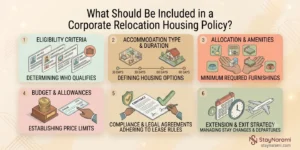
A useful policy is sufficiently specific to answer day-to-day questions and sufficiently simple that it can be understood by a typical employee․
Policy Area |
What the Company Should Define |
| Eligibility | Which hires, transfers, roles, or assignment types qualify |
| Housing period | Standard number of covered days and extension rules |
| Budget | Maximum monthly or total housing amount |
| Property type | Hotel, extended stay, furnished apartment, condo, or home |
| Occupants | Whether spouse, children, or other dependents are covered |
| Pets | Whether pet-friendly housing and fees are allowed |
| Location | Maximum commute or approved geographic area |
| Included expenses | Rent, utilities, internet, parking, taxes, deposits, cleaning |
| Booking method | Company-booked, reimbursed, stipend, or hybrid |
| Extensions | Who can approve more time and under what conditions |
| Cancellation | Responsibility for early departure or cancellation charges |
| Tax treatment | How taxable benefits or gross-ups will be handled |
| Documentation | Receipts, approvals, invoices, and required forms |
The policy should also state whether employees may spend above the company’s allowance with their own money
For example‚ if the company has a policy to pay up to $4000 a month in rent‚ and the employee wants to rent a flat for $4500‚ that is closer to the children’s school‚ the policy needs to clarify whether the employee can pay the outstanding $500 or whether all properties must be within the limit․
Small questions like this become big problems when the answer is unclear after a lease has already been signed
How Do Companies Decide Between a Housing Stipend and Direct-Booked Housing?
There are several ways to provide housing for corporate relocation, but two common approaches are a housing allowance and direct-booked accommodation
1. Housing stipend or lump sum
The company gives the employee a fixed amount and lets them arrange accommodation
This provides greater personal choice and reduces some administrative work for HR. It can work well for employees who know the destination city, have simple housing needs, or want more control over where they stay
The disadvantage is that the employee takes on the housing search during an already busy move. If the local market is expensive, the allowance may also prove inadequate
2. Direct-booked housing
The company or its housing partner finds the property, confirms the terms, and arranges the stay
This gives the employer more control over costs, property standards, lease terms, and billing. It also removes a major task from the relocating employee
Atlas found that relocation funding in 2025 included 47% fully reimbursed moves, 23% partially reimbursed moves, and 19% funded through lump sums. There is no single payment structure that fits every employer
A practical way to decide is to consider how complex the move is
Situation |
Approach That May Work Better |
| Employee already knows the city | Stipend may be practical |
| Relocation is simple and short | Stipend or reimbursement |
| Employee has never lived in the city | Direct-booked housing |
| Family is relocating | Direct booking often gives more control |
| Housing market is tight | Direct sourcing may reduce employee workload |
| Company relocates employees frequently | Managed housing can simplify administration |
| Employee has highly personal housing preferences | Flexible allowance may provide more choice |
For example‚ an employee willing to move alone from Phoenix to Dallas may prefer an allowance and their choice of accommodation‚ whereas another employee willing to move with a spouse‚ two children‚ a dog‚ and two cars may prefer a furnished house with a certain number of rooms‚ parking‚ pet rules‚ and commute time․
The amount spent might be similar, but the work required to secure the housing is very different
How Long Should a Relocation Housing Policy Cover an Employee?
There is no universal number that works for every move
Typically‚ relocation housing assistance may be for 30‚ 60‚ or 90 days‚ because temporary housing is only intended to close the gap from arrival to permanent housing․ A 2026 corporate-housing guide identifies common coverage durations of 30‚ 60‚ or 90 days‚ though employer policies may vary according to role or company․
Instead of choosing a number without context, employers should look at four factors:
1. Permanent housing timeline
A renter who expects to sign a new lease quickly may need less time than a homeowner waiting for their previous house to sell
2. Local housing availability
Thirty days may be enough in a market with many rentals but unrealistic in an area where suitable housing is difficult to find
3. Family needs
Parents may require extra time to evaluate schools and housing‚ commute routes‚ and childcare facilities in new neighborhoods․
4. Start-date pressure
If the business needs the employee in the new location immediately, temporary housing may need to begin before the employee has had any real opportunity to look for a permanent home
A useful policy might provide an initial housing period and then define exactly when an extension can be requested
For instance, rather than promising unlimited temporary housing, the policy might cover the first 45 days and allow one 30-day extension when permanent housing has been delayed for a documented reason
How Do Companies Set Budget Limits Within a Relocation Housing Policy?
A housing budget should not be one nationwide dollar amount
That is‚ a furnished apartment in Manhattan or San Francisco or Boston isn’t the same as a furnished apartment in a smaller market․ Household size matters as well․
Companies can control costs more effectively by considering:
Location: Set budgets by destination market or housing-cost band
Household size: A family needing three bedrooms shouldn’t be in the same category as an employee going alone․
Length of stay: Longer stays may support different types of housing‚ different rates‚ or different rental conditions than a 2-week stay․
Required commute: Cheaper housing can become a poor choice if it requires a long commute‚ extra parking costs‚ or important transportation costs․
Included costs: Specify the total cost of housing‚ instead of only the rent․
The real calculation should look something like this:
Monthly rent + utilities + internet + parking + taxes + required fees + pet costs = actual monthly housing cost
However‚ if one unit is $3‚800 including utilities‚ internet‚ furniture, and parking‚ and the other is only $3‚300 without any of those things‚ it is not obvious which is the better deal․
A strong budget rule therefore defines what counts toward the housing cap, not simply the maximum rent
What Eligibility Criteria Do Companies Use for Relocation Housing Benefits?
Employers often determine eligibility according to the amount of support employees require‚ which can vary across different employees․
- Whether the move is company-requested
- Whether the person is a new hire or existing employee
- Permanent versus temporary assignment
- Role or job level
- Distance between the current and new work location
- Length of assignment
- Homeowner versus renter status
- Whether dependents are moving
- Business need
- Destination housing conditions
The rules should be written before individual negotiations begin
However, they should also leave room for unusual situations. Atlas found that 51% of surveyed employers make policy exceptions, which suggests that exceptions are already a normal part of modern relocation programs
A better approach is therefore to define both eligibility and exception authority. For example:
- Standard benefit: 45 days
- Possible extension: up to 30 additional days
- Approval required from: HR director or relocation manager
Acceptable reasons: delayed closing, documented housing shortage, family arrival issue, or another approved business need
That gives employees flexibility without turning every relocation into an open-ended commitment
How Do Companies Handle Relocation Housing for Employees With Families?
Family relocations require more than increasing the bedroom count
The housing must work with the family’s daily routine
Employers should ask about:
- Number and age of occupants
- Bedroom requirements
- Pets
- Parking
- Accessibility needs
- School or childcare locations
- Employee work location
- Laundry
- Kitchen facilities
- Internet
- Expected length of stay
In Atlas’ 2026 study‚ the most common reason employees refused to move was family‚ with 34% of respondents․ The second most common reason was the availability of housing‚ with 28%․
In another example‚ if an employee’s family goes from Ohio to Texas‚ the employee starts work on June 1 and the permanent home is ready in July‚ the employee cannot deduct expenses․
Placing the employee alone in a hotel beside the office may appear efficient. Once the spouse and children arrive, however, that room may no longer work
A furnished two- or three-bedroom property with a kitchen, laundry, parking, and reasonable access to both work and the areas where the family is considering permanent housing may solve the actual relocation problem more effectively
The policy should therefore require the company to collect household requirements before accommodation is booked
Turn Your Relocation Policy Into a Better Employee Experience
StayNarami’s temporary housing for job relocation gives employers a practical way to support 30+ day moves with furnished options matched to the employee’s household, timeline, and destination.
How Can Companies Simplify Their Relocation Housing Policy With a Housing Partner?
A housing policy can define what employees are allowed to receive. Someone still has to find the property
That part becomes harder when a company is moving employees into several cities, dealing with unfamiliar markets, or trying to manage multiple lease dates at once
A housing partner can take the employer’s approved requirements and use them as the basis of the search
At StayNarami, the process starts with the practical details: location, number of people, timeline, and housing needs. StayNarami then sources furnished properties, coordinates the lease and move-in, and remains involved during the stay. Its current model supports housing across all 50 states, with stays beginning at 30 days and the ability to extend based on the timeline
For HR, that can turn a housing policy into a repeatable process
Instead of asking an employee to search dozens of listings, the company can send a housing requirement such as:
- Denver, Colorado
- One employee and spouse
- Two bedrooms
- June 10 move-in
- 60-day expected stay
- One vehicle
- Furnished
- Full kitchen
- Laundry
- Maximum approved monthly budget
- Preferred commute of 30 minutes or less
The housing search can then focus on properties that match those requirements rather than presenting options the employee cannot actually use
It also helps the company keep its policy separate from the unpredictable details of individual housing markets. The policy sets the rules; the housing search adapts those rules to the actual location
A Note on Taxes in a Corporate Relocation Housing Policy
Employers should address tax treatment before promising a relocation benefit
This area changed again for 2026
The IRS’s current 2026 Employer’s Tax Guide to Fringe Benefits states that federal law permanently eliminated the general exclusion for qualified moving expense reimbursements from employee income, with specific exceptions including qualifying active-duty military moves and certain intelligence-community relocations
Temporary work assignments can involve different rules. IRS Publication 463 states that an assignment at one location is generally considered temporary when it is realistically expected to last, and actually lasts, one year or less. If an assignment becomes indefinite, the work location may become the employee’s new tax home, which can change the treatment of living expenses
Because a permanent relocation and a temporary work assignment are not necessarily treated the same way, employers should have their payroll or tax adviser review their specific program rather than assuming all temporary housing is either taxable or tax-free
The housing policy should also tell employees whether any taxable relocation benefit will be grossed up by the employer or whether the employee will be responsible for the tax
Give Employees Clarity Before They Pack
Share the destination, dates, household size, budget, pets, vehicles, and expected stay with StayNarami to arrange housing that fits your relocation policy and the employee’s actual needs.
Conclusion
Companies handle housing for corporate relocation best when they decide the rules before someone needs to move
A useful corporate relocation housing policy should clearly define eligibility, housing duration, spending limits, covered costs, family rules, booking methods, extension procedures, and tax handling. At the same time, it should leave enough controlled flexibility for situations that cannot be predicted, such as delayed home closings, tight housing markets, larger families, or changing start dates
For employees, that creates clarity at a time when almost everything else in their life is changing. For employers, it creates a housing process that can be repeated instead of rebuilt for every move
The most practical next step is to review your current relocation policy and see whether an employee can answer five questions without contacting HR: Do I qualify? How much housing is covered? For how long? What is included? What happens if I need more time?
If those answers are not clear, the housing section of the policy needs work
Frequently Asked Questions
1. What is a typical corporate relocation policy?
A typical relocation policy defines who qualifies for support and what the employer will cover, which may include temporary housing, moving costs, travel, storage, lease-related costs, or other relocation expenses. The exact benefits vary widely by employer and role
2. Do all companies offer housing assistance for relocation?
No. Some companies provide managed temporary housing, while others reimburse expenses, pay a lump sum, provide limited assistance, or offer no relocation benefit. Atlas’ 2026 survey showed a mix of full reimbursement, partial reimbursement, and lump-sum approaches
3. How much do companies typically pay for relocation housing?
There is no reliable single national amount because cost depends heavily on the destination, property size, stay length, market conditions, and household needs. Employers should create location-based budgets and compare the complete monthly housing cost rather than rent alone
4. Is relocation housing taxable income for employees?
It can be, depending on the type of relocation and how the benefit is provided. Federal tax treatment changed for 2026, and the IRS now permanently disallows the general exclusion for qualified moving expense reimbursements for most employees. Temporary business assignments can follow different rules, so employers should confirm treatment with a qualified tax or payroll professional
5. What is the difference between a relocation package and a housing policy?
A relocation package covers the broader move and may include transportation, household goods, storage, travel, housing, and other benefits. The housing policy specifically defines how temporary accommodation is approved, booked, paid for, and managed
6. How long does a company usually cover temporary housing after relocation?
Many programs use defined periods such as 30, 60, or 90 days, but there is no universal rule. The appropriate period depends on the destination housing market, employee circumstances, permanent housing timeline, and company policy
7. Can employees negotiate their relocation housing benefits?
Sometimes. Employers may allow exceptions based on role, family needs, destination costs, or other circumstances. However, any exception should be approved and documented before the employee commits to housing
Need housing for your team?
Tell us what you need and we'll take care of the rest — anywhere in the U.S., 30+ days.
Request Housing →Related Articles