Temporary Housing for Event Staff and Production Teams

When the Crew Stays Longer, Change the Housing
StayNarami helps production teams move beyond nightly hotel bookings with furnished housing built around 30+ day stays, crew size, venue location, and schedule.
An event crew rarely works a normal travel schedule. The lighting team may arrive before everyone else. Stage crews can be working while the venue is still empty. Production staff may finish long after the audience has gone home, then be expected back early the next morning. If the event moves to another city, the whole process starts again.
Housing can get messy quickly.
The U.S. Bureau of Labor Statistics counted 155,800 meeting, convention, and event planner jobs in 2024. It also notes that planners often travel for events, work more than 40 hours as major dates approach, and may work weekends while an event is underway. Those figures cover planners rather than every technician, stagehand, driver, or touring worker behind an event, but they show how demanding event schedules can become.
For companies bringing people in from out of town, housing for production crew teams therefore needs more thought than booking whichever rooms happen to be available. Location matters. So do arrival dates, parking, kitchen access, laundry, room sharing, extensions, and the number of times the team will move during the assignment.
A three-night festival crew and a production team working in one city for six weeks should not have the same housing plan.
TL;DR (Too Long; Didn’t Read)
- Built for event companies, production managers, tour teams, and operations staff arranging housing for crews working away from home.
- Short events and longer production shoots need a different kind of housing․ When a crew is in town only for a short time‚ hotels work․ But‚ when a crew stays for 30 days or more‚ the need for kitchens‚ laundry‚ parking‚ and expanded living and sleeping space requires furnished housing․
- The plan will take into account the timing of the production schedule‚ the impact of early set-up crews‚ staggered arrivals‚ distances to venues‚ the mode of transport used‚ time extensions‚ and team accommodation․
- This guide explains how to choose between hotels and furnished housing, manage crews moving between cities, control costs, and plan longer stays around the way production teams actually work.
What Is Temporary Housing for Event Staff and Production Crews?
Temporary crew housing is accommodation arranged for employees or contractors who have traveled away from home to work on an event or production. The people staying there might include:
- Stage and production managers
- Lighting and audio technicians
- Rigging crews
- Camera and broadcast teams
- Wardrobe staff
- Set and staging crews
- Drivers
- Event operations staff
- Production assistants
- Tour management teams
- Vendor or activation teams
Sometimes they need a room for three nights. Sometimes they need an apartment for two months.
That difference matters.
Hotels make sense when a crew is arriving Tuesday, working Wednesday and Thursday, and leaving Friday morning. Once people remain in one market for several weeks, however, furnished homes or apartments become worth comparing because the crew is no longer simply visiting. They are temporarily living there.
1. Staying in One City for 30+ Days?
For longer production runs, StayNarami can help teams find furnished housing based on crew size, work location, dates, and budget. StayNarami focuses on 30+ day assignments across the U.S., making it better suited to extended productions than one- or two-night event stops.
2. Who Needs Housing for Production Crew Work?
The need goes well beyond film sets. Housing for film crews tends to get the most attention, but concerts, festivals, conferences, and broadcasts create the same pressure on dates, parking, and space.
3. Concerts and Touring Shows
Large shows can include sound‚ lighting‚ video‚ staging‚ wardrobe‚ technical‚ management‚ and travel teams․ For tours that stay in a different city every two days‚ hotels are often more practical. A four- or six-week residency in one city is different. In that case, putting part of the team into furnished housing may give them more room and basic home amenities.
3. Festivals
Festival crews often arrive before attendees. A team may spend days building stages, installing lighting, setting up vendor areas, testing sound, and preparing guest spaces before the public enters the site. Some staff may also stay afterward for breakdown. Housing dates should follow those work days, not simply the advertised event dates.
4. Conferences and Trade Shows
Large conferences may use event managers‚ installation teams‚ exhibitors‚ production teams‚ broadcast workers, and technicians․
5. Broadcast and Sports Productions
Broadcast crews can travel with cameras, sound equipment, control-room personnel, producers, and technical support. Long tournaments, seasons, and extended broadcast projects can create a need for housing for production crew members who will be based in one market for weeks at a time.
When traveling‚ broadcast production crews are typically accompanied by broadcast cameras‚ sound‚ control room staff‚ producers‚ and sometimes technical support․ Long tournaments‚ seasons, and other long-term broadcast projects often require housing for production crew who can be in the same market for many weeks at a time․
What Types of Housing Options Suit Event and Production Teams?
There is no single best option. Start with the schedule.
Housing Type |
Usually Makes Sense For |
Main Advantage |
Watch For |
| Standard hotel | 1–7 nights | Easy for fast-moving crews | Cost, small rooms, limited kitchens |
| Extended-stay hotel | Several days to a few weeks | More living facilities | Rates can rise during major events |
| Furnished apartment | Around 30 days or longer | Kitchen, laundry, living space | Needs earlier planning |
| Furnished home | Smaller teams staying together | Bedrooms plus common space | Occupancy and parking limits |
| Multiple furnished units | Large longer-term teams | Crew can stay near each other | Inventory may be limited |
| Remote workforce housing | Events outside major lodging markets | Solves local accommodation shortages | Transportation becomes important |
The length of the stay should drive the decision. Do not choose furnished housing simply because it sounds more comfortable. Likewise, do not automatically keep a team in hotel rooms for eight weeks because hotels are easier to book. Look at how the crew will actually live. Good film crew housing often does both, with hotels for a short prep stay and furnished units once principal photography begins.
How Do We Coordinate Housing for Teams Moving From Event to Event?
Touring adds another layer because there may be no single housing location. Start with the event calendar and work backward from each show. A simple crew housing sheet should include:
City |
Crew Arrival |
Event Date |
Crew Departure |
Headcount |
Housing Type |
| City A | Monday | Wednesday | Thursday | 18 | Hotel |
| City B | Friday | Saturday | Sunday | 18 | Hotel |
| City C | Monday | 6-week residency | 6 weeks later | 14 | Furnished housing |
This immediately shows which stops are short stays and which ones deserve a separate housing strategy.
Avoid making every city follow the same rule.
1. A Simple Touring Example
Imagine a production that moves through four cities in 10 days before reaching its final destination for a five-week run.
Booking apartments for the first four stops would make little sense. Hotels allow the crew to arrive and leave quickly.
The five-week stop is different. That is where apartments with kitchens, laundry, parking, and more living space become much more useful. The housing plan changes because the work changes.
How Close Should Housing Be to the Venue or Event Site?
A cheap property can become expensive when everyone needs a long ride to work twice a day.
Start with travel time rather than mileage. A hotel eight miles from a downtown arena might take 15 minutes at midnight but 40 minutes when the crew heads in during afternoon traffic. A convention-center team may also need to travel during the same morning hours as thousands of commuters.
Check:
- Normal drive time
- Traffic during crew arrival hours
- Traffic around event dismissal
- Parking near the venue
- Public transportation where practical
- Shuttle costs
- Large vehicle access
- Late-night transportation
A production coordinator should also ask whether everyone needs to stay in the same area.
The setup crew may be based at the warehouse or staging area‚ and the event management may spend most of the time at the venue․ It may be easier to have two small housing areas than a single distant housing area․
How Much Does Housing for Production Crew Typically Cost?
There is no useful nationwide number for housing for production crew teams because rates change dramatically from one event market to another. A hotel during a quiet week and that same hotel during a championship game, festival, convention, or major concert weekend may have very different pricing. Instead of asking for an average, build the cost around the assignment. Include:
- Nightly or monthly housing rate
- Hotel and lodging taxes
- Parking
- Resort or destination fees
- Internet if charged separately
- Laundry
- Cleaning
- Deposits
- Transportation
- Shuttle service
- Extension costs
- Cancellation charges
Consider an illustrative example.
For example‚ if a 15-member team needed 15 hotel rooms (at $180 per room per night) for 30 nights‚ the pre-tax‚ pre-parking‚ pre-non-hotel expenses total would be $81‚000․
That does not prove furnished housing will always cost less. It shows why a month-long assignment deserves a full comparison instead of automatically extending the hotel reservation.
A furnished unit that appears more expensive at first may include utilities, kitchen facilities, laundry, and parking. A cheap property farther away could create higher vehicle and fuel costs.
The useful number is the total cost of housing the team, not the number printed beside the room.
Keep the Crew Ready for the Next Call
StayNarami provides furnished housing for TV, film, and event crews that need practical space, kitchens, laundry, parking, and a location that works with demanding production schedules.
How Do We Handle Short, Multi-Day Events vs. Longer Productions?
This distinction solves many crew-housing decisions.
1. For a Few Nights
Keep it simple․ Hotels work‚ since the only thing the team needs to do is check in‚ work‚ sleep‚ and leave․ Other considerations include distance from venues‚ parking‚ availability of late check-in‚ breakfast hours, and maximum numbers of guests․
2. For Several Weeks or Months
The crew starts needing normal living facilities. Kitchen access matters more. Laundry matters more. Having somewhere to sit that is not a bed matters more. This is where furnished homes and apartments become stronger options.
Current entertainment-housing resources commonly focus on fully furnished units, kitchens, Wi-Fi, utilities, laundry, housing near venues, multiple-unit placement, and flexibility when production dates move.
P.T. Barnum once wrote:
“The noblest art is that of making others happy.”
The Barnum Museum preserves that line from one of America’s best-known showmen. Audiences may see the finished show. Crew members live through everything required to create it. Giving a traveling team somewhere practical to eat, sleep, wash clothes, and recover between demanding workdays is not glamorous, but it matters.
What Support Do Event Staff Need When Housing Changes Frequently?
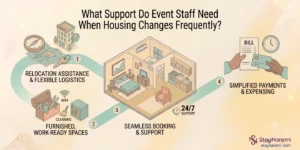
Frequent moves create small problems that add up. Someone has not received their check-in details. A technician has been placed somewhere without parking. An apartment is available until Friday, but the event has just extended through Sunday. Two employees who were supposed to share are arriving on different days. Good coordination starts with one current crew list. Record:
- Full name
- Phone number
- Arrival and departure
- Housing address
- Room or unit assignment
- Vehicle
- Special requirements
- Extension status
Send new housing details before the crew begins traveling to the next city. That habit matters most in housing for touring event staff, where one missed message can leave someone without a room at the next stop.
For longer stays, also decide who handles maintenance questions. Crew members should not have to chase several property owners while trying to work an event.
How Do We Help Event Companies Secure Housing for Production Crews Nationwide?
StayNarami is most relevant when a crew will remain in one location for 30 days or longer.
That might include a long event build, sports production, extended venue residency, major brand activation, television production, touring base, or another project where workers are temporarily based away from home.
The useful information to provide at the beginning is straightforward:
- Venue or job-site address
- Number of people
- Move-in date
- Expected move-out
- Bedroom needs
- Number of units
- Vehicle count
- Parking requirements
- Budget
- Pets or accessibility needs
- Possibility of an extension
StayNarami can then source furnished temporary housing around those requirements rather than leaving an event company to search through individual properties in an unfamiliar city.
For crews moving every few days, traditional group hotel booking will normally remain more suitable. If the tour reaches a city where the team will stay for a month or longer, that longer stop becomes a much better fit for furnished housing.
That distinction is important. A useful housing provider should fit the assignment rather than try to force every assignment into the same type of accommodation.
Plan Housing Around the Run, Not Just the Event Date
Share your venue, crew size, arrival dates, expected stay, vehicles, and budget with StayNarami to build housing around the full production timeline.
Conclusion
Event housing becomes much easier when the first question is not “hotel or apartment?” Start with the schedule.
If the workers are being rotated out in four days‚ there might be a hotel nearby that solves the problem․ Are 20 people really needed to work the same 1,422-square-foot market for eight weeks? And do you really need to put them all in standard rooms?
Then check distance‚ parking‚ when the work is actually being done‚ use of kitchen and laundry‚ travel, and what happens if the job runs over․
For teams that are on the road‚ we want people to do their work and head back to their living quarters with enough rest to be ready for the next day’s work․
Good housing for production crew teams‚ as with all housing‚ does not need to be complicated․ It needs to fit the way the crew is actually working․
Frequently Asked Questions
1. Do event companies provide housing for staff working on-site?
Another common practice is to set up or pay for hotel or other accommodation‚ when employees travel for events‚ which is typically subject to employer and contract conditions․
2. How much does short-term housing cost for production crews?
Rates depend on the city‚ season‚ demand for events‚ crew size‚ parking‚ and length of stay‚ and have no standard․ Compare total cost for your stay‚ as opposed to just the room rate․
3. Can housing be booked for just a few days for an event?
Hotels and other nightly accommodations tend to be the simplest option when staying for a few days․ The StayNarami model of furnished housing is intended for longer stays of 30 days or more․
4. Is furnished housing available for touring production teams?
Yes. Furnished homes and apartments can work well when a touring team remains in one city for several weeks or months.
5. How do companies house crews for events in different cities each week?
Most use hotels or group lodging for short stops and manage each city around the tour schedule. A longer residency can be handled separately with furnished housing if the stay is long enough.
6. What’s the difference between housing for film crews and event staff?
Film crews may remain near the same filming area for several weeks or months. Event crews are more likely to move between venues and cities. The actual project determines the housing choice, however, and both groups may use hotels or furnished housing.
7. Do production companies pay for crew housing directly?
Many do, although policies vary. Some companies pay lodging directly, while others give employees a housing allowance or per diem. The arrangement should be clear before travel starts.
Need housing for your team?
Tell us what you need and we'll take care of the rest — anywhere in the U.S., 30+ days.
Request Housing →Related Articles