Housing Solutions for Traveling Event Teams

Long Stop? Rethink the Hotel Block.
StayNarami helps touring teams source furnished housing when a residency or production keeps the crew in one city for 30 days or longer.
A touring team can finish a show in one city late at night, travel the next morning, and start loading into another venue before most people have checked into their hotel. Do that for several weeks, and housing stops being a simple travel booking. It becomes part of the tour schedule.
That is the main challenge with housing for touring event staff. The team is not traveling for a normal business trip. Sound engineers, lighting technicians, production managers, stage crews, wardrobe staff, drivers, and other team members may work irregular hours while moving through several markets.
The broader live-performance workforce is large. The Bureau of Labor Statistics counted about 169,800 musician and singer jobs in 2024 and notes that performers frequently travel locally, nationally, or internationally for work. Event planners face similar pressure: BLS counted 155,800 event-planning jobs in 2024 and notes that planners may travel regularly, work more than 40 hours near an event, and work weekends during events.
Tour managers also consider how far away the new accommodation is from the venue‚ check-in times‚ parking‚ rooming list‚ time to recuperate between shows‚ when the group is going back‚ and whether the stay is three nights or six weeks․
TL;DR (Too Long; Didn’t Read)
- The building was used by tour managers‚ production teams, and event companies for crews that need to travel from city to city or stay in one market․
- Usually‚ short-tour housing is in hotels․ This works well for crews moving rapidly between cities․ For crews staying 30 days or longer‚ kitchens‚ laundry‚ parking‚ Wi-Fi connectivity‚ and much more living space become of greater use․
- A full tour calendar will separate short stops and longer play dates to accommodate travel‚ vehicles on the road‚ rooming lists‚ cancellation of dates, and possible changes of schedule․
- The guide gives tips on arranging housing for multi-city crew members‚ ensuring that housing costs remain low‚ accommodating last-minute changes to a touring schedule, and knowing when to obtain furnished housing instead of extending hotel reservations․
What Is Housing for Touring Event Staff and Why Is It Different?
Housing for touring event staff covers temporary accommodation for people who travel from city to city while supporting concerts, festivals, theater productions, sports events, corporate roadshows, brand activations, and other live productions. A touring group might include:
- Tour and production managers
- Audio technicians
- Lighting crews
- Video teams
- Stage technicians
- Rigging crews
- Wardrobe staff
- Drivers
- Merchandising teams
- Event operations staff
- Production assistants
The unusual part is movement.
Someone working on a temporary construction project may stay in one apartment for three months. A touring crew could sleep in Nashville on Monday, Atlanta on Wednesday, and Charlotte on Friday.
Tour manager Tom Begley described touring as work filled with constant small choices:
“The job involves lots of little decisions.”
Those decisions include hotels, flights, timing, food, equipment, and day-to-day problems that can change without warning.
Housing has to work within that same moving system.
What Challenges Come With Housing a Team That Moves City to City?
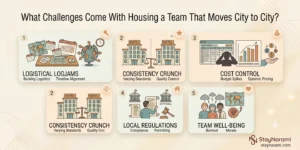
The number of reservations grows surprisingly fast. Suppose a 22-person team has 15 tour stops. Even if everyone follows the same schedule, that can mean hundreds of individual room nights. Now add reality.
Two technicians join halfway through the tour. A manager leaves for three dates. One show gets postponed. Another city is added. A crew bus arrives after normal hotel check-in hours. Four staff members need parking for large vehicles.
The tour manager may now be dealing with:
- Different hotels in each market
- Different check-in and check-out rules
- Changing rooming lists
- Hotel cutoff dates
- Deposits
- Parking
- Cancellation terms
- Different rates for different nights
- Late additions
- Early departures
Current event-housing platforms specifically focus on this problem. One current example describes event production companies managing room blocks across multiple hotels, cities, shows, and cutoff dates at the same time.
That is why a housing plan should be built from the complete tour calendar, not city by city at the last minute.
What Types of Housing Work Best for Touring Event Teams?
There is no reason every tour stop should use the same type of accommodation.
Type of Stay |
Housing That Usually Fits |
Why |
| One or two nights | Hotel | Fast check-in and check-out |
| Several nights | Hotel or extended-stay hotel | Simple for moving crews |
| Two or three weeks | Extended stay may be worth comparing | More useful living facilities |
| 30+ days in one city | Furnished apartment or home | Kitchen, laundry, living space |
| Long residency | Furnished housing | Better suited to temporary living |
| Remote extended assignment | Furnished or workforce housing | Can solve limited hotel supply |
Hotels remain the normal choice for fast-moving tours.
A live-music industry guide on tour accommodation identifies hotels as a common lodging option for touring artists and crews. It treats accommodation as a specific part of the tour budget.
Furnished housing becomes more relevant when movement slows down.
For example, a concert crew doing five cities in eight days probably needs hotels. If the same production then settles into Las Vegas for six weeks, keeping everyone in standard hotel rooms for another month and a half is worth reconsidering. Film productions follow the same logic, which is why housing for film crews usually moves to furnished units once a shoot settles in one place.
How Do We Plan Housing Across an Entire Tour Schedule in Advance?
Start with one master itinerary. Do not begin by opening hotel searches for the first city. Build a table that shows the entire route:
Stop |
Crew Arrival |
Show Dates |
Departure |
People |
Expected Stay |
| Denver | June 2 | June 3 | June 4 | 24 | 2 nights |
| Dallas | June 5 | June 6–7 | June 8 | 24 | 3 nights |
| Austin | June 8 | June 9 | June 10 | 22 | 2 nights |
| Los Angeles | June 12 | June 14–July 20 | July 21 | 18 | 39 nights |
The long stop immediately stands out.
That matters because you do not need one housing strategy for this tour. You need two.
Denver, Dallas, and Austin are normal tour lodging. Los Angeles is temporary living, and at that point the stop needs to be planned like any other housing for production crews, with kitchens, laundry, parking, and space for a five-week stay.
For every stop, track:
- Venue address
- Crew arrival
- Crew departure
- Headcount
- Vehicles
- Nightly or monthly budget
- Cancellation deadline
- Possible schedule changes
Housing becomes much easier to control once all of those details live in one place.
How Close Should Housing Be to Each Tour Stop or Venue?
Do not judge this by miles alone.
A hotel six miles from a stadium could still require 40 minutes in event traffic. Meanwhile, another property 10 miles away might sit directly along a faster route.
Check drive time when the crew will actually be traveling.
For example‚ load-in at 7 a․m․‚ load-out at 1:30 a․m․‚ and a long drive immediately prior to bed would mean that a cheap hotel room would not be worth much to a touring worker who has just ended a long day․
For each stop, look at:
- Venue travel time
- Highway access
- Event-day traffic
- Venue parking
- Hotel parking
- Bus and truck access
- Late-night transportation
- Food availability nearby
Large venues can also create major traffic immediately after an event, so the nearest hotel is not always the fastest one to reach.
How Much Does Housing for Touring Event Staff Cost Across Multiple Cities?
As it is‚ a national average is meaningless․ Each city is different․ Thus‚ the price of a room on a slow Tuesday in one market may be much less than that same room during a festival‚ playoff game, or convention․ For housing for touring event staff, the right calculation is total cost per stop. Include:
- Room or housing rate
- Local lodging taxes
- Parking
- Destination or resort fees
- Internet charges
- Laundry
- Transportation
- Deposits
- Cancellation penalties
- Early-arrival rooms
- Late-checkout charges
Then compare the full tour.
For instance‚ if 20 members of the crew stayed there at an imaginary rate of $190․
A two-night stay costs $7‚600 before taxes and fees․ That would total $133‚000 for 35 nights at that rate․ That does not mean furnished housing will always be cheaper․ A long stop deserves a different comparison than a two-night stop.
1. When a Tour Stops Moving, Change the Housing Plan
A residency or extended production assignment should not automatically inherit the hotel plan used on the road. StayNarami sources fully furnished housing for teams staying 30 days or longer anywhere in the U.S.
When the Tour Stops, Give the Crew Room to Live
StayNarami provides furnished housing for TV, film, and event crews needing kitchens, laundry, parking, and practical space during longer production stays.
How Do We Handle Last-Minute Changes to a Tour’s City Lineup?
Tour schedules change. Weather can postpone a show. A venue problem may force a move. An additional date can be added after strong ticket sales. Travel delays may require an extra night somewhere nobody planned to stay.
The housing plan needs room for that. Before booking a large group, know:
- The final cancellation date
- Whether rooms can be reduced
- Whether extra rooms can be added
- What happens if the stay extends
- Whether unused rooms trigger penalties
- Who approves changes
Room-block management becomes especially important here because hotels can have different cutoff and attrition rules. Event production tools now specifically track these deadlines because missing them can leave companies paying for rooms they no longer need.
1. A Simple Example
For example‚ if a 26-person tour was supposed to leave Chicago Monday morning‚ the Sunday show may have been moved to Tuesday. The crew now needs two extra nights.
If the hotel has availability, the fix may be simple. If the rooms are already sold for Monday night, the crew may have to move to another property. Keeping a backup list of nearby hotels for major tour stops can save time when this happens. Film productions run into the same problem when shooting days are added, which is why film crew housing is usually booked with extension terms agreed up front.
What Amenities Matter Most for Staff Living Out of Housing for Weeks?
For one-night stops, the crew mostly needs somewhere clean and convenient to sleep. After several weeks on the road, different things matter.
1. Laundry
Crew members cannot pack enough clothes for a two-month tour. Easy laundry access quickly becomes more important than decorative hotel amenities.
2. Kitchen Access
Eating every meal on the road can be expensive and repetitive‚ so people enjoy a kitchen‚ especially on longer trips where they can create their own meals․
3. Reliable Wi-Fi
Crew members may still have schedules‚ files‚ transportation‚ expense reports‚ and communication to deal with after they have left the venue․
4. Parking
Always confirm this separately. A property saying “parking available” does not tell you whether it can handle crew vans, trailers, buses, or several individual vehicles.
5. Space Away From Work
As tour manager Tom Begley explains‚ crews work such long hours that they hardly get to spend any time in the city they are performing in․
If an extended stay is necessary‚ a separate living room‚ kitchen‚ or outdoor space can make temporary housing seem much more like normal than living in a single hotel room․
As a result‚ entertainment-housing suppliers typically include a full kitchen‚ living space‚ Wi-Fi‚ utilities‚ laundry‚ and proximity to venues as part of their package․
How Do We Help Tours Book Consistent Housing Nationwide?
There is an important distinction here. StayNarami should not replace hotels for a tour that changes cities every two days.
Its current housing model is built around fully furnished, move-in-ready accommodations for stays of 30 days or longer, with nationwide coverage across all 50 states. StayNarami says its terms can run from 30 days to 12+ months.
That makes it more useful for:
- Concert residencies
- Long festival build-outs
- Extended sports productions
- Theater runs
- Long brand activations
- Touring teams with a month-long base
- Production staff remaining in one market between events
The request process is straightforward. StayNarami asks for the location, number of people, start date, length of stay, and monthly budget, then sources furnished properties and coordinates the move-in and stay.
For a tour with both quick stops and long stays, the answer may therefore be mixed.
Use hotels while the crew is moving. Use longer-term furnished housing when the schedule puts the team in one place long enough for it to make sense.
Turn the Longest Stop Into a Housing Plan
Send StayNarami the city, crew count, dates, venue location, vehicles, and budget to source housing around the extended stop instead of another month of hotel rooms.
Conclusion
Tour housing gets easier once every stop is not treated the same. While a 36-hour stay is short for the crew‚ they require a hotel not too far from the venue‚ with flexible check-in and check-out times․
The crew can spend up to six weeks in a market and need a place to stay between working days‚ with laundry‚ kitchen facilities‚ parking‚ strong Wi-Fi reception, and a single‚ preferably permanent‚ home base․
Good housing for touring event staff follows the tour rather than forcing the tour into one lodging model.
Map out the whole route before identifying long stops․ Use time‚ not distance‚ comparisons․ Track cancellation deadlines and note that the budget goes beyond the nightly rate․ If you’ll be in one city for a month or more‚ you may wish to bypass nightly accommodation․
Frequently Asked Questions
1. How do concert tours house their crew in each city?
As hotels are often used for short stays in each city‚ a furnished apartment or house may be used when the crew will be remaining in a market for more than a month․
2. Is touring event staff housing cheaper than hotels for a multi-city tour?
Not always․ For short stops, hotels are often more practical‚ and furnished housing is often comparable for longer assignments because the cost of living space‚ kitchen‚ laundry‚ utilities‚ and other amenities are included․
3. Can housing be pre-booked for an entire tour schedule at once?
Yes․ However‚ contracts‚ room blocks‚ and cancellations may be different‚ since tour managers may book hotels in advance for the entire tour․
4. What happens if a tour date or city is added last minute?
The travel team should reconfirm housing‚ transportation‚ room blocks‚ and cancellation policies․ Backup properties should be identified in major markets in case the housing inventory needs to be expanded immediately․
5. Do touring crews get the same housing standard in every city?
Not necessarily․ Properties‚ prices‚ venue locations‚ and length of stay may vary from market to market․ The end goal should be a minimum baseline‚ not identical housing․
6. How far in advance should a tour book housing for all its stops?
Start once the route and approximate crew count are stable enough to plan. High-demand cities, major event weekends, large groups, and month-long stays usually benefit from earlier booking.
Need housing for your team?
Tell us what you need and we'll take care of the rest — anywhere in the U.S., 30+ days.
Request Housing →Related Articles