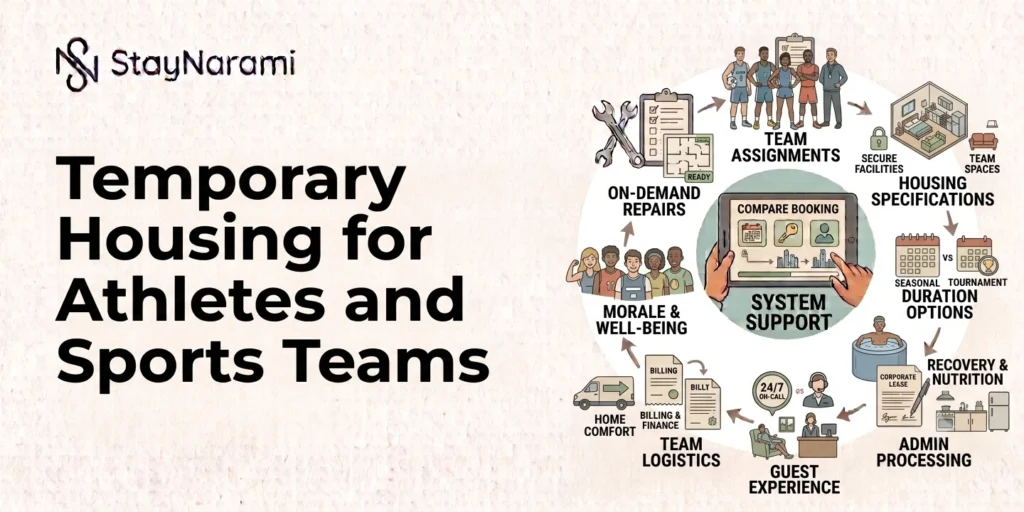
Temporary Housing for Athletes and Sports Teams

Keep the Commute Out of the Training Plan
StayNarami helps sports organizations source furnished housing near training facilities, stadiums, and rehabilitation centers for stays of 30 days or longer.
Moving an athlete is rarely as simple as handing over an apartment key.
A player may report for training camp before the season begins. A coach may need housing for three months while a family remains in another state. A minor league player can be promoted and sent to a new city with little notice. Rehabilitation may keep an athlete near a medical or training facility longer than expected. Then there are entire teams arriving for preseason programs, tournaments, or extended training periods.
For the people arranging housing for sports teams, the difficult part is keeping all of those dates, people, properties, and locations working together.
Professional baseball offers a useful example of how important housing has become. MLB introduced a policy designed to provide furnished accommodations to more than 90% of assigned Minor League players beginning in 2022. The first Minor League collective bargaining agreement followed in 2023 and further improved housing and working conditions.
Housing is also important because athletes need a place to recover from practice and competition․ According to the International Olympic Committee‚ recovery‚ including nutrition‚ hydration‚ sleep‚ and rest‚ is required after strenuous training‚ competition‚ and travel․
That changes what counts as good temporary housing. Distance from the facility matters. So do kitchens, laundry, quiet bedrooms, parking, privacy, flexible dates, and the ability to add or remove units when a roster changes.
TL;DR (Too Long; Didn’t Read)
- This article is built for the use of team managers‚ operations staff‚ coaches‚ and sports organizations in arranging housing for a team’s players‚ trainers, and staff․
- Hotels are sufficient for road games and short-term tournaments․ Furnished housing is more useful for players or staff in a market for 30 days or more‚ especially where kitchens‚ laundry‚ privacy‚ parking‚ recovery time‚ and proximity to the training center play meaningful roles․
- An effective housing plan accounts for the published roster and schedule‚ arrival dates‚ families or pets‚ potential roster changes‚ extensions, and the actual distances between housing‚ training, and medical facilities․
- This guide explains how to choose the right housing type, coordinate multiple players and staff, compare total costs, and plan longer stays without making housing another season-long problem.
What Is Temporary Housing for Athletes and Sports Teams?
Temporary sports housing is any housing for athletes‚ coaches‚ trainers‚ or other team personnel when they are away from their permanent residences for a short period․ It can be needed during:
- Preseason and training camps
- Spring training
- Minor league assignments
- Extended tournaments
- Rehabilitation programs
- Off-season training
- Temporary trades or call-ups
- Coaching assignments
- Relocation periods
- Long competitions or sports events
The length of the stay makes a major difference. If a basketball team is on the road for two games‚ no one’s getting an apartment․ No one needs to be in town for three nights․
If eight players and three coaches will train in Arizona for seven weeks, the calculation changes. At that point, extended stay housing for teams, such as furnished apartments or homes, can provide kitchens, laundry, separate living areas, and a more normal routine.
That is the basic rule for housing for sports teams: match the housing to the actual length and purpose of the stay.
What Types of Housing Options Work Best for Sports Teams?
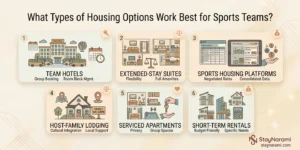
Different sports assignments call for different solutions.
Housing Type |
Best Fit |
Main Benefit |
What to Check |
| Hotels | Away games and short tournaments | Easy nightly booking | Group rates and parking |
| Extended-stay hotels | Several days or a few weeks | Kitchenettes and hotel services | Long-stay cost |
| Furnished apartments | 30+ day assignments | Kitchen, laundry, privacy | Distance from training |
| Furnished homes | Small groups or coaching staff | More bedrooms and shared space | Occupancy and parking |
| Multiple furnished units | Larger teams | Can house players near one another | Unit availability |
| Corporate housing | Training camps and longer stays | Furnished, move-in-ready housing | Lease flexibility |
The corporate housing in this table is the same furnished, move-in-ready model companies use for corporate housing for traveling employees, adapted for preseason camps, rehabilitation stays, roster moves, and players moving between markets.
No option is automatically better than the others. The mistake is using a short-trip solution for a long stay simply because it’s familiar.
How Close Should Team Housing Be to the Training Facility or Stadium?
Basis changes on time‚ not mileage․ A home eight miles away would be a 12-minute commute in the early morning‚ or a 40-minute commute in the evening. That difference matters when athletes may travel between housing, practice, treatment, strength sessions, team meetings, and games several times during the week.
MLB’s original Minor League housing policy even required club-provided accommodation to be within a reasonable, commutable distance from the ballpark.
For any longer sports assignment, map the housing against:
- Training facility
- Stadium or arena
- Practice field
- Medical or rehabilitation center
- Team offices
- Grocery stores
- Airport
- Regular transportation routes
The closest property is not always the best property, either. A unit 10 minutes from the stadium but 45 minutes from the training complex may be inconvenient if players spend far more time training than competing. Look at the athlete’s actual weekly schedule before choosing an area.
How Do We Arrange Housing for an Entire Team and Coaching Staff?
Do not begin with individual property searches. Begin with the roster. A housing coordinator should create one working list showing:
Detail |
Why It Matters |
| Player or staff member | Tracks each assignment |
| Role | Player, coach, trainer, support staff |
| Arrival | Determines move-in |
| Departure | Prevents paying for unused housing |
| Bedroom need | Private or shared accommodation |
| Vehicle | Determines parking |
| Family or pet | Changes property requirements |
| Facility | Helps choose location |
| Possible extension | Helps avoid last-minute moves |
Then divide the group into people with similar needs.
For example, imagine 24 players report for a six-week preseason program. Six coaches arrive five days earlier, while three medical staff members stay another week after camp ends.
Booking every property for exactly six weeks would be simple, but it would also be inaccurate.
The housing plan should reflect those three different schedules.
This becomes even more important during a season when athletes are traded, promoted, injured, released, or transferred.
A real professional sports operation cited by a current national housing provider involved 175 players across five markets and 75 rotating housing units during a six-month season.
At that size, spreadsheets, accurate move dates, and one clear person responsible for housing become essential.
What Amenities Do Athletes Need Most From Temporary Housing?
Fancy amenities are much less important than the things athletes use every day.
1. A Quiet Place to Sleep
Sleep should be near the top of the list․ LeBron James‚ before the 2018 NBA Game 7‚ said sleep is:
“The best recovery that you can get.”
That makes quiet bedrooms‚ comfortable beds‚ reasonable room sharing‚ and location noise more important than other comfort․
An apartment close to a loud entertainment district may present well in photographs but be an awful fit for an athlete training early enough to start at 7:00 a․m.
2. A Real Kitchen
Athletes often follow specific nutrition plans. A usable kitchen gives them far more control than relying entirely on restaurant meals. Check for:
- Full-size refrigerator
- Stove and oven
- Microwave
- Basic cookware
- Food storage
- Dishwasher where useful
3. Laundry
Training creates a lot of laundry. For a month-long assignment, in-unit laundry can be far more useful than many premium building amenities.
4. Reliable Wi-Fi
Players and staff may use it for video review‚ virtual meetings‚ talking with coaches‚ entertainment‚ and personal business․
5. Parking
Ask how many spaces actually come with each unit. Teams may have rental vehicles, staff cars, vans, or larger transport needs. Never assume that an apartment advertised with parking can accommodate the whole group.
6. Privacy
Not every athlete should automatically be placed into shared housing because it lowers the cost. While many groups can share a room‚ others‚ including veteran players‚ coaches‚ injured players‚ and those traveling with family‚ may find that unacceptable․
How Much Does Housing for Sports Teams Typically Cost?
There is no useful nationwide average for housing for sports teams. A spring-training apartment in Arizona, a furnished unit near a downtown NBA arena, and housing beside a minor league ballpark in a smaller city are three completely different markets. Instead, calculate the total cost of the assignment. Include:
- Monthly rent or nightly room rate
- Lodging taxes
- Furniture
- Utilities
- Wi-Fi
- Parking
- Cleaning
- Deposits
- Transportation
- Extension charges
- Cancellation costs
The stay length can change the math quickly.
As a simple example, fifteen hotel rooms at an illustrative price of $180 per night per room would cost $81‚000 for 30 nights (less applicable taxes‚ parking fees, and other charges)․
That does not mean furnished housing will always cost less. It means any team staying for a month or longer should compare a monthly furnished option before automatically extending hotel rooms.
Housing That Works Beyond Game Day
StayNarami provides furnished housing for athletes and sports teams who need kitchens, laundry, privacy, parking, and a more stable setup during extended assignments.
How Do We Handle Housing for Away Games or Away-Season Training?
These are two different housing problems.
1. Away Games
For normal road games lasting one or several nights, hotels remain the practical choice. The priority is moving the team together, providing meals, keeping transportation simple, and getting everyone to the venue on time. There is little value in arranging monthly housing for a team leaving after two games.
2. Extended Training or Temporary Bases
Longer assignments deserve another approach. Examples include:
- Six-week preseason camps
- Two-month rehabilitation stays
- Seasonal development programs
- Extended tournaments
- Off-season training blocks
- Staff temporarily assigned to another facility
Here, furnished housing for sports teams can give athletes more space and a steadier routine than weeks of hotel living. This is also where kitchens, laundry, separate bedrooms, and normal living space begin to carry more weight. Our comparison of corporate housing vs hotels for sports teams breaks down where each one makes more sense.
How Far in Advance Should Teams Book Housing for a Season?
Start once three things are reasonably clear:
- Location, approximate headcount, and move-in window.
- Do not wait until every roster decision is final.
- Sports rosters rarely stay completely fixed anyway.
Earlier planning is particularly useful when:
- 10 or more units are needed
- Players should live in the same building or neighborhood
- Training takes place in a small market
- Camp overlaps with peak tourist season
- Families are traveling with players
- Pets are involved
- Accessible units are needed
- The organization requires specific parking or security
At the same time‚ contracts are flexible․ Sports housing can change rapidly due to injuries‚ trades‚ promotions‚ roster cuts‚ and call-ups․ As such‚ the Corporate Housing Providers Association lists flexible leasing and rapid relocation as core components of sports housing․
Ask about extension and early-departure terms before the athlete moves in, not after plans change.
How Do We Help Sports Organizations Secure Housing for Athletes Nationwide?
StayNarami’s model is most relevant when players, coaches, staff, or training teams will stay in one market for at least 30 days.
StayNarami currently provides fully furnished housing across all 50 states, with stays running from 30 days to 12 months or longer. Properties are sourced around the team’s location, timeline, and housing requirements.
For a sports organization, the initial request should ideally include:
- Training or stadium address
- Number of athletes
- Number of coaches or staff
- Move-in date
- Expected departure
- Number of units or bedrooms
- Monthly budget
- Parking needs
- Family or pet requirements
- Possible roster changes
- Likelihood of extensions
The goal is not simply to find available apartments.
It is to find housing that makes sense for where the team trains, how long people will be there, and how the roster may move during the assignment.
For two-night away games, use normal team travel lodging. For six-week camps, long rehabilitation assignments, seasonal placements, or other extended stays, furnished housing becomes much more relevant.
Build the Housing Plan Around the Roster
Share your location, player and staff count, dates, bedroom needs, parking, and possible roster changes with StayNarami to source housing around the actual assignment.
Conclusion
Temporary athlete housing works best when it is planned around the sports schedule rather than treated as a normal apartment search.
Start with the roster and map the training facility․ Research the earliest date you can move in‚ the latest date you can stay‚ how long it takes to commute‚ and rules on kitchens‚ laundry‚ parking‚ bedrooms‚ and extensions․
Most importantly‚ identify the duration of stay before selecting the appropriate accommodation type․
Hotels are excellent for road games and short tournaments. Once athletes are living somewhere for a month or longer, it makes sense to compare furnished housing for sports teams that provides more of the things people need for everyday life.
An athlete’s home is where they go at the end of the day․ It shouldn’t be another problem in their season‚ it should help them eat‚ sleep‚ recover, and get back to training․
Frequently Asked Questions
1. Do Sports Teams Provide Housing for Players?
However‚ that is league‚ team‚ contract‚ and level dependent‚ and essential terms allow Minor League Baseball players to be covered for player housing through a collective bargaining agreement․ Other professional players may have housing‚ housing allowances‚ relocation costs‚ and other arrangements․
2. How Much Does Housing Cost for a Professional Sports Team?
There is no national average‚ as costs depend on market conditions‚ number of players‚ time of year‚ length of stay‚ type and number of bedrooms‚ parking‚ and distance from the team’s facilities.
3. Is Furnished Housing Available for Athletes During Preseason?
Yes. Furnished apartments and homes can work particularly well when preseason or training camp lasts 30 days or longer.
4. Can Housing Be Arranged Near Training Camps or Stadiums?
Yes. Teams should provide the exact training or stadium address when searching so properties can be compared using real commute times rather than city-wide averages.
5. Do Minor League or College Athletes Get Team Housing?
Minor League Baseball’s current collective bargaining framework addresses player housing. College arrangements are different. NCAA athletics scholarships can cover room and board, but most student-athletes receive partial rather than full athletics aid, so housing support varies by athlete, school, sport, and scholarship package. The NCAA says more than 196,000 student-athletes receive athletics aid each year.
6. How Do Teams House Players and Staff During Away-Season Stints?
Hotels usually work for brief road trips. For longer stays, organizations may use furnished apartments, homes, extended-stay properties, or several units grouped near a training facility.
7. Is Housing Included in an Athlete’s Contract or Relocation Package?
It can be, but there is no universal rule. Housing may be directly provided, reimbursed, included in relocation support, covered under a collective bargaining agreement, or left to the athlete depending on the sport and contract.
Need housing for your team?
Tell us what you need and we'll take care of the rest — anywhere in the U.S., 30+ days.
Request Housing →Related Articles