Corporate Housing vs Hotels for Sports Teams

When the Stay Gets Longer, the Hotel Gets Smaller
StayNarami helps teams move from short-trip lodging to furnished 30+ day housing with more space, privacy, kitchens, and laundry.
A team traveling for two away games has a simple housing problem. Players need clean rooms, easy transportation, meals, and somewhere to sleep before the next game.
A team staying in another city for six weeks has a different problem altogether. By that point, athletes are not simply visiting. They are living away from home while training, recovering, eating, doing laundry, attending meetings, and following a demanding schedule. That is where the corporate housing vs hotels for sports teams comparison starts to matter.
Travel already puts pressure on athletes. A major sports-medicine consensus found that teams in the National Basketball Association (NBA), National Football League (NFL), National Hockey League (NHL), and Major League Baseball (MLB) may travel roughly 40,000 to 80,000 kilometers during a season. Travel fatigue can affect sleep, mood, alertness, and recovery, which is why researchers recommend protecting sleep and carefully planning food, hydration, transportation, and recovery time.
Housing does not diminish the demands of a season‚ but it can avoid making them worse․
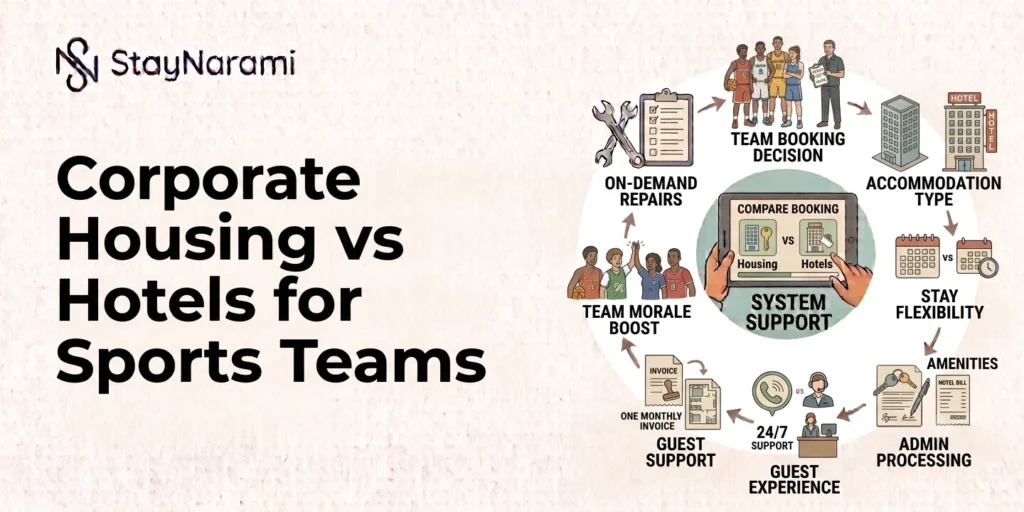
The right option depends on the length of stay‚ number of guests‚ location‚ budget‚ privacy preferences‚ food options‚ transportation requirements‚ and flexibility in guest changes․ For example‚ a hotel is hard to beat for three nights․ Consider furnished corporate housing for 30‚ 60, or 90 days‚ which is worth a look․
TL;DR (Too Long; Didn’t Read)
- Intended for team operations staff‚ coaches‚ and sports organizations‚ it compares hotels with corporate housing when players and staff are on long-term assignments․
- However‚ hotels are generally better for short trips․ When players are in the same market for 30‚ 60, or 90 days‚ the importance of kitchens‚ laundry‚ privacy‚ recovery‚ travel time‚ and roster adjustment time vastly increases․
- Ultimately‚ which is cheaper also depends on total costs‚ including parking‚ taxes‚ transportation‚ food‚ laundry‚ deposits‚ and extensions or changing dates․ Nightly versus monthly rates‚ as well as whether a player stays months or years‚ can also factor in․
- Here are some guidelines for determining when hotels still win‚ when corporate residences are needed‚ and things to consider when determining whether hotels or corporate housing would be a better fit for training camps‚ rehab stays‚ short-term‚ or long-term corporate traveling․
What Is the Difference Between Corporate Housing and Hotels for Sports Teams?
The biggest difference is what each option is designed to do. Hotels are built for travelers. They are easy to book by the night, offer front-desk service, and work well when teams arrive and leave quickly.
Corporate housing is built for temporary living. A furnished apartment or home normally gives the athlete separate sleeping and living areas, a real kitchen, furniture, Wi-Fi, utilities, and laundry access. Current sports-housing programs also offer properties near stadiums and training facilities, along with lease terms that can account for roster movement.
Here is the practical difference:
Factor |
Hotel |
Corporate Housing |
| Best stay length | Days or short trips | Usually longer assignments |
| Booking | Nightly | Often monthly or fixed term |
| Kitchen | Limited or none | Full kitchen |
| Living space | Usually one room | Separate living and sleeping areas |
| Laundry | Shared or paid service | Often in-unit |
| Housekeeping | Usually included | Less frequent |
| Front desk | Yes | Usually no |
| Privacy | Hotel environment | More residential |
| Group meals | Easier to organize | Players can cook individually |
| Roster changes | Easy for short stays | Depends on lease flexibility |
| Best use | Road games | Camps, rehab, temporary assignments |
Neither option wins every category. The better question is which one fits what the team is doing, and that’s the starting point for any housing for sports teams decision.
How Do Costs Compare Between Corporate Housing and Hotels for Teams?
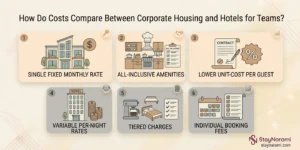
Do not compare only the hotel nightly rate with the apartment monthly rent. That leaves out too much. Teams should calculate the full cost of the stay, including:
- Base room or rental cost
- Taxes
- Parking
- Wi-Fi
- Laundry
- Utilities
- Cleaning
- Transportation
- Food arrangements
- Deposits
- Extension fees
- Cancellation charges
Consider a simple example. If 16 players each had a hotel room for 35 nights‚ at age 35‚ the room total would have been $195 per room/night‚ or $109‚200 plus taxes‚ parking, and other hotel expenses․
That does not mean 16 furnished apartments will automatically cost less. The actual market may prove otherwise. It does mean that once a team reaches a month-long stay, comparing alternatives becomes worthwhile, and extended stay housing for teams belongs in that comparison.
Hotels can also offer valuable group rates, especially for large teams. Corporate housing may offer better monthly economics during long stays, but availability, bedroom requirements, neighborhood, and season all affect the result.
For that reason, there is no honest national answer to “Which one is cheaper?” Run the numbers for the actual city and dates.
Which Offers More Space and Privacy for Athletes: Corporate Housing or Hotels?
Corporate housing is usually a better option for extended stays․ In a normal hotel room‚ you sleep‚ eat‚ watch television‚ talk on the telephone, and sit around in the same place․ That may be fine for a weekend․
After six weeks it can feel stifling․ Usually‚ the one-bedroom furnished apartments have a bedroom separated from the living area‚ with players also getting a kitchen‚ dining room, and laundry․ Privacy depends on the arrangement, though.
If four athletes are placed into a two-bedroom furnished unit to reduce costs, the space advantage quickly becomes less meaningful. Teams should decide bedroom-sharing rules before comparing properties.
Professional and collegiate sports housing providers specifically promote furnished residences as offering more space and privacy than hotel-style stays. For teams, the lesson is simple: compare space per athlete, not simply space per property.
How Do Amenities Compare Between Corporate Housing and Hotels for Sports Teams?
Hotels and corporate housing provide different kinds of convenience. Hotels usually do better with:
- Front-desk support
- Daily or regular housekeeping
- Group check-in
- Meeting rooms
- On-site food
- Team bus access
- Luggage handling
- Very short stays
Corporate housing usually does better with:
- Full kitchens
- Refrigerators and food storage
- Separate bedrooms
- Living rooms
- In-unit laundry
- More residential privacy
- Longer-term parking
- Normal day-to-day living
Current sports corporate-housing providers commonly include furnished living spaces, kitchens, Wi-Fi, laundry, and properties close to training facilities.
Food is an especially important difference. A hotel can be excellent when the team controls catering, and everyone follows the same meal schedule.
For a six-week training assignment, players may want more flexibility. A kitchen lets athletes prepare meals around individual nutrition plans, treatment schedules, or training times.
Give Players a Better Setup Between Training Days
StayNarami provides furnished athlete housing designed for longer stays near training facilities, rehab centers, and team locations.
Which Option Supports Recovery and Rest Better for Athletes?
Housing by itself does not improve athletic performance. What it can do is create conditions that make rest easier.
Sleep is one of the clearest examples. Travel has been linked to sleep disturbances‚ fatigue‚ mood alterations‚ and difficulty coordinating circadian rhythms in elite athletes․ Recommendations include sleep protection before‚ during, and after travel․
LeBron James has made the same point much more simply:
“Sleep is the best recovery you can have.”
For James, sleep has remained one of the foundations of recovery despite access to far more complicated recovery technology. That does not mean an apartment automatically provides better sleep than a hotel. A quiet hotel close to training could be far better than an apartment beside a noisy highway. Teams should check:
- Bedroom sharing
- Outside noise
- Blackout curtains
- Mattress quality
- Commute time
- Building activity
- Temperature control
- Privacy
Commute deserves particular attention. But saving $400 a month per player on housing isn’t nearly as appealing when it adds 40 minutes to both sides of every commute․
Which Is Better for Longer Stays: Training Camps or Season-Long Housing?
This is where corporate housing usually becomes much more competitive. The same furnished model companies use for corporate housing for traveling employees now covers a wide range of sports assignments, including:
- Spring training
- Preseason camps
- In-season player placements
- Trades and call-ups
- Rehabilitation
- Postseason assignments
- Coaching and staff placements
- Season-long stays
One professional sports operations example involved managing 175 players across five markets with 75 rotating housing units during a six-month season. That scale makes another advantage clear: teams are not only managing bedrooms. They are managing movement.
Imagine a development squad with 20 players based in Arizona for eight weeks. Three players leave after week four. Two replacements arrive. One injured player stays an extra three weeks for rehabilitation.
When furnished unit options arise‚ the operations team can plan around those different dates rather than treating all 20 players as one identical booking․ Before you do‚ ask exactly what happens when the roster changes․ Check extension terms, early departure rules, replacement occupants, deposits, and how quickly another unit can be added.
When Should Teams Choose a Hotel Instead of Corporate Housing?
Corporate housing is not the right answer for every sports trip. Choose a hotel when the team is:
1. Playing Normal Road Games
Hotels are much easier to get for two or three nights․ Teams arrive together‚ check in‚ have team transport‚ are fed‚ and leave in an organized team fashion․
2. Moving Through Several Cities
For instance‚ a basketball team would play Dallas on a Monday‚ Houston on a Wednesday‚ New Orleans on a Friday, and Atlanta on a Sunday․ Apartments would add unnecessary work. Hotels are built for this kind of movement.
3. Needing Full-Service Group Operations
Some teams need banquet rooms, catering, secure entrances, large bus areas, luggage storage, and meeting facilities. A well-equipped hotel may handle those needs much better than scattered apartments.
4. Staying for Less Than a Month
StayNarami focuses on 30+ day housing, so normal road-game lodging falls outside the main use case. That distinction matters. A housing provider should solve the problem the team actually has, not force every trip into the same model.
Why Do We Recommend Corporate Housing Over Hotels for Sports Teams?
We recommend corporate housing when the assignment is long enough to make temporary living more important than nightly convenience. For a 45-day training camp, 60-day rehabilitation program, seasonal player placement, or coaching assignment, players may benefit from:
- More personal space
- Full kitchens
- Laundry at home
- Greater privacy
- Residential parking
- More predictable longer-term living
- Housing closer to training facilities
CHPA’s current sports-housing guidance similarly points to fully furnished, move-in-ready homes, flexible leases, additional space, and fast placement as reasons professional and collegiate organizations use corporate housing.
StayNarami’s model fits these longer assignments by helping teams source furnished housing around the location, number of people, dates, and budget. The important phrase is longer assignments. For three nights, choose the hotel. For three months, compare both options carefully.
Compare the Full Stay Before You Extend the Hotel
StayNarami can help you source furnished options around your team size, dates, location, bedroom needs, parking, and budget.
Conclusion
The corporate housing vs hotels for sports teams question becomes much easier once the team starts with the length of stay.
Hotels are excellent at what they are built for. They handle short trips, group arrivals, overnight stays, team meals, and quick departures extremely well. Corporate housing solves a different problem.
Instead‚ for athletes who may be away from home for a month or more‚ separate living space‚ kitchens‚ laundry‚ privacy‚ and a more residential routine are often more practical․
Cost is important‚ but it should not be the only consideration․ This might include considerations such as your commute‚ space‚ bedroom space‚ food‚ transport‚ laundry‚ how flexible you are‚ and whether or not the roster will change. The goal is not to prove one housing type is better. It is to stop using a road-trip solution for a long-term assignment.
Frequently Asked Questions
1. Is corporate housing cheaper than hotels for sports teams?
It can be longer-term‚ though there is no industry standard․ It varies by destination city‚ time of year‚ number of units‚ taxes‚ parking‚ and lease terms․ Teams should compare the total price for a stay․
2. Do professional sports teams prefer hotels or corporate housing?
They make use of both․ For a typical road trip‚ hotels are adequate․ Furnished housing is used mainly for training camp‚ players on loan‚ rehabilitation‚ call-ups‚ and other long-term uses․
3. Does corporate housing offer more privacy for athletes than hotels?
It often can because athletes have separate bedrooms‚ living spaces‚ kitchens‚ and entrances to their residences․ This level of privacy is based on whether units are single or shared․
4. Can corporate housing accommodate a team’s dietary or training needs better than a hotel?
Furthermore‚ although having a full kitchen allows athletes more flexibility in meal preparation‚ hotels can be more efficient for a team preferring catered meals and large group dining․
5. Which is better for a college team on a road trip: hotel or corporate housing?
For a typical college road trip that requires an overnight stay in a hotel‚ corporate housing may also be used when athletes or staff members will be at a destination for extended periods for training or competition․
6. Do hotels offer better amenities than corporate housing for athletes?
In addition to these basic features‚ hotels typically have housekeeping‚ front desk‚ restaurants‚ meeting and conference facilities‚ and group accommodation․ Generally‚ corporate housing offers larger living space‚ kitchens‚ laundry‚ and privacy․ Better amenities depend on what the team actually needs.
Need housing for your team?
Tell us what you need and we'll take care of the rest — anywhere in the U.S., 30+ days.
Request Housing →Related Articles