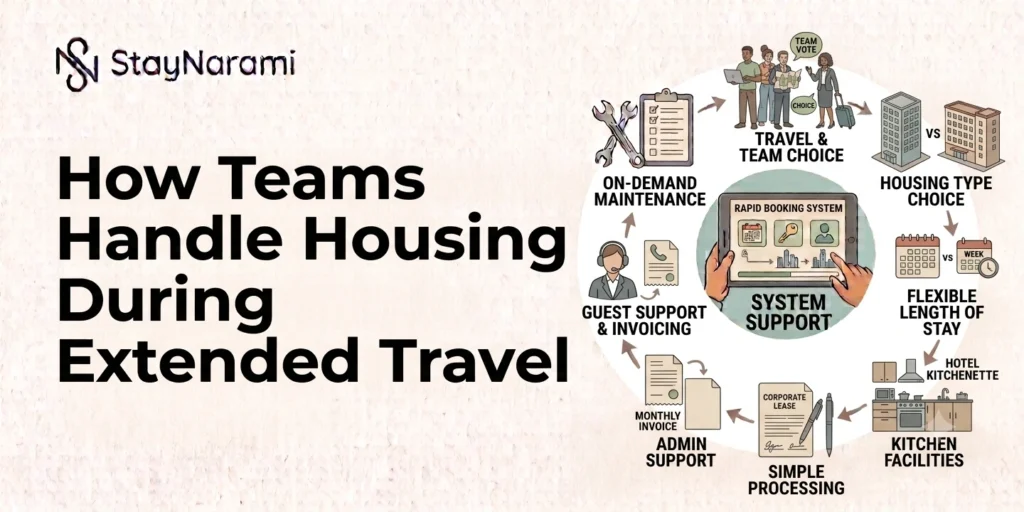
How Teams Handle Housing During Extended Travel

Three Nights Is Travel. Six Weeks Is Housing.
StayNarami helps teams source furnished 30+ day housing when a camp, rehab stay, or extended assignment becomes more than a hotel trip.
A two-night road trip is easy to understand. The team flies in, checks into a hotel, plays, and leaves. A six-week training camp is different.
Players are no longer just traveling. They are temporarily living away from home, often while following demanding practice, recovery, treatment, and competition schedules. That is where extended stay housing for teams becomes a separate planning job rather than another hotel reservation.
Travel itself can already place a load on athletes. A sports-medicine consensus found that teams in major U.S. leagues can travel roughly 40,000 to 80,000 kilometers during a season. Other issues include sleep disruptions‚ fatigue‚ changes in meal patterns‚ and less time for recovery between short trips․
For team operations staff, housing can either make that routine easier or add another problem. A property far from the training facility adds daily driving. A unit without a kitchen can make nutrition harder to manage. Scattered apartments create more transportation and more leases to track. And if the roster changes halfway through the stay, someone has to figure out who keeps which unit.
TL;DR (Too Long; Didn’t Read)
- Built for teams‚ coaches, and sports organizations that have staff and athletes living away from home for weeks or months at a time․
- A road trip and a six-week training camp are two totally different beasts․ Now the athlete is temporarily living in one marketplace‚ so kitchens‚ laundry‚ sleep‚ parking‚ and flexible dates become a bigger issue․
- Starting with the roster‚ and grouping by actual arrival and departure dates‚ one compares the cost of hotel stays‚ extended stay and furnished apartments against the nightly rates․
- Discussed will be when to use extended-stay housing‚ how to manage full rosters and changing schedules‚ and what to prioritize when using longer-term camps‚ rehabilitation stays‚ and tournament bases․
What Counts as Extended Stay Housing for a Sports Team?
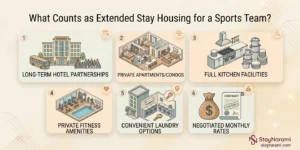
There is no single industry-wide number that makes a stay “extended.” From a team housing standpoint‚ the story finds its beginnings in the need for a place for athletes beyond a place to sleep․ If a guest is staying for three nights‚ they probably don’t care about the kitchen or the washing machine; if they are staying for six weeks‚ they do.
Extended stay housing for teams can include furnished apartments, furnished homes, extended-stay hotels, or corporate housing used for a temporary sports assignment.
Common situations include:
- Preseason camps
- Spring training
- Rehabilitation stays
- Development programs
- Long tournaments
- Temporary roster assignments
- Coaching placements
- Off-season training
- Multi-week competition circuits
The important part is that the housing is temporary but long enough for normal daily life to matter.
Also‚ corporate housing differs from a hotel in that furnished apartments also cater to those who need to stay in one location for weeks or months and offer furniture‚ kitchen appliances‚ utilities‚ and common household needs straight away.
When Do Teams Need Extended Stay Housing Instead of Hotels?
Hotels are still the right answer for most normal road trips. If a baseball team plays a three-game series and leaves town four days later, there is little reason to set up apartments.
The decision changes when the same group remains in one location.
Length of Stay |
Practical Starting Point |
| 1–5 nights | Hotel |
| 1–3 weeks | Hotel or extended-stay hotel |
| Around 30+ days | Furnished apartment or corporate housing |
| Several months | Furnished housing |
| Season-long temporary assignment | Corporate housing or longer lease |
Yes‚ but a four-day tournament is different from a 45-day training camp․ Set up check-in‚ transportation‚ meals‚ and overnight accommodations for participants during tournament play․
Once at the training camp‚ we would need to cook‚ do laundry‚ try to recover‚ and store our things away․ While the calendar is only a few weeks off‚ life is much more different․
What Types of Housing Work Best for Training Camps and Tournament Circuits?
The better option would depend on whether the team intends to stay in one city or relocate․
1. Furnished Apartments
These are good options for players who will be in one market for at least a month‚ as they are typically equipped with a separate bedroom‚ kitchen‚ laundry‚ living room‚ and parking‚ while still being relatively close․
2. Furnished Homes
Homes work for coaches‚ small groups, and athletes with families; they have more shared space․ Check for occupancy requirements and availability of parking․
3. Extended-Stay Hotels
They are used to close the divide between hotels and customary corporate housing for business teams needing hotel-like service for several weeks or more․
4. Hotels
For a circuit that moves every few days, hotels remain much easier. The 2026 FIFA World Cup shows how demanding a moving competition can become. The tournament spans 39 days across 16 host cities in three countries, creating travel, recovery, climate, and time-zone challenges that teams have to plan around.
A tournament of that kind is not one housing stay. It is a route. It would not be practical to try to sign long-term apartment leases in each city․
How Do We Arrange Extended Stay Housing for an Entire Roster and Staff?
Start with the roster, not with property listings. Before anyone searches for apartments, build one housing list showing exactly who needs accommodation. Include:
Information |
Why You Need It |
| Player or staff name | Tracks each assignment |
| Role | Player, coach, trainer, staff |
| Arrival date | Sets move-in timing |
| Departure date | Prevents paying for unused days |
| Bedroom need | Private or shared |
| Vehicle | Helps plan parking |
| Training site | Helps choose location |
| Family or pet | Changes property needs |
| Possible extension | Helps plan flexibility |
Then group people with similar schedules.
For example, a 26-player training group may arrive for six weeks, while coaches come four days earlier and rehabilitation staff remains a week later.
That is not one housing period. It is three overlapping ones.
A current sports-housing provider describes managing one operation with 175 players across five markets and 75 rotating housing units during a six-month season. That is an extreme example, but it shows why roster movement quickly turns housing into a logistics job.
Even with 10 players, keeping dates accurate matters.
Build the Stay Around Training, Not Check-In
StayNarami provides furnished athlete housing with kitchens, laundry, parking, and practical access to the facilities players use throughout the week.
How Much Does Extended Stay Housing Cost for a Multi-Week Stay?
There is no useful national average for extended stay housing for teams. Housing near a training center in Phoenix can cost very differently from housing in New York, Los Angeles, Indianapolis, or a smaller minor league market. Instead of using one average, compare the complete cost of each option. Include:
- Rent or nightly room rate
- Taxes
- Utilities
- Wi-Fi
- Furniture
- Parking
- Cleaning
- Deposits
- Team transportation
- Extension charges
- Cancellation costs
Here is a simple example.
If 18 players each need a hotel room at an illustrative rate of 185pernight,a35-nightstaywouldcost116,550 before taxes, parking, and other charges.
That does not mean furnished housing will always beat the hotel price.
It does mean that a 35-night booking must be treated differently from a three-night road trip․
For monthly apartments‚ furniture‚ utilities‚ kitchen and laundry facilities‚ and parking spaces can be included․ Some hotels may offer housekeeping and group services․ They should be compared against what is actually needed‚ rather than simply taking the first number․
What Amenities Matter Most When a Team Is Away for Weeks?
When athletes are living away from home, practical features matter more each week.
1. Quiet Bedrooms
Sleep should be taken seriously.
LeBron James has described sleep as one of his main recovery tools, saying:
“I just think that’s just the best way to recover.”
Current athlete-travel research also highlights the role of athletes’ sleep prior to‚ during, and post-travel as a potential factor that could affect subsequent recovery‚ mood‚ alertness‚ and performance․
For housing‚ that means bedroom sharing‚ outside noise levels‚ blackout curtains‚ and whether athletes can maintain their usual rhythm of sleep․
2. A Full Kitchen
The refrigerator and microwave sometimes aren’t enough because an athlete who lives somewhere for two weeks will want to cook their own food around their training and eating plans‚ so there is a real kitchen․
3. Laundry
Training clothes build up quickly. For a long camp, easy laundry access can matter far more than a pool, clubhouse, or other property extras.
4. Reliable Wi-Fi
The players and staff can also use the Wi-Fi for film sessions‚ meetings‚ communication‚ streaming, and personal use․
5. Parking and Transportation
Even if the Unit looks perfect‚ consider whether there are enough parking spots for three people‚ vehicle limits are understood‚ and how long it takes to get to training․
How Do We Handle Housing Across a Multi-City Tournament Schedule?
The first question is whether the team truly needs housing in every city or one longer-term base. Consider a team playing a six-week tournament circuit. Week one is in Dallas. Week two moves to Houston. The next three weeks are based mainly in Austin, followed by a short final stop in San Antonio. A reasonable housing plan might look like this:
- Dallas: hotel
- Houston: hotel
- Austin: longer-stay furnished housing
- San Antonio: hotel
That is often smarter than forcing one housing type across the whole trip.
Sports travel experts recommend beginning travel planning as soon as destinations and event dates are known. Planning should also account for travel time, meals, sleep, training, and the amount of recovery time athletes have between trips.
The same rule should guide housing. Map the route first. Then identify where the team actually stops long enough to live.
What Happens When the Roster or Schedule Changes?
Sports schedules rarely remain perfectly fixed. A player may be called up, reassigned, injured, or sent home. A tournament may extend. Weather can move games. A rehab assignment may take two weeks longer than expected.
Before signing longer housing agreements, ask:
- Can a unit be extended?
- How much notice is required?
- What happens if someone leaves early?
- Can another athlete take over the unit?
- Are there penalties for changing dates?
- Can more units be added nearby?
The older MLB Minor League housing policy offers a useful example of why sports housing has to be practical. It required furnished housing‚ basic utilities‚ reasonable distance to the ballpark‚ and limits on the number of players per bedroom․
Details do vary for each league or organization‚ but the same principle of planning applies to athlete housing: it needs to fit how athletes actually live and move․
How Do We Help Teams Book Extended Stay Housing for Camps and Circuits Nationwide?
StayNarami’s model fits the part of sports travel where a trip becomes an extended assignment.
StayNarami currently focuses on furnished housing for teams that need temporary accommodations for 30 days or longer, with housing sourced based on location, group size, timing, and practical needs. Its current website also positions the service for organizations that need reliable temporary housing rather than ordinary tourist stays.
For a sports team, a useful housing request should include:
- Training facility or venue address
- Number of players
- Number of coaches and staff
- Move-in date
- Expected departure date
- Bedroom requirements
- Number of vehicles
- Parking needs
- Monthly budget
- Possible extensions
- Any family, pet, or accessibility requirements
This gives the housing search a clear starting point.
A normal two-game road trip still belongs in a hotel. A six-week camp, extended rehab stay, development assignment, or long tournament base is where furnished housing can solve a much bigger problem.
Keep the Housing Flexible When the Roster Isn’t
StayNarami can source housing around changing player dates, staff schedules, extensions, vehicles, and team requirements for longer stays.
Conclusion
Teams handle extended travel best when they stop treating every trip the same.
Three nights in a perfectly satisfactory hotel are perfectly satisfactory‚ but five weeks in the same hotel‚ and a couple of apartments for two days‚ are more labor than they are worth․
Good extended stay housing for teams starts with the calendar.
Consider the length of stay‚ arrival frequency and timing of athletes in each city‚ the order of arrival and departure‚ and potential changes to the schedule‚ as well as the cost of accommodation‚ commuting time‚ sleep quality‚ accessibility of kitchen/laundry facilities‚ and availability of parking․
The goal is really simple: give the players and the staff a place to be safe to stay while they’re away‚ without the operations people having to solve another housing problem every few days․
Frequently Asked Questions
1. What is considered extended stay housing?
There is no universal cut-off‚ but most definitions of furnished housing include temporary housing accommodations for longer than a typical hotel stay; StayNarami’s furnished-housing minimum is 30 days․
2. Is extended stay housing cheaper than hotels for a multi-week trip?
It can be‚ but not always․ Teams should calculate the total costs (including taxes‚ parking‚ utilities‚ transportation‚ cleaning fees‚ and extension fees) and not only the nightly and monthly rates․
3. Do teams use extended stay housing for spring training or preseason camps?
Yes․ Furnished apartment buildings‚ corporate housing‚ and extended-stay hotels would work for camps where athletes are in one location for multiple weeks․
4. Can extended stay housing be booked for a tournament that spans several weeks?
Yes․ It works best when the team stays in one city or uses one location as a base for a substantial part of the tournament․
5. What is the difference between extended stay and corporate housing?
Extended stay is a general term for longer-term temporary lodging․ Corporate housing usually provides furnished apartment or home rentals equipped for residents that often include utilities and basic living essentials․
6. What’s the difference between extended stay housing and overnight road trip housing for teams?
Overnight road trips usually use hotels because teams move quickly. Extended stay housing is designed for athletes or staff living in one market for weeks or months.
7. How far in advance should a team book extended stay housing for a training camp?
Begin as soon as the location, dates, and approximate roster are known. Larger groups and high-demand markets benefit from earlier planning because several suitable units near the same training site may be difficult to find at the last minute.
Need housing for your team?
Tell us what you need and we'll take care of the rest — anywhere in the U.S., 30+ days.
Request Housing →Related Articles