Corporate Housing for Traveling Sports Teams

When the Team Stays, the Hotel Stops Making Sense
StayNarami helps teams source furnished housing for 30+ day training, rehab, and temporary player assignments.
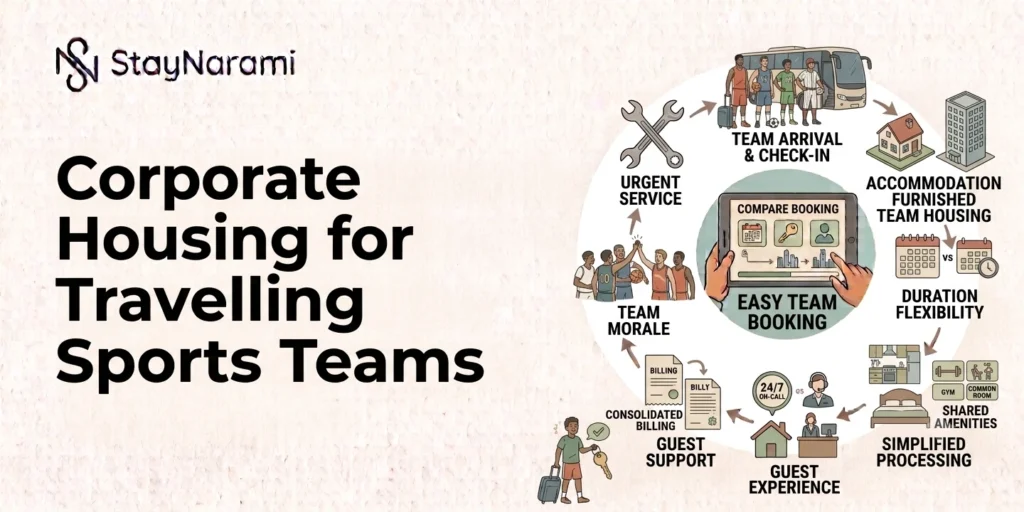
Travel is built into competitive sports, but not every trip creates the same housing problem. A team flying into Chicago for two games needs a hotel. A group of players spending six weeks at a training facility needs something very different. For longer assignments, corporate housing for traveling players can give athletes a furnished place to live without asking the team to arrange furniture, utilities, internet, and separate leases from scratch.
The amount of travel athletes deal with can be substantial. A sports-medicine consensus review found that teams in the NBA, NFL, NHL, and MLB can travel roughly 40,000 to 80,000 kilometers during a season, depending on the league and schedule. The same research notes that frequent travel can contribute to fatigue, poor sleep, lower alertness, and disruption to normal routines.
That does not mean the corporate housing should always replace the team hotel every time the players leave home‚ because it should not․ Corporate housing is used by NFL teams for long assignments outside their home city‚ such as training camps‚ rehabilitation‚ long tournaments‚ placement on extended rosters‚ or preseason conditioning in another city for a month or longer․
For team operations staff‚ it includes monitoring when that line has been crossed and how to make that call‚ what length-of-stay housing has to provide‚ how to compare housing costs‚ and how to account for changes to the roster and schedule․
TL;DR (Too Long; Didn’t Read)
- Meant to assist team operations staff‚ coaches‚ and sports organizations when hotels may not be the best option and athlete assignments need furnished housing․
- For short road trips‚ hotels are the ideal option‚ but once players‚ coaches, or staff are in one market for 30 days or longer‚ kitchens‚ laundry‚ privacy‚ recovery‚ parking, and proximity to training facilities or rehab centers become more of a priority․
- The housing plan must also account for roster movement‚ changes to departure dates‚ temporary placements away from home‚ and extensions from home without the team needing to restart․
- Learn when using corporate housing makes sense for sports travel‚ how to compare the total cost of accommodations‚ what athletes need for longer stays‚ and how to work around rosters with flexible housing․
What Is Corporate Housing for Traveling Players and Why Do Teams Need It?
Corporate housing for traveling players is a type of fully furnished temporary housing sometimes used by professional athletes‚ coaches‚ trainers, or support staff for long periods away from home․
Unlike empty apartments‚ furnished apartments come with furniture‚ making them move-in ready․ They usually include a bedroom‚ living room‚ kitchen‚ furniture‚ WiFi‚ utilities‚ and access to laundry․
Such housing is used by sports organizations when people are in a single market long enough that a hotel room is impractical․
Common situations include:
- Training camps lasting a month or longer
- Rehabilitation near a specialist or team facility
- Minor league or development assignments
- Temporary roster moves
- Seasonal coaching assignments
- Long tournaments or competition programs
- Extended preseason training
- Players waiting for permanent relocation housing
Current sports-housing guidance also puts a strong emphasis on furnished units, flexible terms, proximity to team facilities, and the ability to respond when rosters change. The point is not luxury. It is giving someone who is away for six or eight weeks a practical place to live.
How Is Housing for Traveling Players Different From a Team’s Home-Base Housing?
Home-base housing is usually built around a season, a permanent move, or an athlete’s normal life in the team’s city. Travel housing has a different job. The stay has an end date. That date may also move.
A player might be assigned to another market for 45 days and then return home. A coach could spend two months at preseason camp. An injured athlete might need housing near a rehabilitation center until medical staff clears the next step.
That means temporary housing needs more flexibility than a normal apartment lease.
Home-Base Housing |
Traveling Player Housing |
| Often long-term | Usually tied to an assignment |
| Player may furnish it | Usually move-in ready |
| Stable location | May change during the season |
| Normal lease planning | Schedule can change quickly |
| Built around daily life | Built around training or competition |
| Usually one household | May involve several players or staff |
This is also why furnished housing can work well for temporary assignments. Nobody wants to buy a bed, sofa, cookware, and internet service for a stay that ends six weeks later.
What Types of Housing Work Best for Away Games and Road Trips?
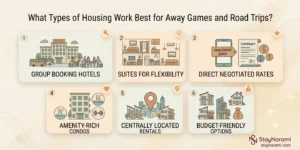
Length of stay should make this decision.
A corporate apartment is not automatically better because it has more space. The hotels players stay in on the road are usually the next best option‚ since they are staying for one to two nights‚ before flying to the next city․ It is easy for a hotel to accommodate late arrivals‚ early departures‚ team meals‚ luggage‚ and transportation․
Longer stays change the calculation.
Length of Stay |
Usually the Better Starting Point |
| 1–5 nights | Hotel |
| About 1–3 weeks | Hotel or extended-stay hotel |
| Around 30 days or longer | Furnished corporate housing |
| Several months | Furnished apartment or home |
| Season-long temporary placement | Corporate housing or longer lease |
Consider a development team that plays road games in three cities over nine days and then spends six weeks training in Arizona.
The nine-day road section belongs in hotels.
The six-week Arizona stay deserves a furnished-housing comparison.
Trying to make one lodging format fit both parts of the schedule usually makes the housing plan worse, not simpler.
How Close Should Housing Be to the Away-Game Venue?
For longer stays, do not look only at the stadium.
Ask where players spend most of their week. That facility could be a training complex‚ practice court‚ rehabilitation facility‚ team office‚ or stadium․ Players may go to the training facility almost every day‚ but go to the stadium only for games․
Check actual drive time between housing and:
- Training facilities
- Stadium or arena
- Medical and rehabilitation facilities
- Team offices
- Airport
- Grocery stores and food options
Traffic matters too.
An eight-mile trip can take 12 minutes in the early morning or 45 minutes in rush hour․ This is especially important when the athletes are also frequent travelers. The athlete-travel consensus recommends planning trips carefully and protecting recovery time and sleep whenever possible.
Removing an unnecessary daily commute is a small decision that can make a month-long stay much easier.
How Do We Arrange Housing for a Full Roster on Short Notice?
Start with the people, not the properties. Before searching for apartments, create one current housing roster showing who actually needs accommodation.
For each person, record the arrival date, expected departure, role, bedroom requirement, vehicle, family or pet needs, and whether the assignment could be extended. Then separate firm requirements from preferences.
For example, being within 20 minutes of the training center might be required. A pool may only be preferred. That difference becomes useful when inventory is limited.
1. When the Roster Changes
Suppose a team has 12 furnished units booked for a development group.
Four players are called up. Two new players arrive three days later. Another athlete must remain in town for rehabilitation.
Now the housing plan has changed without the season stopping.
This is why sports housing needs clear move-in, move-out, extension, and early-departure terms.
Industry sports-housing programs are designed around this kind of movement. One current provider describes managing 175 players across five markets with 75 rotating units during a six-month season, which shows how quickly housing becomes an operations job once rosters begin moving.
Smaller teams face the same problem, just with fewer doors to manage.
How Much Does Corporate Housing Cost for Traveling Sports Teams?
There is no dependable nationwide average for corporate housing for traveling players. New York‚ Phoenix‚ Indianapolis‚ and a small minor league market are priced differently from the other leagues; pricing varies with the season‚ number of bedrooms‚ location‚ quality‚ and demand․
The better approach is to compare the total cost of the stay. Look at:
Cost |
What to Include |
| Accommodation | Nightly or monthly price |
| Taxes | Especially important with hotels |
| Utilities | Electricity, water, gas |
| Wi-Fi | Included or separate |
| Parking | Number and type of spaces |
| Furniture | Included with corporate housing |
| Cleaning | One-time or recurring |
| Deposits | Upfront cash requirement |
| Transportation | Daily travel to team facilities |
| Changes | Extension or cancellation costs |
Here is a simple illustration.
Fifteen players needing a room at $210 per night for 30 nights would have cost $ 94,500; however, taxes‚ parking, and other costs were not included in that figure․
That figure does not prove corporate housing will be cheaper. Rates need to be checked in the actual market.
It does show why a 30- or 60-day stay should be evaluated differently from a weekend road trip.
A Better Base Between Training Days
StayNarami gives athletes furnished housing with kitchens, laundry, privacy, and practical access to team facilities.
How Do We Handle Housing for Back-to-Back Away Games in Different Cities?
For a regular multi-city road trip‚ corporate housing is the wrong tool․ Let’s suppose the basketball team plays:
- Monday in Dallas
- Wednesday in Houston
- Friday in New Orleans
- Sunday in Atlanta
The team is moving too quickly to benefit from apartments in each market. Hotels are built for that kind of schedule.
The better opportunity for corporate housing for traveling players appears when the team has a longer temporary base.
It is also common for leagues‚ tournaments‚ development programs‚ rehabilitation assignments‚ or extended training periods to keep players for a month or longer in a particular city while still traveling to games․
In that instance‚ they will occupy furnished houses or apartments between those flights. That distinction matters because teams should not compare a monthly apartment directly with a two-night hotel reservation. They solve different problems.
What Amenities Do Traveling Players Need During Longer Stays?
Athletes may appreciate premium features, but the basics deserve attention first.
1. Quiet Bedrooms
Sleep matters when athletes are dealing with practice, competition, travel, and recovery. LeBron James once described sleep this way:
“That’s the best recovery that you can get.”
For a longer stay, check bedroom arrangements, nearby noise, window coverings, and whether athletes are expected to share rooms.
2. A Full Kitchen
Athletes often need greater control over when and what they eat. A full kitchen makes meal preparation easier than relying on restaurants throughout a six-week assignment.
3. Laundry
Training clothes add up quickly. In-unit laundry can be far more valuable during an extended sports stay than many of the amenities that look better in pictures․
4. Reliable Wi-Fi
Players and coaches can use Wi-Fi for film study‚ meetings‚ communications‚ entertainment, and general personal use․
5. Parking
Confirm the number of actual spaces available. Do not assume “parking included” means a property can handle several players, staff vehicles, or vans.
6. Privacy and Space
A player returning from practice should have somewhere to relax that is not simply the edge of a hotel bed. Separate bedrooms and living areas are one reason current sports-housing providers position furnished apartments for extended stays rather than ordinary road trips.
How Do We Help Teams Book Reliable Housing Across Every City on Their Schedule?
This is where it is important to be precise about StayNarami’s service. StayNarami provides fully furnished, move-in-ready housing anywhere in the U.S. for stays of 30 days or longer. Its current housing terms run from 30 days to 12 months or more.
That makes the service relevant when a sports organization needs housing for:
- An extended training location
- A player temporarily assigned to another market
- A month-long tournament base
- Coaching or support staff on temporary assignment
- Rehabilitation near a specialist facility
- Preseason programs lasting 30+ days
- Several athletes temporarily based in the same city
StayNarami’s process starts with the location, team size, timeline, and housing requirements. Furnished properties are then sourced around those needs, with move-in and the stay coordinated through the lease term.
If a team’s schedule involves three nights in one city and two in another, hotels remain the more practical answer.
If players will be based in one market for five, eight, or 12 weeks, that is where the corporate-housing model starts to fit.
House the Roster Without Chasing Every Change
StayNarami helps teams manage longer stays around player movement, changing dates, parking, and housing needs.
Conclusion
Sports travel does not create one housing problem. It creates several.
A one-night road game needs fast check-in and a convenient team hotel. A six-week training assignment needs somewhere athletes can actually live. A temporary roster move needs flexibility. A rehabilitation stay may need housing close to a medical facility rather than the stadium. The best corporate housing for traveling players starts by identifying which of those situations the team is dealing with.
Look at the length of stay first. Then check the training location, commute, bedroom setup, kitchen, laundry, parking, costs, and what happens if a player’s dates change.
Corporate housing does not need to replace team hotels․ When effectively utilized‚ it fills the gap between a road trip and a permanent move․
Frequently Asked Questions
1. Do sports teams book hotels or corporate housing for away games?
Hotels are better suited to the standard road trips that only last a few days․ Corporate housing works better when players are in a market for around 30 days․
2. How far in advance do teams arrange housing for road trips?
Though the schedule will dictate travel plans‚ several factors can impact the lead time of travel․ If a series of longer road trips require several furnished accommodations in one place‚ planning is usually necessary․
3. Is corporate housing better than hotels for traveling sports teams?
Not usually for typical road trips․ Hotels are designed for short stays․ Corporate housing can also be used for month-long training‚ rehabilitation‚ temporary assignments‚ and other long-term stays‚ providing residential facilities such as larger living space‚ kitchens‚ washing facilities‚ and a regular lifestyle․
4. Can housing be booked for just one or two nights during a road trip?
Yes, but that would normally be hotel lodging rather than corporate housing. StayNarami specifically focuses on stays of 30 days or longer.
5. Do minor league teams travel with the same housing standards as pro teams?
Not necessarily. Housing and travel policies vary by league, sport, team, collective bargaining agreement, and level of competition. Teams should follow the rules that apply to their own athletes rather than assuming one professional league’s policy applies everywhere.
6. How do teams coordinate housing across multiple cities in one road trip?
Short city-to-city trips are usually handled through hotels and team travel arrangements. For longer temporary placements, teams can separately arrange furnished housing in the city that will serve as the player’s base.
Need housing for your team?
Tell us what you need and we'll take care of the rest — anywhere in the U.S., 30+ days.
Request Housing →Related Articles