Housing for Film Crews on Location

Keep the Crew Close to Set
StayNarami sources furnished housing around your filming location, crew size, production dates, parking needs, and budget.
Film crews may spend weeks planning a shoot, but housing is often arranged much closer to the arrival date. By then, production teams may be trying to find places for camera, lighting, sound, wardrobe, makeup, transportation, and other crew members when the best housing near the set is already limited.
Good housing matters because film schedules can be demanding, and long commutes only make them harder. The U.S. motion picture and sound recording industries employed about 332,700 people in July 2026. The Bureau of Labor Statistics also notes that film and television crews often work on location, with assignments lasting anywhere from a single day to several months. Their workdays can also be long and irregular.
Rest time can also be tight. The International Alliance of Theatrical Stage Employees (IATSE) Local 476, for example, lists a 10-hour turnaround between the end of one production day and the next call time. That does not mean every production follows the same agreement, but it shows why adding a long drive after wrap can become a real crew issue.
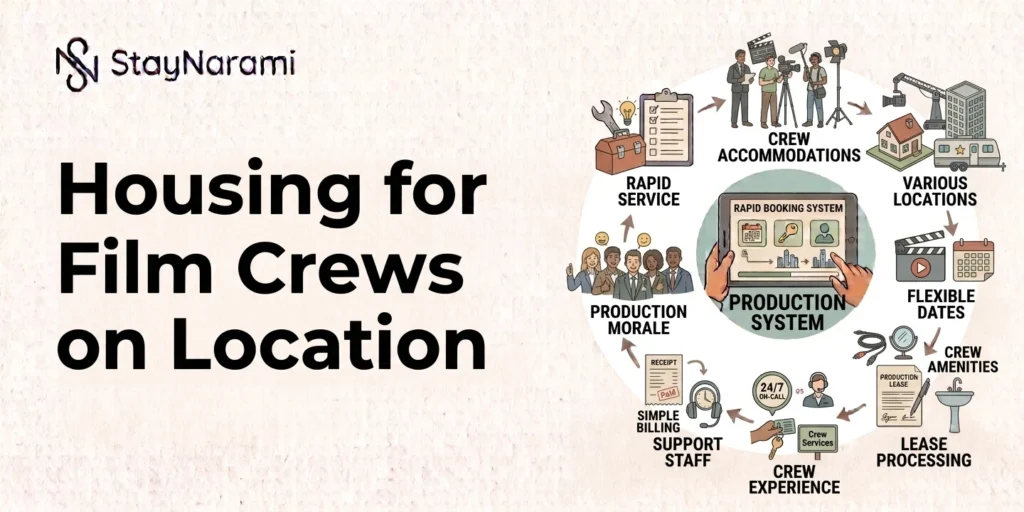
Good housing for film crews therefore has to solve more than the question, “Where can everyone sleep?” The producers have to think about locations‚ units‚ departments‚ parking‚ kitchens‚ launderies‚ workload‚ dates‚ billing‚ and the fact that a three-week shoot could turn into a five-week shoot․
TL;DR (Too Long; Didn’t Read)
- Designed for use by production managers‚ production coordinators‚ and operations teams who house film‚ television‚ commercial, and event crews away from home․
- Crew housing often has prep teams arriving early‚ principal crew on set‚ and wrap teams arriving for longer than other crews․ Monthly rental prices may not be the sole consideration for crew accommodations․ Other factors may include commute time‚ parking‚ kitchens‚ laundry‚ additional sleeping rooms‚ and flexible dates․
- For productions of 30 days or more‚ furnished housing is generally less expensive than several hotel rooms‚ and provides a more home-like environment‚ as well as additional opportunities to coordinate department‚ dates, and locations․
- This guide explains how to plan housing by crew size and department, compare costs, reduce travel time to set, prepare for extensions, and handle remote or difficult filming locations.
What Is Housing for Film Crews on Location?
Film crew housing is temporary accommodation arranged for crew members who travel away from their home market for a production.
That may include people working in camera, lighting, sound, wardrobe, hair and makeup, art, construction, transportation, accounting, production management, and other departments.
The housing setup can vary widely.
A small commercial shoot may place six people in a nearby hotel for four nights. Scenes for TV series may require dozens of crew members living in furnished apartments for weeks or months․ Outside the studio‚ houses‚ apartments‚ hotels‚ and vehicles may house the crew for the duration of the shoot․
This is where housing for production crews] becomes different from a normal hotel booking. You are rarely managing one arrival date, one departure date, and one room type.
One department may arrive early for prep. Another may stay only during principal photography. A few people may remain after wrap. Some need private space, others can share, and several may have vehicles that require secure parking.
A good housing plan accounts for those differences from the beginning.
What Types of Housing Options Work Best for Film Crews?

The right choice usually depends on the duration of the shoot and how many people need accommodation․
Housing Option |
Works Well For |
Main Advantage |
Possible Drawback |
| Hotels | Shoots lasting a few days | Simple booking and daily housekeeping | Limited living space and higher long-stay costs |
| Extended-stay hotels | Short or medium assignments | Kitchens and more space than standard rooms | Large crews may still become expensive |
| Furnished apartments | Month-long or longer shoots | Kitchen, laundry, privacy, normal living environment | Availability can be limited near set |
| Furnished homes | Small departments or shared groups | More bedrooms and shared common space | Parking and occupancy limits need checking |
| Corporate housing | Longer production assignments | Furnished, move-in-ready units | Often requires more planning ahead |
| Remote workforce housing | Productions outside major cities | Can solve shortages in difficult locations | Fewer choices and longer planning windows |
For a three-day shoot, booking furnished apartments may create unnecessary work.
For a three-month production, placing everyone in standard hotel rooms can create the opposite problem. Crew members may have no kitchen, limited laundry access, little room to decompress, and higher overall costs. The housing type should follow the assignment rather than habit, which is why longer shoots often move to furnished housing for TV and event crews instead of rolling hotel bookings.
How Close Should Crew Housing Be to the Filming Location?
Distance on a map can be misleading. Production teams should pay more attention to actual drive time. A property may be only 14 miles from set but require 45 minutes in traffic. Another option might be slightly more expensive but sit 15 minutes away during the hours the crew will actually travel. That difference becomes important after several weeks of long production days.
For example‚ if a crew member has worked a 12-hour day‚ then commutes 50 minutes by car home to his apartment‚ eats‚ showers‚ prepares for the next day, and goes to bed‚ not much sleep will be left over․ If this happens for six weeks‚ then the location of housing has much more importance․
Before booking, check travel time between housing and:
- The primary filming location
- Secondary locations
- The production office
- Equipment or staging areas
- Common crew call times
- Expected wrap times
It may also make sense to house departments in different areas.
In a situation where most of the crew worked in the studio, and only a few construction workers were at another build location for a few weeks‚ this wouldn’t work for the neighborhood․
How Do We Handle Housing for Large Crews on Tight Production Schedules?
The easiest mistake is booking people as housing requests arrive. First, the production manager needs an apartment. Then six camera crew members need rooms. Two weeks later, someone realizes that grip and electric are arriving earlier than expected.
Before long, the production has reservations scattered across several properties, different payment dates, separate deposits, and different cancellation rules. For a larger crew, start with a simple housing roster instead. Include:
- Crew member or department
- Arrival date
- Expected departure
- Number of occupants
- Bedroom requirement
- Vehicle count
- Parking needs
- Pets
- Accessibility requirements
- Budget
- Possible extension
Then group similar stays together.
1. A Typical Production Scenario
Suppose 28 people are traveling for a seven-week shoot. The art department arrives 10 days early. Most of the crew arrives just before principal photography. Camera and sound leave after the final shooting day, but four people remain for another week of wrap work.
Those are really three housing periods, not one. Treating them separately can prevent the production from paying for empty units before or after they are needed.
It also makes extensions easier to handle because you know exactly which department is affected when the schedule changes. Event tours work the same way: advance, load-in, and load-out teams rarely share dates, which is why housing for touring event staff is usually planned in stages too.
What Amenities Do Film Crews Need Most While on Location?
Luxury usually matters less than practicality. Someone coming home after a long shoot day is more likely to care about a working washing machine and somewhere to cook than a fancy lobby. For longer assignments, look closely at the following.
1. Kitchen Access
Restaurant meals become tiring and expensive during long productions. A proper kitchen gives crew members the option to prepare food around unusual schedules.
That can be especially helpful with very early call times when normal breakfast options are limited.
2. Laundry
For a week-long shoot, laundry may not be a major issue. For a two-month assignment, it is. Having in-unit or easy access to a laundry room saves crew members one of their few hours off from laundromats․
3. Reliable Wi-Fi
Production managers‚ coordinators‚ editors‚ department heads‚ and many other crew members would also benefit from Wi-Fi access for looking up schedules‚ sending and receiving files‚ and sorting through paperwork, and communicating with others from their accommodation․
4. Parking
This is one of the most readily overlooked details․ Don’t forget to ask about parking! Ask how many vehicles can be parked on the premises‚ if parking is included‚ and if there are height restrictions or a vehicle size limit․
5. Quiet Sleeping Space
Not all crews work during the day; night shoots can switch someone’s entire schedule around․ This could mean that for a crew member that gets home at about 7:00 a․m․‚ for example‚ they might be sleeping through the afternoon‚ which presents its own challenges․
How Much Does Housing for Film Crews Typically Cost?
There is no useful national average because film production housing varies too much by city, season, length of stay, and crew size.
Housing in Los Angeles during a busy production period will look very different from housing outside a smaller regional location.
Instead of searching for an “average rate,” production teams should calculate the total cost of each option. That means looking beyond rent.
A comparison should include:
Cost |
Why It Matters |
| Base rent or nightly rate | Starting housing expense |
| Lodging taxes | Can materially change hotel pricing |
| Parking | Significant when many crew members drive |
| Utilities | May or may not be included |
| Internet | Essential for longer stays |
| Cleaning fees | Can increase costs across many units |
| Deposits | Affects cash flow |
| Transportation | Longer commutes increase fuel and vehicle costs |
| Extension pricing | Important if production runs long |
| Cancellation fees | Important when dates change |
How Far in Advance Should Productions Book Crew Housing?
Earlier is usually better, especially when the production needs several units near the same location. An Atlanta production housing guide published for the 2026 season recommends starting roughly 8 to 12 weeks ahead for crew housing planning. That is not a universal rule, but it is a useful benchmark for larger productions. More lead time is helpful when:
- The crew is large
- The location is remote
- The shoot overlaps with a major local event
- Several units are needed in the same building
- The production needs extensive parking
- Crew members are bringing pets
- Accessible units are required
- Dates are likely to move
Small productions may be able to arrange accommodation much faster. A 40-person crew shooting in a small town usually cannot.
Housing That Moves With the Production
StayNarami helps film, TV, and event crews secure furnished 30+ day housing around prep, shoot, and wrap schedules.
Can Housing Be Arranged for Different Crew Departments Separately?
Yes, and sometimes that is the cleaner way to manage it. Production departments do not always work on the same timeline.
Art and construction may be on location well before the cameras arrive. Principal photography brings in the largest group. Accounting, transportation, or a small wrap team may stay after much of the crew leaves. Housing can therefore be separated by department, length of stay, location, or privacy needs.
For example, a production could place most crew members in a cluster of furnished apartments while arranging separate one-bedroom units for department heads.
Another production might house construction close to a build site and the main shooting crew closer to the studio.
It is also illogical to try to force people with different working patterns into the same housing solution․
How Do Production Companies House Crews in Remote Filming Locations?
Remote shoots become difficult because there may simply not be enough normal accommodation nearby.
Werner Herzog has spoken about this problem when discussing location filmmaking. Recalling the challenge of reaching a place without enough local infrastructure to support a production, he said:
“You just can’t go there and start shooting.”
That is a useful way to think about film crew housing in remote areas: the housing has to be solved before the shoot can be.
Finding the visual location is only one part of choosing it. The production also has to ask where dozens of people will sleep, eat, park, and travel from each day. In smaller markets, productions may need to combine several solutions.
One department might stay in furnished houses close to the set. Another group may be placed in apartments in the nearest town. Transportation may then be arranged between the housing area and the filming location. The fewer properties available nearby, the earlier this work should begin.
How Do We Help Productions Secure Housing for Film Crews Nationwide?
StayNarami works with teams that need furnished temporary housing for assignments lasting 30 days or longer across the United States. In the film world‚ it all begins with information that actually drives the search․
This includes where the production is located‚ how many people will need accommodation‚ when those people will be arriving and leaving‚ what type of accommodation is needed‚ and how much money the production has available for accommodation․ A useful housing request might include:
- Set or studio location
- Number of crew members
- Departments arriving early
- Move-in date
- Expected wrap date
- Bedroom needs
- Monthly housing budget
- Number of vehicles
- Parking requirements
- Pet-friendly needs
- Accessibility requirements
- Likelihood of an extension
From there, suitable furnished properties can be sourced around the production’s actual needs rather than asking the coordinator to search individual listings one by one. That becomes especially useful when the production is filming in a city the team does not know well.
Build Housing Around the Call Sheet
StayNarami helps employers source furnished 30+ day housing around internship dates, work location, headcount, budget, and commute so students can focus on the opportunity instead of chasing short-term rentals.
Conclusion
Crew housing rarely gets the attention of a shooting location or production schedule, but a poor housing decision is something the crew feels every single day.
A long commute gets longer after a late wrap. A hotel room feels smaller after six weeks. Missing laundry becomes irritating quickly. Scattered reservations create more work for the people already managing dozens of other production details.
The best housing for film crews is therefore not necessarily the cheapest room or the nicest apartment. It is the option that fits the production.
That means putting people close enough to work, matching housing dates to department schedules, checking parking before vehicles arrive, giving longer-stay crews the amenities they actually need, and leaving enough flexibility for the schedule to change. Get those basics right, and housing becomes one less thing everyone has to think about once the cameras start rolling.
Frequently Asked Questions
1. Do production companies provide housing for film crews?
Many productions provide or arrange accommodation when crew members travel outside their home market. The exact arrangement depends on the production company, contract, position, union agreement, and travel policy.
2. How much does housing cost for a film crew on location?
There is no standard cost. Location, season, crew size, property type, parking, length of stay, and availability all affect the price. Comparing the total assignment cost is more useful than looking only at nightly rates.
3. What is the average length of a film crew housing stay?
There is no fixed average. The Bureau of Labor Statistics notes that production work can last from one day to several months, depending on the project and role. (Bureau of Labor Statistics)
4. Can film crew housing be booked for short shoots or single days?
Yes, although hotels are usually more practical for very short productions. Furnished apartments and corporate housing generally make more sense for stays lasting several weeks or longer.
5. Is furnished housing available for film production crews?
Yes. Furnished housing can include bedrooms, living space, kitchen equipment, utilities, Wi-Fi, and laundry, which can make longer location assignments more comfortable.
6. How do production companies house crews in remote filming locations?
They often use a mix of available housing, including furnished homes, apartments, hotels, and workforce accommodation in nearby towns. Transportation may also need to be arranged if the closest housing is some distance from the set.
7. Do film crews get per diem or company-paid housing?
Both arrangements are used. Some productions book and pay for housing directly, while others provide allowances or per diem according to company policy or employment agreements.
Need housing for your team?
Tell us what you need and we'll take care of the rest — anywhere in the U.S., 30+ days.
Request Housing →Related Articles